Some words of investment wisdom for New Years

Many words of wisdom in this clip from Howard Marks and reminding of some critical reasons why most people who try to ‘invest’ in capital markets, are left with losses and trauma each cycle.  It doesn’t have to be that way, but you do need to approach investing and financial management in a completely different way than conventional ‘advice’ suggests.  For those who are today strapped to the titanic for yet another sinking, it is still not too late to save your financial strength.

Howard Marks, Oaktree Capital’s co-founder and co-chairman, discusses market liquidity, risk-blindness at Central banks and opportunities that come for those who have the discipline to wait for value.  Here is a direct video link.

Probably the biggest problem (of many) with conventional investment theory is that it assumes investors all have long time horizons and the ability and fortitude to ride out bear markets and deploy fresh cash when valuations are low. In reality, most don’t have any of this–especially once we are at or within a few years of retirement. And let’s face it, most don’t get the bulk of our savings amassed until we are late in our working career. So lower risk tolerance actually comes with having more savings to lose–yet this is the exact opposite of how the risk-selling industry sees its customers.

Since investment ‘advisors’ typically make little to no fees on any capital left in cash, most never recommend their clients hold anything more than 5 or 10% cash and so almost no clients are prepared and able to buy assets in a meaningful way in bear markets. Not only that, but once their savings have already lost a ton of value in falling markets, very few have the stability or strength to buy more when prices are finally attractive.  To the contrary:  most feel the need to run for the exits after they have lost.

A second big reason for misery is that most people are putting money they need for income and expenses within the next 5 years–into highly volatile, long-term asset bets. Performance of these bets is far from guaranteed, and yet most are set up on a needed income withdrawal plan far above actual yields. When valuations are high, the probability of capital losses over 5 and even 10 year time frames far outweighs the probability of gains, and yet most are foolishly betting away their peace and financial security as if it was all superfluous cash.  Madness is mainstream in the investment business.  Buyers beware.
Posted in Main Page | Comments Off on Some words of investment wisdom for New Years

Realism not blind optimism key to financial success

Marc Faber, editor and publisher of the “Gloom Boom Doom” report, and Frank Berlage, chief executive officer at Multilateral Partners, discuss what investors should look for in 2016.  Here is a direct video link.

David Levy, chairman of the Jerome Levy Forecasting Center, discusses why he’s predicting a recession in the U.S. in 2016. Here is a direct video link.

Posted in Main Page | Comments Off on Realism not blind optimism key to financial success

After the debt rush: oil tsunami swamping unprepared

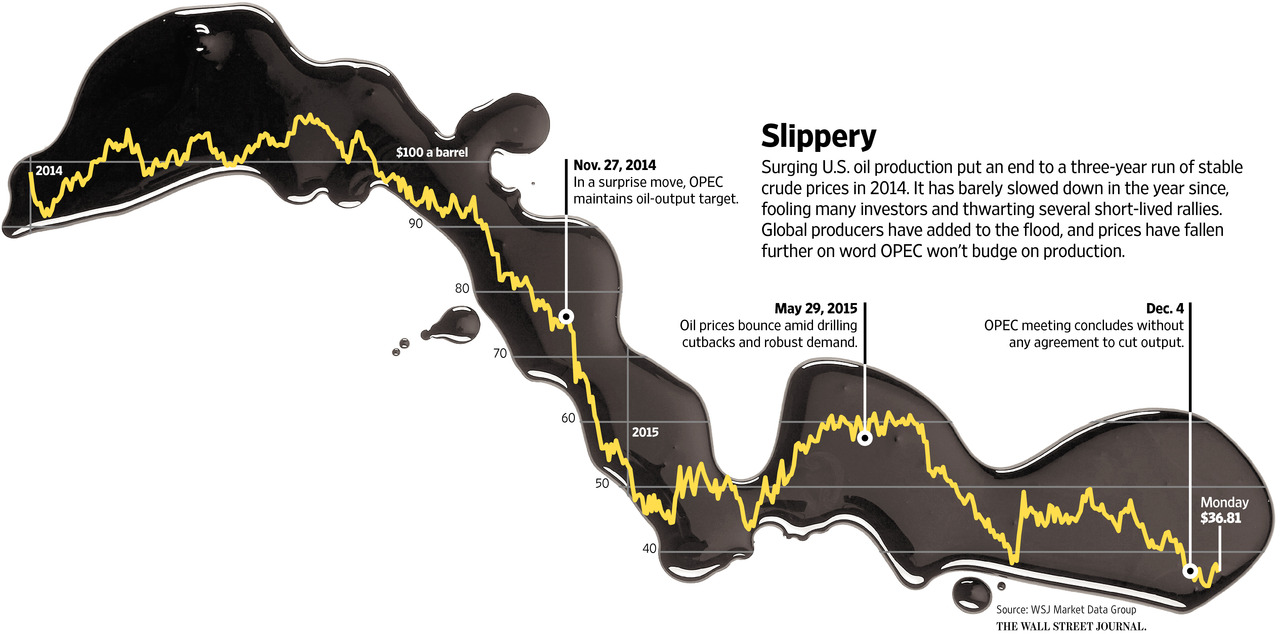
Very few saw it coming, but today everyone knows what happened to oil prices over the past year.  This graphic from the Wall Street Journal captures the relentless price tsunami which has been hammering so many investors, companies and countries over the last 12 months.
Oil graphic Dec 30 2015
As always, the financially critical question is what happens from here?
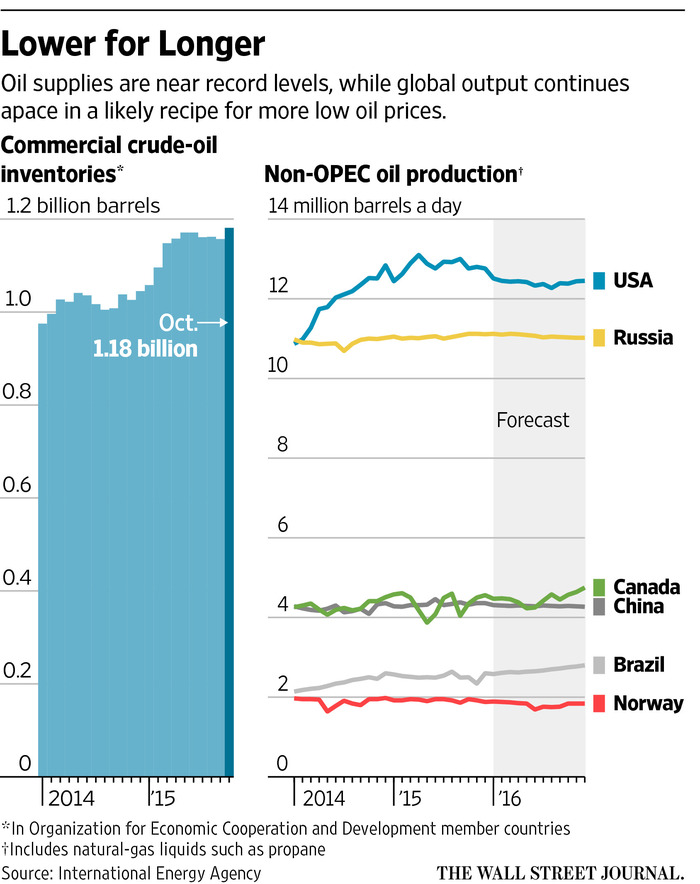
Oil supply and demand Dec 30 2015 To postulate it is important to note that oil production and inventories have increased, not fallen with prices, as so many had predicted.

Second it is essential to comprehend just how indebted and cash-strapped the price collapse has left many unprepared producers and related service providers.  The net effect of high debt and plunging income is an increasing desperation for cash flow to cover expenses.  Those in weak financial circumstances are in no position to strategically game output.  To the contrary, they are likely to pump even more superfluous product as prices plunge.

With growth recessing all around the world, and alternative energies booming, oil demand is not likely to soak up excess supply quickly.  In response the US is moving to export and the Saudis are slashing budgets and hunkering down for a long haul.  2016 is unlikely to be kind to the many companies and governments that have factored in a presumption of crude above $50 a barrel.  See:  Not even OPEC can fix oil glut.

And yet, today under $37, the probability of even lower prices from here must be acknowledged.  In fact charted here since 1982, the 2005-2015 decade of crude above $40 a barrel (brown band) was an anomaly caused by the banker-stoked global credit bubble.  Now that the whole world is in the debt hangover phase , crude in the $20’s (green band) is entirely reasonable–it might even be dear.
WTIC Dec 30 2015

Posted in Main Page | Comments Off on After the debt rush: oil tsunami swamping unprepared