Gushing government loans making higher education toxic

The only people gargantuan student loans serve are those growing fat on the higher education sector and associated services.  For the rest of us from students to taxpayers, this business model is perfectly toxic.  The fact that schools should have a duty to place the best interests of their students first, is no where to be found in yet another grotesque greed chapter.  This is what happens when the private sector and free market forces become disfigured by gushing government money.  Everyone is left weaker in the end.  The days of all-you-can-eat credit must end now.  See:  Schools lobbying for unlimited student loans

For the past nine years, graduate students in the U.S. have had almost a blank check to take out as much as $80,000 a year in government-backed loans to pay for tuition and living expenses. Republican Senator Lamar Alexander of Tennessee thinks that’s too much. He’s introduced legislation, backed by his Democratic colleagues Michael Bennet of Colorado and Cory Booker of New Jersey, to limit borrowing to $30,000 a year, with a cap of $150,000. Programs with especially high costs could appeal to the U.S. Department of Education to let their students borrow up to $15,000 more each year.

Colleges, whose lobbyists and trade associations have succeeded in defeating just about every attempt to control rising tuition costs over the last decade, are trying to soften Alexander’s proposed law…

The presence of university lobbying in Washington dates back at least to World War II, when the federal government began awarding large research grants. “The people running the government were graduates of the top schools, so they” wanted their own schools to get the grants, says Gerald Cassidy, a Washington lobbyist who represented dozens of colleges and universities over the years before he retired in December. In the 1970s and ’80s, many institutions brought their lobbying in-house, opening Washington offices.
Posted in Main Page | Comments Off on Gushing government loans making higher education toxic

Alberta to produce 25% more oil as prices fall

With the price of Western Canadian Crude hovering around $30 a barrel (WTI @ 46-13.30)–and likely to go lower for longer from here–one would expect that new projects that require a West Texas Intermediate (WTI) price of $80 a barrel to break even would be cancelled or postponed.  And that is happening.  But one would be wrong to assume that means Canadian oil sands production (some of the most expensive on the planet even before full accounting of its environmental costs) will be falling from here.

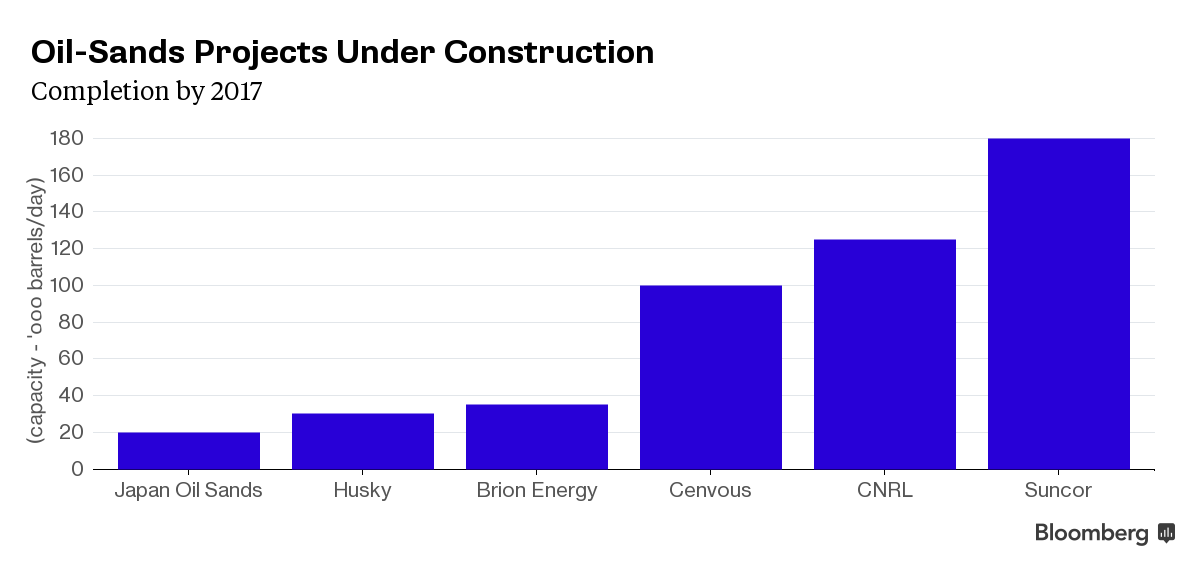
Thanks to sunk costs in projects considered too far along to turn back now, Alberta alone will add at least another 500,000 barrels a day –about a 25% increase — to an already oversupplied North American market by 2017.

All those governments and companies banking on a quick rebound in oil revenues, might want to invest some serious work in developing a viable Plan B….  See:  The Oil-Sands Glut is about to get a lot bigger
Oil sands under construction

Posted in Main Page | Comments Off on Alberta to produce 25% more oil as prices fall

Canada’s worse this time

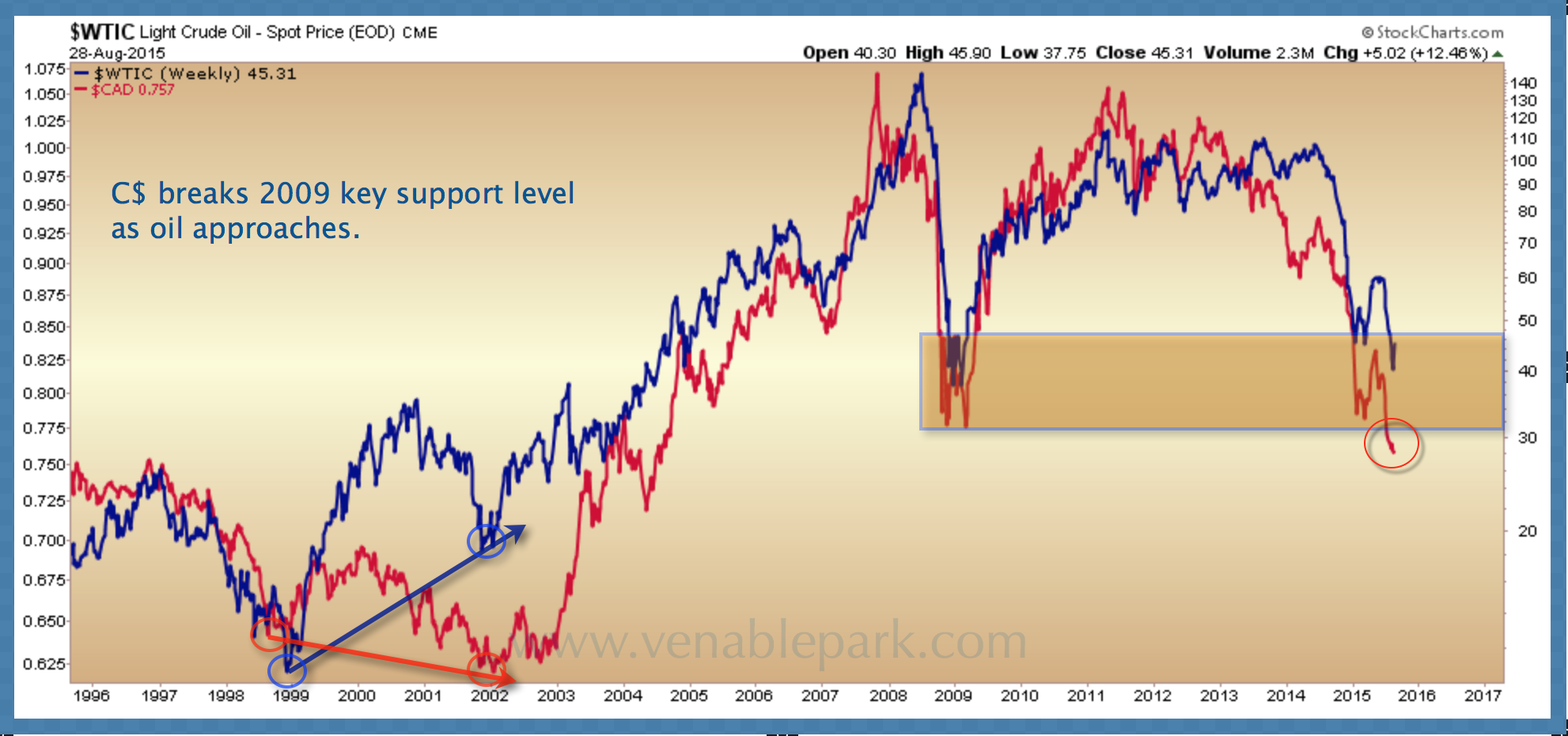
As oil flops around near its 2009 recession lows (brown box below), the Canadian dollar has already said “Canada’s worse this time” with a decisive break to a lower low at the end of August (red circle below) and in September still falling, today within a hair of its recent 52 week low.  And indeed compared with Canada’s standing among other OECD countries before the 2008 recession, the economy is in fact worse today on several key metrics. See a few here: Canada’s economic slide (since 2006) in 5 charts.
WTIC and C$ Aug 29 2015
Most importantly, the commodity supercycle that ran from 2001 to 2008 is now over, and that makes Canada’s financial prospects worse than at any time in the last 15 years.

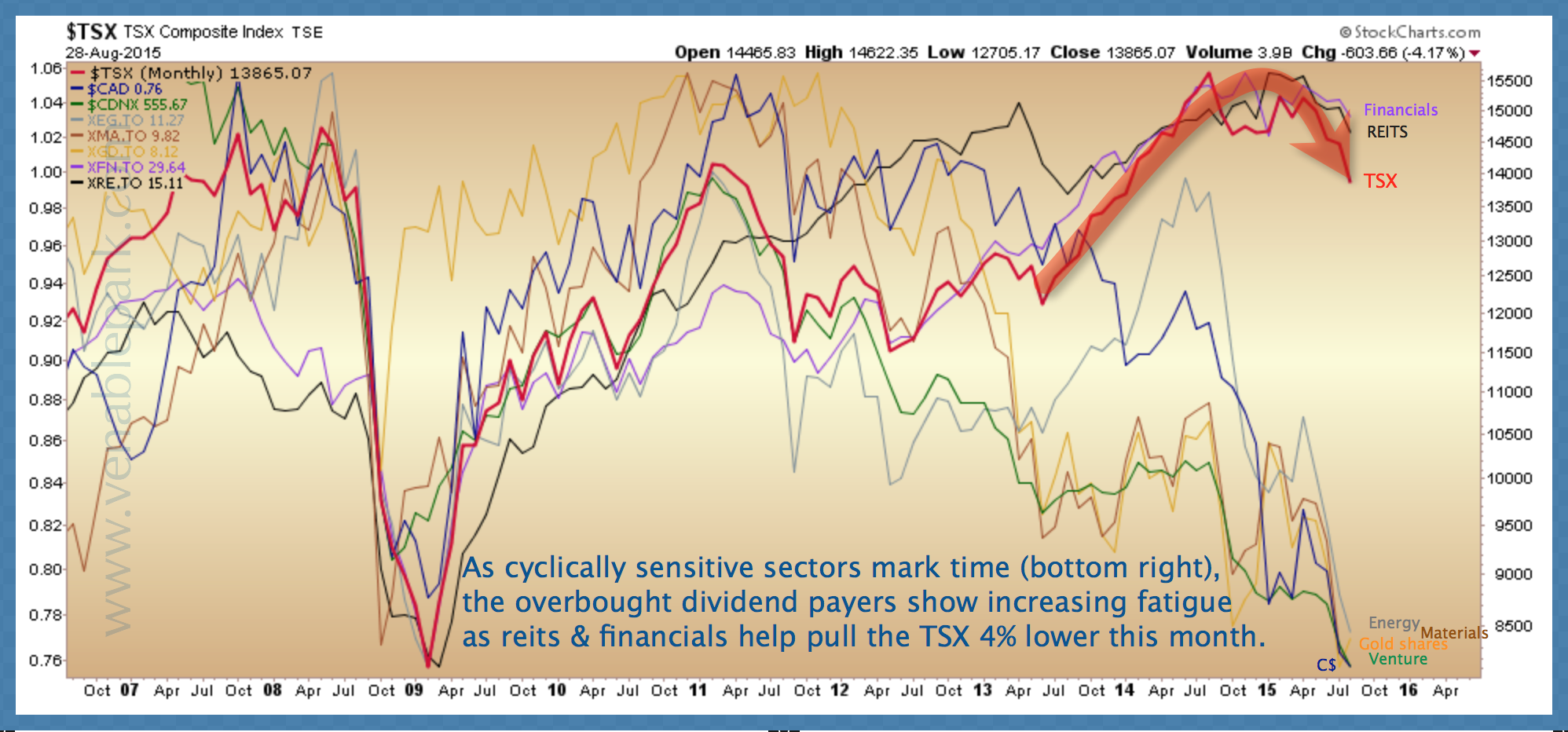
Revenue is falling and not likely to bounce back soon, just as Canadian households are the most indebted they have ever been and realty prices some of the most over-valued in the world.  All of this underlines the glaring price risk apparent in Canadian REIT (below in navy) and financial shares (purple) as well as the broader TSX (in red) which today remains perilously dependent upon these last two now rightsizing sectors.

TSX Aug 29 2015
On the upside, for those who can see the big picture and minimize downside exposure today, a future of investment opportunity at much lower prices ahead looks bright.  With Canada’s financial strength much worse this time, and the resource-centric Venture exchange (in green above) and the Canadian dollar (in blue) already acknowledging this with a move below their 2009 cycle lows, the obvious question is, does a similar acknowledgement now await the broader market, financials and REITs?

For those with cash, patience and discipline today, the odds have very rarely been as good.

Posted in Main Page | Comments Off on Canada’s worse this time
Social media & sharing icons powered by UltimatelySocial