
Canada’s lust for home equity lines of credit

Canadian household debt rose to a fresh all time high in April above 1.8 trillion. Trustees in bankruptcy are warning that they have never seen so many 2nd mortgages and Home Equity Lines of Credit (HELCO) on Canadian household balance sheets. This chart showing Canadian HELCO debt since 2000 (in red) versus the US (in blue) since 2000 seems to concur.
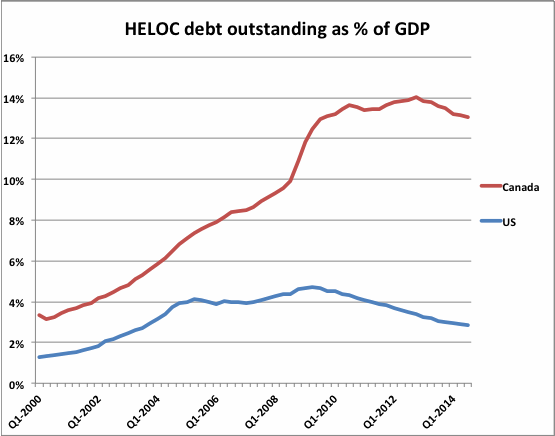
Cdn HELCOs to GDP
“It’s easy, accessible cash at a very cheap price. The banks make it so easy for you to obtain it.”

See:  The national lust for home equity lines of credit.

Chart source: Ben Rabidoux


Canadians are using their appreciating homes as ATM’s (as Americans did in the early 2000’s before their house crash) and the funds being borrowed are not just for home improvements, but in many cases to fund living and lifestyle expenses.

Of course, the Canadian Bankers Association says it’s not worried, insisting that Canadians are responsible borrowers and that banks are prudent lenders.  (Sure they are…) Bank of Canada, governor Stephen Poloz, acknowledged this morning, that Canadian household debt levels will aggravate the severity of economic downturn in Canada.

‘Twas always thus:

 “-overconfidence seldom does any great harm except, when, as, and if, it beguiles its victims into debt.”    

               —Irving Fisher, Economist, The debt-deflation theory of Great Depressions, 1933

Posted in Main Page | Comments Off on Canada’s lust for home equity lines of credit

Time to get wise about water

Water is the world’s most valuable, critical, finite commodity. And yet we are wasting it unnecessarily on old technologies and approaches which can be replaced by renewable, sustainable methods that don’t leave gallons of poisoned waste water. Time to get wise about water.

Julia Roberts, Harrison Ford, Kevin Spacey, Edward Norton, Penélope Cruz, Robert Redford and Ian Somerhalder all join forces to give nature a voice. Watch the films and take action at natureisspeaking.org Here is a direct video link.

|
Here is a direct video link.

Posted in Main Page | Comments Off on Time to get wise about water

Why we can’t keep QE gains and future returns too

The reality of present financial asset valuations is brilliantly encapsulated by John Hussman this week. QE interventions have brought forward asset appreciation from the next 10 years and spent it over the past 5 in order to quickly make back 2008 losses.  Those banking on gains from here, have misunderstood the deal.  See: Why stocks are not ‘cheap relative to bonds’.

The S&P 500 has seen negative 10-year prospective returns before (as we correctly projected in real-time at the 2000 peak, based on similar arithmetic, even allowing for optimistic assumptions). What we haven’t seen at any point in history is the combination of dismal projected returns for the S&P 500 coupled with a similarly dismal yield-to-maturity on bonds. The coming decade will be an underfunding disaster for corporate pension plans, endowments, and municipalities, most that still typically plan around an assumed rate of return closer to 8%.

The most reliable measures we identify suggest that nominal total returns on a conventional asset mix are likely to be closer to 1% annually. Quantitative easing has already given investors, at least on paper, the gains that they would otherwise have waited years longer to achieve (again, at least on paper). Particularly in equities, investors who do not have a very long horizon and cannot actually tolerate a 50% loss should consider realizing those paper gains now and cutting exposure to a tolerable level. That’s not market timing – it’s sound financial planning that may be quite overdue.

Posted in Main Page | Comments Off on Why we can’t keep QE gains and future returns too




