
ECB guns for inflation or bust (further bust)

Unfortunately we already have the bust part of their handiwork…pretty much worldwide.

ECB head Mario Draghi is your typical ex-Goldman, deluded banker, consumed by a God complex that prevents him from admitting the failed policies and mistakes of he and his colleagues. Indeed convinced of their own brilliance, he promises to perpetrate more of the same, so long as he is allowed to stay in the seat.

Today he acknowledged that 8 years of monetary magic and counting and inflation rates in the EU are presently zero. But not to fear. He says he is confident that his 2 percent annual inflation target is attainable any day now. Here is the cheat sheet on the latest QE plan, announced today. See ECB ready to buy bonds, signals inflation goal in reach.

Here are the key facts:

• Purchases under the program will start on March 9.
Purchases will total €60 billion per month.
• The ECB will purchase debt with negative yields, so long as those yields are not below the ECB deposit rate at time of purchase. The ECB deposit rate is currently -0.2%.
• If a Euro-Area central bank cannot purchase sufficient marketable debt instruments to fulfill its allocation, the ECB will allow substitute purchases. This substitute purchases rule should enable the ECB to fill its €60 billion target each month.
• The ECB will not buy more than 25% share of any one issue in order to avoid it having a blocking majority in case of any debt restructuring.
• The ECB will only buy in the secondary market.
• The ECB will purchase debt with remaining maturity between 2 and 30 years only.
• The ECB provided a list of the international and supernational institutions and agencies it would purchase the debt of

Note that the ECB said they can buy bonds with slightly negative yields of no more than the ECB deposit rate–currently -0.2%. But in truth the club of negative yielding sovereign issuers is spreading and growing more deeply inverted and negative by the day as pension funds and other conservative capital is left chasing whatever scraps of relative stability are left in a world now full of broken investment options.   Such a mess.  See:  This is nuts, where have all the bonds gone.
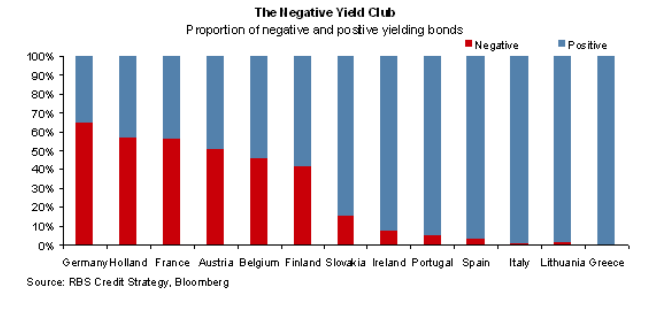
Negative yield club

Posted in Main Page | Comments Off on ECB guns for inflation or bust (further bust)

Why cheap oil doesn’t stop the drilling

Here is a direct video link.

Posted in Main Page | Comments Off on Why cheap oil doesn’t stop the drilling

Rigs down, jobs down, energy production up, inventory overflowing

The commodities boom, followed by the QE liquidity boom, gushed capital at the oil and gas sector over the past decade. Technological advances have been huge and production has skyrocketed. That’s good news for supply. But it’s bad news for those counting on a price rebound any time soon. See: Exxon Mobil: Shale to the chief

The relentless rise in U.S. oil inventories continues. Indeed, tanks at Cushing—the big pipeline hub in Oklahoma—are two-thirds full already, according to Energy Department data released this week. Think of that as a giant bucket filling up above the heads of oil investors.

But there is an even bigger bucket out there: Big Oil.

…Exxon has been putting itself through shale class, learning “how to get the most out of these rocks in the most cost-efficient way.”

That represents a bearish trend that will weigh on oil prices for years to come. Exxon says its costs in the Bakken have dropped by 20% to 25%. So, many prospects that made sense at $100-a-barrel oil still make sense now, the company says.

This gives Exxon, along with its peers, a base of resources from which it can grow production profitably. That is even if, as now, lower oil prices force delays in advancing the big ticket, multiyear projects such as liquefied natural gas that the majors are usually known for. Indeed, roughly half the increase in output that Exxon targets by 2017 is expected to come from U.S. onshore wells.

It’s also bad news for the many highly indebted producers and related service providers who borrowed their brains out the past few years in the belief that prices had reached a ‘permanently high plateau’. The need for cash flow to service debt payments, will drive most to keep pumping and tendering on jobs even into bankruptcy. Highly levered players can’t operate at a loss forever. A need to shrink expenses is already causing cut backs in capital spending and workers. This morning’s February Challenger jobs report, confirmed these trends:

Employers announced 103,620 planned layoffs through the first two months of 2015, which is up 19 percent from the 86,942 job cuts recorded during the same period in 2014.

Once again, the energy sector saw the heaviest job cutting in February, with these firms announcing 16,339 job cuts, due primarily to oil prices.

Falling oil prices have been responsible for 39,621 job cuts, to date. That represents 38 percent of all recorded workforce reductions announced in the first two months of 2015. In February, 36 percent of all job cuts (18,299) were blamed on oil prices.

“Oil exploration and extraction companies, as well as the companies that supply them, are definitely feeling the impact of the lowest oil prices since 2009. These companies, while reluctant to completely shutter operations, are being forced to trim payrolls to contain costs,” said John A. Challenger, chief executive officer of Challenger, Gray & Christmas.

And so far much lower gas and oil prices have not led to the widely forecast pick up in consumer spending and retail sales:

“So far, falling oil prices have not resulted in higher retail spending. However, that is not necessarily the cause behind ongoing job cuts in retail. Falling oil prices might stave off job cuts for some retailers but, the fact is, some retailers are beyond the point where cheap oil will help turn things around. For example, the heaviest retail job cuts last month were the result of RadioShack’s long decline, which culminated in bankruptcy and liquidation,” said Challenger.”

Don’t look now, but real world fundamentals like supply, demand, debt levels, falling cash flow and rising unemployment are overwhelming central bank ‘control’ attempts once more.

Posted in Main Page | Comments Off on Rigs down, jobs down, energy production up, inventory overflowing





