The grotesque bubble in US education costs

Suckled on the public purse through a decade of excessive government-backed student loans, education costs in America have formed a grotesque bubble. When your customers no longer have the means to purchase your service, fresh more affordable business models and solutions take over.

The cost of higher education has jumped more than 13-fold in records dating to 1978, illustrating bloated tuition costs even as enrollment slows and graduates struggle to land jobs.

The CHART OF THE DAY shows that tuition expenses have ballooned 1,225 percent in the 36-year period, compared with a 634 percent rise in medical costs and a 279 percent increase in the consumer price index.

…“Some schools are effectively limiting cost increases by bigger tuition discounting, but on the whole college presidents have not adjusted to a fundamental shift in attitudes toward the value of a high-cost education,” said Richard Vedder, director of the Center for College Affordability and Productivity in Washington. “Colleges are too slow to reinvent themselves,” particularly as enrollments are waning…”  See: College Tuition costs soar
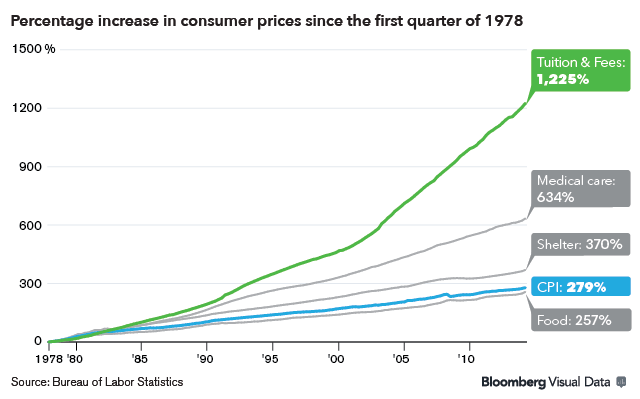
Education cost inflation since 1978

Posted in Main Page | Comments Off on The grotesque bubble in US education costs

A crash course in how speculative markets break

As the most reckless players are today taking “genius” laps on the back of stock prices which have once more reclaimed the rare distinction of being the most most leveraged and over-valued in history next to 1929 and 2000, it is helpful to consider a little reminder on how speculative markets break: suddenly and all at once. Even the few participants today that feel confident that they have downside protection by using stop loss limits are likely to learn that once prices gap down, stops are often impotent.

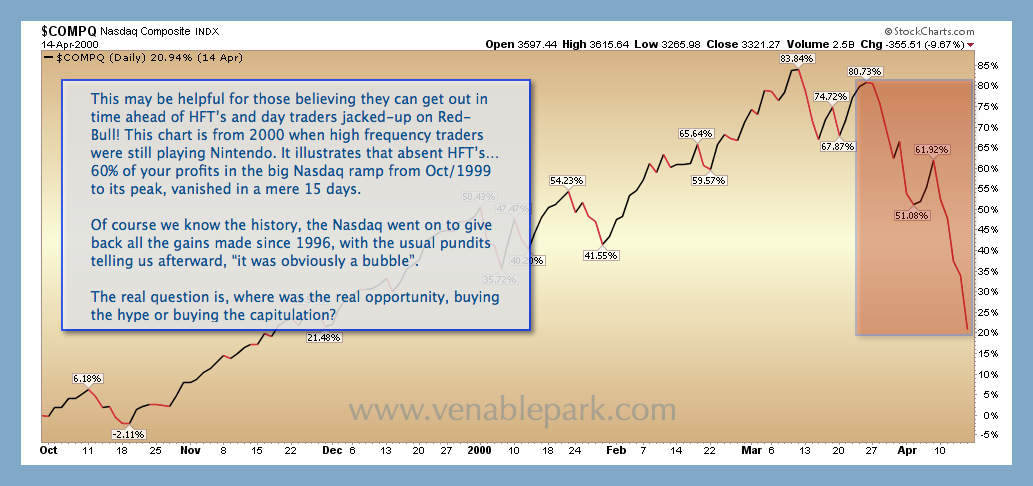
This chart of the NASDAQ in its blow off top from October 1999 to March 2000, shows the incredible ramp and then rapid plunge that evaporated 60% of the prior ‘gains’ in 2 weeks (red box).
Nasdaq 1999

“…it is the nature of a speculative boom that almost anything can collapse it. Any serious shock to confidence can cause sales by those speculators who have always hoped to get out before the final collapse, but after all possible gains from rising prices have been reaped. Their pessimism will infect the simpler souls who had thought the market might go up forever but who now will change their minds and sell. Soon there will be margin calls, and still others will be forced to sell. So the bubble breaks.”  –John Kenneth Galbraith, (1954) The Great Crash 1929

Posted in Main Page | Comments Off on A crash course in how speculative markets break

Worthwhile video: Humans need not apply

Interesting reminder on some of the impacts of automated help. Here is a direct video link.

Time to watch The Matrix again… For me the broader question is always about health.  If humans no longer need to leave their house or physically exert themselves for their existence, how do we keep our bodies healthy enough to enjoy life?

Discussing these ideas with some friends on the weekend, I began to think that perhaps in a virtual world, where people do not need to actually eat a Big Mac, or drink alcohol or smoke a cigarette to feel like they are experiencing these things, perhaps our bodies will also benefit from not suffering the toxic impacts of ingesting.   Less clear to me is how inactive people are then to maintain their muscles and vascular systems.  Maybe we will become uploaded to a virtual conscience and out of a physical body altogether?

Posted in Main Page | Comments Off on Worthwhile video: Humans need not apply