NASDAQ hitting another 7 year itch in 2014?

The NASDAQ 100 composite is off about 3.5% since its most recent peak 3 months ago. The smooth of that average decline however, masks a rockier ride for many constituents that are down more than 20% since March. Since tech tends to lead the broader market cycle, the question of the hour is whether the tech and small cap declines(49% of Russell 2000 also down more than 20% in 2 months) are signalling the next phase of cycle weakness in broad risk markets.

Since margin use and financial leverage in the world has never been higher or more concentrated among fewer participants than today, and since several key valuations metrics are at the highest or second highest (behind 2000) ever in history, while volatility has recently been the lowest in 25 years but for the sub-prime-induced-comma that preceded the nightmare of 2008, a broad market decline once it begins next, is likely to be one of the most spectacular loss phases ever recorded in the history books.

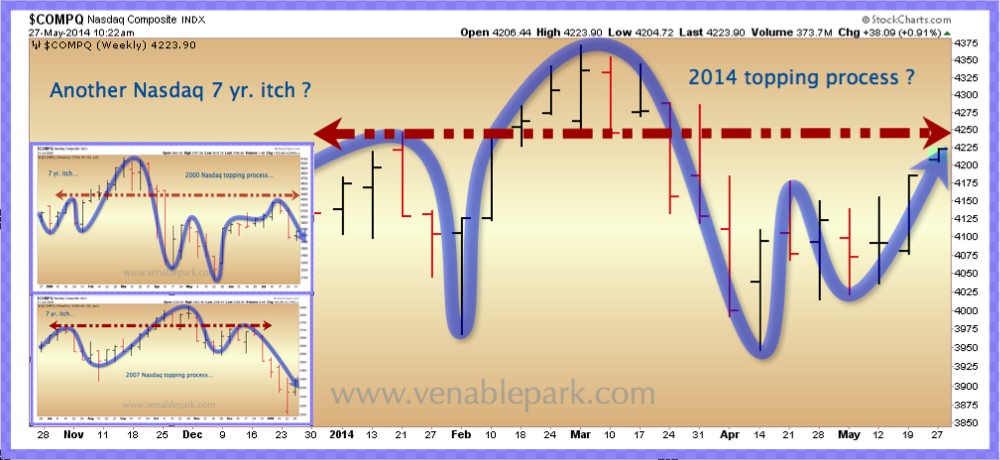
As shown in this chart, the price action of the NASDAQ over the past year has a similar look to the price action it followed to the previous market peaks in 2000 and 2007 (smaller inset boxes on left). Fireworks to follow? At some point here, one should count on it.
NASDAQ 7 year itch

Posted in Main Page | Comments Off on NASDAQ hitting another 7 year itch in 2014?

More of the same Down Under

The Sydney Morning Herald runs with some interesting articles this morning on some key issues now pretty much ubiquitous worldwide:

  • First, lax lending and excessive borrowing have pumped up housing prices in Australia to levels that are unaffordable and unsustainable.  This means that under-employed and already indebted young people have a more difficult time buying into the property market. This presents a liquidity problem for all the baby boomers who are over-housed and under-saved and needing someone to buy their home in order to pay off debt and cover expenses in retirement.   The ancillary problem to over-priced housing, is that even where boomers do find someone who can borrow enough to buy their house at present levels, the boomers then have a difficult challenge finding less expensive housing to downsize into:

    “In contrast to the general perception of boomers as cash-rich gadabouts, the reality for many is different.With their wealth tied up in the family home, the majority in fact, depend on trading down to realize cash that will see them through their retirement.

    But without a suitable and suitably priced dwelling for them to trade down into, many are unable to access that wealth.

    The government-funded Australian Housing and Urban Research Institute says people are retiring with more mortgage debt than ever, as a result of dwelling purchases later in life and a greater number of singles.

    That’s not just a problem for an increasingly elderly couple stuck in a too-large house that they can’t afford to maintain.”

    See: Housing squeeze: Baby boomers moving to mum’s retirement village for a good sense of the issues.

    • Secondly, as a recent World Bank study noted, like the rest of the world, many of Australia’s major industries are now dominated by a handful of public companies.  This fact is nowhere more obvious and harmful than in the ‘wealth manglement management’ arms of the major banks, which have been running their relentless battle against proposed financial advice reforms:

      “The central issue is not legislation that attempts to mediate selling and advice but that these two roles are combined in the first place. It’s a bit like eating tuna custard. Some things aren’t meant to go together.

      No one asks a drug company for medical advice because we understand that the vested interest is so great that any answer, even an honest one, can’t be relied upon.

      The recent Fairfax/4 Corners investigation into the behaviour of the Commonwealth Bank in its despicable treatment of sick and elderly clients makes this point.

      The bank wanted to sell products; the adviser wanted the highest possible commission; and the customer wanted good advice (but was unable to tell good from bad, which was why they consulted an adviser in the first place). No prizes for guessing who won that little tussle.

      The lobbying to repeal FoFA is all about preserving that culture at the expense of advice because it’s impossible to do both well…

      In financial planning, the planner knows he or she has to sell bank products but because it says ‘adviser’ on the business card, the customer thinks they’re getting advice when in fact they’re getting sold.

      Economists call this information asymmetry, which is a technical way of saying the major banks are profiting from the ignorance of their customers.

      And all that compliance stuff? It may not seem like it but that’s there to protect the banks, not you. In court, or, for instance, before a Senate inquiry, the compliance ‘process’ allows the bank to claim it acted legally, even though it cost you your nest egg.

      There’s only one way to start to fix this problem and that’s to break one of Australia’s leading oligopolies and force the banks to divest their wealth management arms.”

      So refreshing to hear someone so clearly assess the conflicted mess that is the global financial industry today. It would be great if more people would catch on, see: Banks structured to deliver poor financial advice

    • And lastly, it seems JP Morgan has been up to its lying, cheating, fraudulent ways in Australia just like in the rest of the world.  New evidence from yet another whistle blower outlines a laundry list of the usual antics:

      ■ Misleading reports being provided to head office and the Federal Reserve Bank of New York on the number of outstanding trades.

      ■ Trades not being booked into the system until they were ”in-the-money”.

      ■ Trades not booked into systems and only being tracked by paper-based legal agreements, which would be ”torn up” if required, thereby leaving no trace.

      ■ Bypassing or attempting to bypass the opinions of in-house lawyers to complete work faster, even if this resulted in incorrect legal agreements being signed by the traders and sent to other major banks as final confirmation of the terms of the trade.

      The person said he sought to discuss his concerns with lower and middle management but was warned that ”front office would get rid of me if I persisted”.

      See: Explosive claims on JP Morgan conduct

      Same old, same old…at least we can see that the banking cartel is consistent everywhere they operate.

Posted in Main Page | Comments Off on More of the same Down Under

Bond yields not running with equity bulls

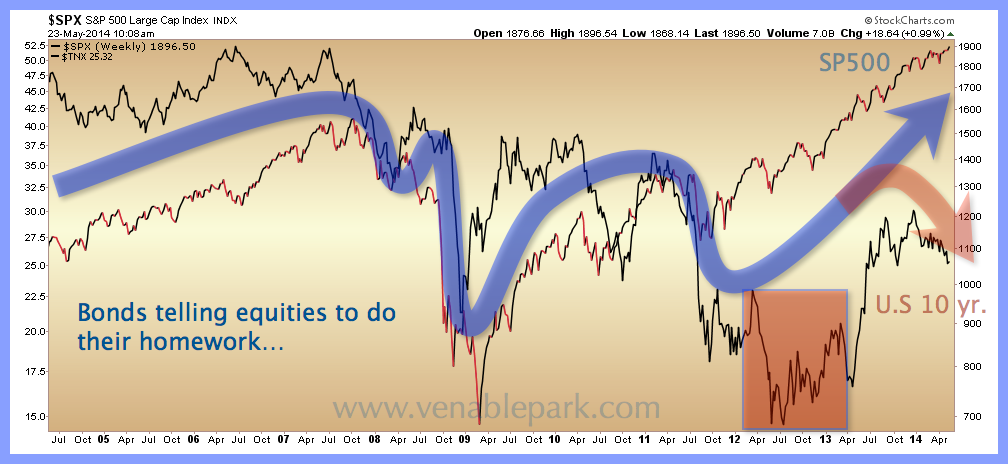
For a couple of years off the bottom in 2009, bond yields believed the economic promise of growth buoyed by fiscal and monetary stimulus. But then in 2010, bond yields noted that global growth was declining once more and yields and then commodity prices broke faith with the narrative of economic recovery and inflation and turned back down. Equities conceded too for a while, declining into the fall of 2012 before Central Banks gushed reckless liquidity into risk-traders over the past 18 months.   Bond yields (shown below in black with the S&P in red) along with emerging markets, small caps, tech and previously loved momentum stocks, are all not confirming US large cap (HFT rich) euphoria year to date.
Bond yields part ways with equities

Posted in Main Page | Comments Off on Bond yields not running with equity bulls