
Tapering sooner? later? sooner?

This morning we have bedlam as the algo computers troll global markets with millions of rapidly flashing lures hoping for bites on a belief trend one way or the other. Snapchat has nothing on high frequency trading: more than 95% of HFT orders self-destruct in milliseconds.

On the one hand, today’s US consumer sentiment (lagging indicator) and jobs report came in stronger than the consensus forecast, moving the unemployment rate (lagging indicator) down to 7% and making the case for the Fed to taper their bond buying sooner (Dec or Jan meeting) than later (ie., March). This is reflected so far this morning in a stronger US dollar and flat Canadian dollar and precious metals (all of which are down heavily over past several weeks).

On the other hand we learned that US personal income fell in November missing estimates for gains and in line with weak holiday sales (and surging inventories in yesterday’s GDP revision) and consumer spending of late which has been afforded only by drawing down the already anemic savings rate from just 5.2% to an even less 4.8%. Which underlines how under-funded and under-saved consumers actually are today and why consumption-led western economies will continue to struggle with lower than targeted growth. This suggests taper may be off for a while longer still, at least a thesis reflected in rebounding stock and bond prices (at least so far today).

This is what happens when finance and policy makers have become preoccupied with levered wagering in capital markets rather than investing in the businesses, innovation, people and infrastructure of the real economy. At the end of the day, it doesn’t matter a wit whether the US Fed cuts back 10 billion on its 85 billion a month bond buying starting in December, January, March or next summer. Demand continues to be weak, and asset prices continue to be unreasonably high and therefore unable to attract sober investors but only the same old pool of highly levered speculators.

Round and round prices go like water swirling ’round the top of a drain, circling, circling, but nevertheless destined to be sucked down the hole.
Posted in Main Page | Comments Off on Tapering sooner? later? sooner?

Financial sector not bowed but emboldened by 2008 financial crisis

There is a belief system widely espoused today that the financial crisis of 2008 is behind us and the reckless and unethical policies, leverage and practices that caused the crisis, are no more. Nothing could be further from the truth. Unfortunately a reversion to old habits is the predictable outcome when people are saved from paying–legally and financially–for their destructive choices. This is Taleb’s “Antifragile” thesis personified, and it is the reason that our financial system will not recover until actors are finally left to their just desserts. I have no doubt that the financial crisis is alive and well and that the next wave will bring greater pain and less forgiveness for those who have made bad decisions to date.

Former Citigroup (C) forex trader Chris Arnade details why Wall Street has a hard time being ethical. It’s his view from working on Wall Street for 20 years (he left in 2012 to pursue writing and photography):

“What surprised me and ulitmately drove me off of Wall Street [was] I expected after the financial crisis, we would all sort of look at each other and say ‘this philosophy of unregulated free markets, it didn’t work’…I had expected many people on Wall Street would say ‘hey, let’s rethink what we’re doing,’ and actually the opposite happened…people doubled down in their philosophy…not only that…they managed to blame everybody but themselves.” Here is a direct video link.

Posted in Main Page | Comments Off on Financial sector not bowed but emboldened by 2008 financial crisis

Canadian financials now the Achilles heel of the TSX

At the Canadian stock market’s last cycle peak in the summer of 2008, it was the bubbling commodity and resource sectors that presented the greatest over-valuations and thus price risk within the topping TSX. After collapsing 30 to 70% to date, mining, materials and energy companies are continuing to pay back for their credit bubble euphoria, trading down with global demand and taking the closely tied Canadian dollar along for the ride.

The broader Canadian stock market also lost half of its value into 2009, and has only managed to recover 79% of that loss over the 4 years into 2013. But much of that recovery was courtesy of the greatly over loved Canadian financial sector. First it was the international praise that the Canadian banks had fared better through the 2008 crisis than most (thanks to less leverage on their balance sheets going into the crisis). Then it was euphoria about soaring bank profits as Canadians borrowed their brains out and the Canadian government shoveled hundreds of billions of taxpayer obligations behind bank mortgage products through the Canada Mortgage and Housing Corp. And lastly there was the global branding coup as our Bank of Canada head Mark Carney was hired by the Brits to show them how its done.

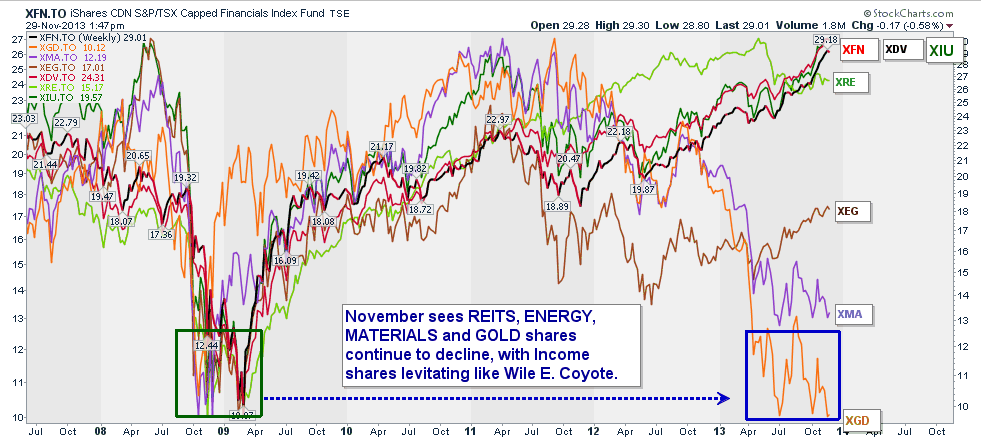
On all of this happy news, the Canadian financial sector (XFN) rocketed up 41% in the past 18 months, 29% in just the past year alone, as income-desperate folks herded toward the promise of “conservative, dividend-paying stocks”. It has been a meteoric rise to be sure, leaving most investors, advisers and fund managers today heavily loaded in this now extremely over-priced sector.

Even broad market investors who may not realize it, are up to their uxters in the Canadian financial sector today with the TSX 60 Index market cap now more than 37% concentrated in financials, compared with a 23% weight in energy, 10.8% in materials and just 7.4% in industrials. This chart gives a recent big picture view on the various sector prices, showing the “feeder fish” financials at an all time record high at top, and the meat and potato sectors of the Canadian economy (energy, materials, mining) at or moving toward their previous 2009 cycle lows (at bottom).

Source: Cory Venable, CMT, Venable Park Investment Counsel Inc.

Capitalizing on recent price gains, the broker/dealers are doing their usual scrambling to roll out all manner of new funds, split shares, ETFs and structured products focused on the “hot” financial sector. Just as they did in 2000 and 2007 (when financial shares were last at cycle peaks, and soon to drop 50%).

At the same time Canadian consumers are tapped out on debt and loan demand has softened. Canadian businesses are consolidating and the IMF is recommending that the Canadian government rethink its extraordinary backing of the Canadian banks and mortgages through CMHC and start looking at ways to encourage meaningful business investment and development rather than just the non-productive housing sector.

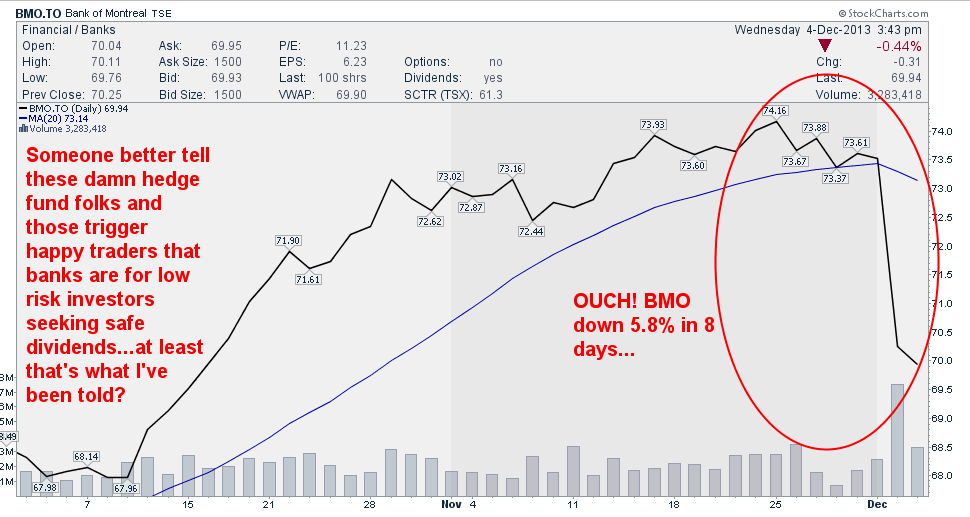
This week the big 6 Canadian banks began reporting their latest quarterly earnings. While profits are huge, the outlooks have been disappointing and the stocks have been selling off. Priced for perfection and then some, Canadian financials are today the Achilles heel of the Canadian stock market. This recent chart of Bank of Montreal gives a sense of the price risk now confronting holders. Look out below.


Chart source: Cory Venable, CMT, Venable Park Investment Counsel Inc.

Posted in Main Page | Comments Off on Canadian financials now the Achilles heel of the TSX





