Danielle was a guest on the CBC Weekend Business Panel, talking about the Bank of Canada rate decision, grocery prices and McDonald’s efforts to increase sales. You can watch a video clip of the segment here.
Posted inMain Page|Comments Off on Danielle on CBC Weekend Business Panel
Equifax Canada reports that Canadian households added $80 billion of additional consumer debt over the past year, making the total outstanding an eye-watering $2.4 trillion.
Well beyond paycheck to paycheck, many are living credit card to credit card. Money owed on credit cards climbed to a new high of $113.4 billion in the third quarter of 2023, up 16% from last year. More than six million new credit cards were opened in the past 12 months, up 13.7% from last year, with the average card balance rising to $4,119 and beyond pre-COVID levels. The percentage of cardholders making the minimum payment rose by 3.4%, while the percentage of those paying off their balance in full dropped by 1.5%.
Equifax vice-president Rebecca Oakes noted that increased rent and mortgage costs mean more people are relying on credit to cover their living costs, and “As more mortgage renewals continue to happen, we’re going to see more Canadians begin to experience payment shock, and that’ll continue over the next year.”
It’s not just households struggling to stay afloat; corporate debt is also at historic highs, with loans coming up for renewal at significantly higher interest rates every month.
Forty percent of the economically sensitive Russell 2000 companies are unprofitable today compared with 20% pre-COVID. Many have relied on cheap credit and government handouts for years to keep the lights on, and neither is on offer now.
In the latest Canadian Business surveys, insufficient demand has overtaken labour shortages as a primary concern. It is little wonder that new hires, job openings and average hours worked are declining while layoffs are rising. Labour’s share of national income has tumbled toward the 2011-2015 all-time-lows of 55%–the least since at least 1945.
Deflation is back on deck as financial mania sobers to the brutal math of high leverage and mean-reverting asset prices. The segment below offers a worthwhile update.
Is 2024 likely to be the year the Lag Effect arrives in force? To find out, we’re fortunate to speak today with CEO & Chief Strategist for QI Research LLC and the author of the book “Fed Up: An Insider’s Take on Why the Federal Reserve is Bad for America.” Here’s a direct video link.
Posted inMain Page|Comments Off on Lagged effects of epic tightening cycle will intensify in 2024
This morning, weaker-than-expected US job creation in November adds to the growing list of negative economic surprises globally and reinforces the expectation that the Bank of Canada today and the US Fed next Wednesday will make no rate changes for the fifth consecutive meeting.
Before this morning’s data, the futures market was pricing in 120 basis points of Fed rate cuts in 2024 (shown below courtesy of Bloomberg)–the odds they begin in the first quarter just rose. Government bond prices have been moving higher across the board.
Canada’s 10-year Treasury yield is down a whopping 100bps since October 3rd and at 3.28%, is back to where it was six months ago. Rising Treasury prices help lower interest rates on new credit while hurting speculators still holding near-record short contracts against 10-year Treasuries (CBOT). As these shorts move to cover, their buying pressure should further boost government bond prices and help lower interest rates.
Oil (WTIC) has slumped under $71 a barrel- the lowest since last June- despite the recent extension of OPEC+ production cuts.
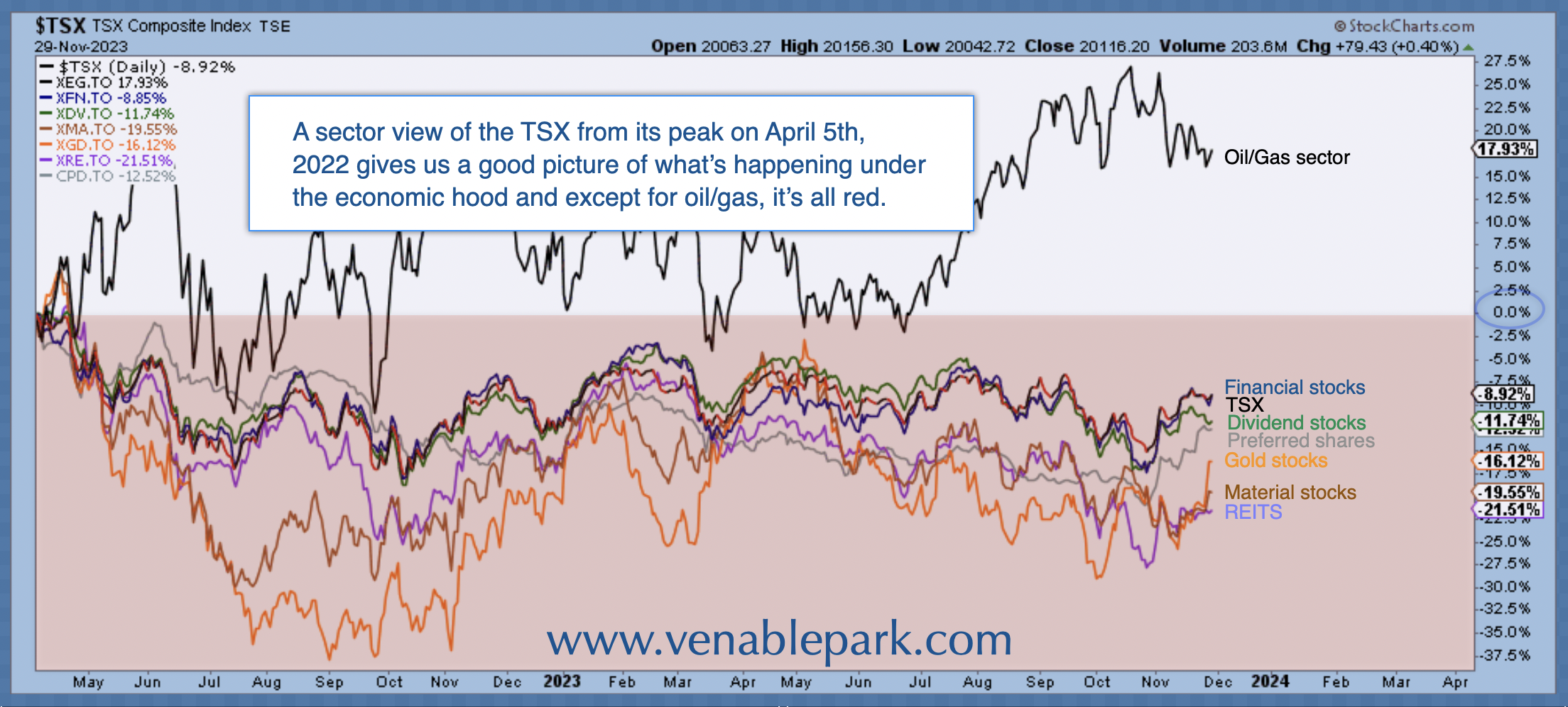
Shares in the oil and gas sector (XEG) comprise nearly 20% of Canada’s TSX and are -10% since October 19 and flat year-over-year. We watch with interest because oil and gas companies–late-cycle performers–are the only sector that has propped up the broad TSX index since April of 2022. As shown below, courtesy of my partner Cory Venable, all other sectors have lost ground (see red band), including materials (XMA) and gold producers (XGD), despite another rebound in bullion prices year-to-date. We expect oil and gas companies to follow the rest down as oil demand slumps and stockpiles mount.
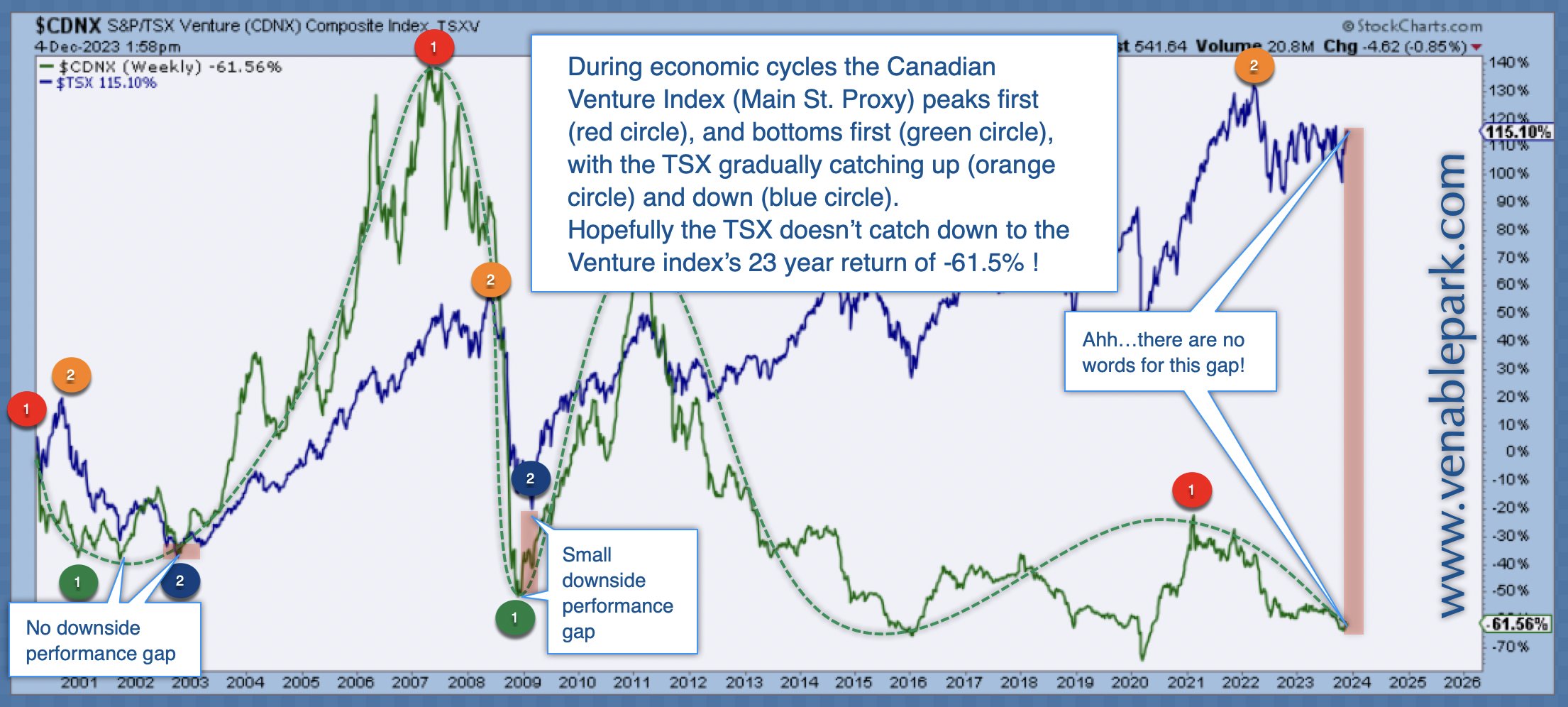
Canada has long been known as a resource-centric economy. Traditionally, the small-cap-junior-mining-heavy TSX Venture Index (CDNX in green below since 2000, courtesy of Cory Venable) has moved in correlation with the large-cap TSX index (in blue). That changed around 2012, however, when the world economy turned down again, and central banks turned to the monetary magic of Quantitative Easing and zero-interest policies to stimulate asset prices. This helped boost profits for the financial and real estate sectors (which comprise more than 30% of the broad TSX) while other sectors struggled.
The garish gap between the Venture Exchange Index price today (-61% since 2000) and still-elevated TSX (in blue) suggests magnified downside risk for the broad Canadian stock market as financials and real estate catch down in the post-bubble pay-back cycle.
Posted inMain Page|Comments Off on Economic weakness is leading interest rates lower
“An explosive critique about the investment industry: provocative and well worth reading.”
Financial Post
“Juggling Dynamite, #1 pick for best new books about money and markets.”
Money Sense
“Park manages to not only explain finances well for the average person, she also manages to entertain and educate while cutting through the clutter of information she knows every investor faces.”
Toronto Sun