Resisting financial sentinels

Investment banks are having a rough year. Sharply higher interest rates are taking a toll. Falling asset prices since 2021 have reduced fees tied to assets under management just as bad debts are rising. Underwriting fees are not helping: year-to-date investment banks have sold 22% fewer Initial public offerings (IPOs) to the public than in 2022, and 2022 had 82% fewer IPOs than in 2021. Birkenstock was this week’s big thud see Birkenstock shares sink 13% in first day of trading after what was supposed to be a red-hot IPO.

Most of the investment industry sees client accounts as product distribution channels. To hit revenue targets, they pump and dump the highest-risk securities onto their customers.

Even where clients pay a fee for asset management, most firms reserve the right to collect additional, often hidden compensation from product creators. If clients own the least-risk securities like government bonds and cash equivalents, investment fees are relatively little, so, unsurprisingly, these assets are rarely recommended.

The finance sector moves with the economy and leads overall markets, especially in Canada, where financial shares comprise 33% of the 60 largest companies that make up the bulk of Canadian equity portfolios and funds.

Since peaking in February 2022, the basket of Canadian financial shares (XFN) has dropped 20 percent, evaporating more than five years of dividend income in 20 months. This is typical price performance heading into economic downturns, but it’s early days yet. Past recessions have seen financial shares drop more than 40% before they bottomed.

The table below (courtesy of A. Gary Shilling) shows the peak-to-trough price decline for all equity sectors during past recessions (1990, 2000-02, 2007-09 and 2020), as well as the average loss over all four (5th column). Mind those “defensive” dividend-paying sectors! Defensive for whom, you should ask.
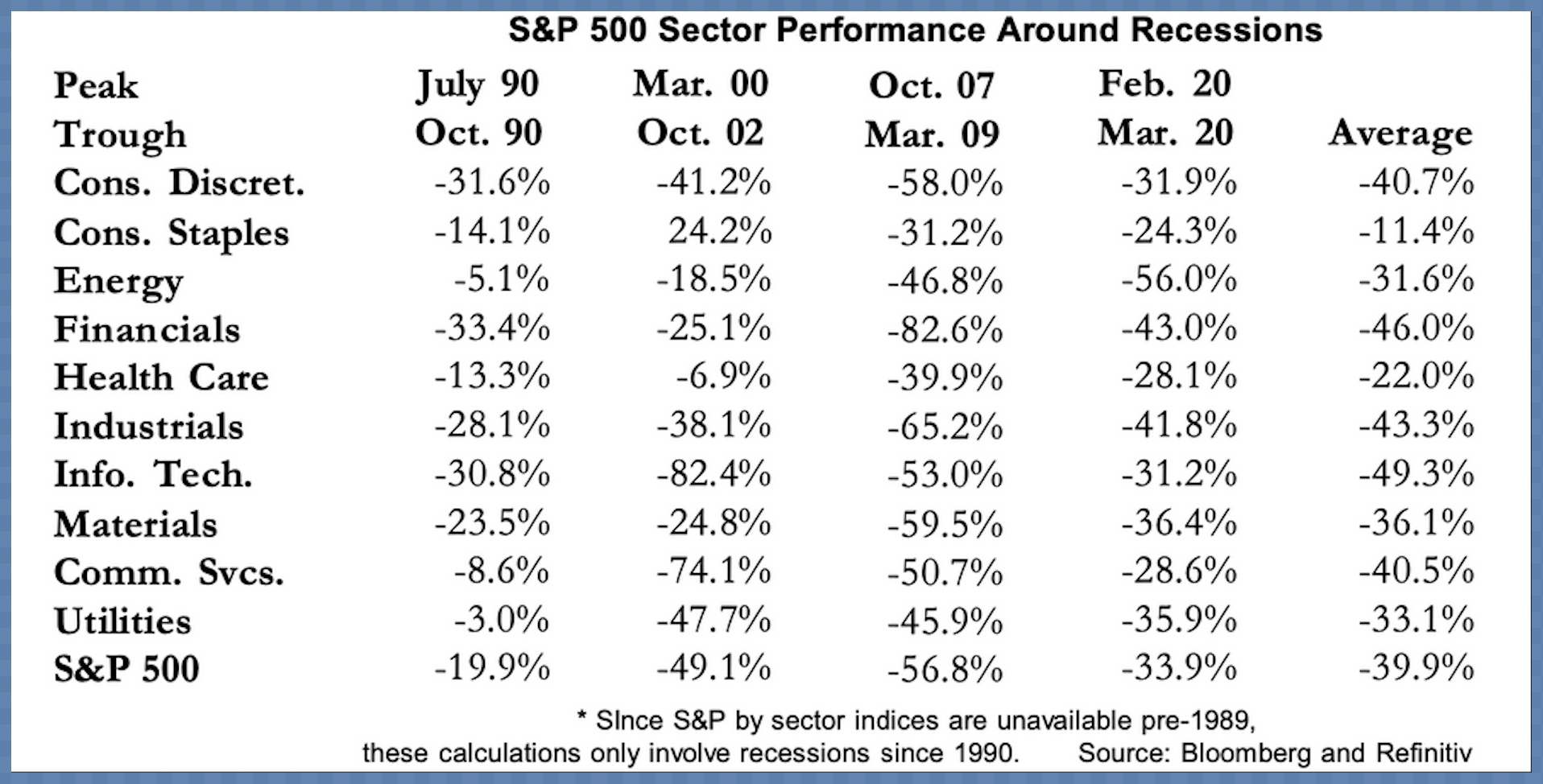
Remember, recessionary bear markets have seen the lion’s share of equity and corporate debt losses happen in the months after the Fed ends tightening efforts and returns to easing. So, with central banks still in a tightening bias, it’s probable that risk assets have significant downside yet to come.

It’s true that government bond prices have sold off as interest rates have risen, but terms under 10 years have fared better than stocks, and unlike equities, treasuries have defined maturity dates where the face value is returned to the holder. They are also one of the only assets that have typically rebounded as equities and the economy contract into a bottom. But don’t expect the fee-maximizing financial industry to tell you this.

Like the sentinels in The Matrix, financial firms exist to protect the Matrix, not the humans in their midst. As markets deflate, financial sentinels intensify their marketing attacks to suck in new cash. With discipline, understanding and concentration, we can summon the power to resist and protect ourselves. It takes effort, but it’s possible to prosper through recessions and be among the few ready and able to buy near-cycle lows when most others are liquidating in losses. Yes, we can.

Posted in Main Page | Comments Off on Resisting financial sentinels

Hot homeowner accessory: two homes in one

More and more people are starting to understand that homes can be very expensive consumption items and ways to make them more efficient/lower per capita living costs are savvy. Secondary dwellings in primary residences are one way to do this. Whether to share shelter costs with friends, extended family, or caregivers or to generate rental income, multi-dwelling homes are valuable. See Tiny homes are hot new homeowners’ accessory:

The latest amenity for homeowners is another, smaller home.
These add-ons are known as accessory dwelling units. They can be free-standing miniature homes as small as a studio apartment and tucked away in a backyard. They can reside above a garage or in a basement and extend to more than 2,000 square feet.

ADUs are growing in popularity as states encourage their construction through zoning changes and homeowners seek ways to lower their housing costs by renting out these units. The typical cost to construct one is around $100,000, according to building-permit data company Builty.

“It’s gone from a small niche in the market to really a much more impactful part of new housing,” said Scott Wild, senior vice president of consulting at John Burns Research and Consulting. “Municipalities love it, existing homeowners love it, developers love it.”

Now, more home builders are starting to offer ADUs as amenities.

Posted in Main Page | Comments Off on Hot homeowner accessory: two homes in one

Buying power has halved, do the math

Home listings and price reductions are popping up like measles. You can see this by signing into Zillow (or many other sites). Meanwhile, offers are increasingly scarce, and a quick look at any mortgage calculator shows why.

When Canadian variable rate mortgages were available at 1.65% from 2020 to early 2022, one was enabled to buy a $750,000 property with 20% down and a monthly payment of $2441 over a 25-year amortization. At a current rate of 6.14%, buying power is reduced by 38 percent with the same monthly payment enabling a maximum purchase price of $465,000.

To qualify for a CMHC-insured mortgage in Canada (less than 20 percent downpayment), one must qualify based on an interest rate of around 8.14%. At this rate assumption, the same $2400 monthly payment can qualify for a maximum purchase price of $340,000 (54% lower than in 2021). Sellers are in denial–the average Canadian home listing in August was $750,100 and well over $1 million in the highest population areas.

Similar math is evident in America, where a $1k monthly payment today can buy a home priced at $173,000, down 44% from $309,000 in 2020 (chart below courtesy of Jeff Weniger). At the end of June, the average US asking price was $416,100.The inverse correlation between mortgage rates and home sales is evident in the Visual Capitalist chart below since 2014–unsurprisingly, sales have tumbled to the lowest level in more than 20 years. As motivated sellers and lenders rise, steep discounts will be needed.

The liquidity Calvery is not riding to this rescue. The average time from the last Fed rate hike to the first cut has been ten months, with a range of four to eighteen months. Moreover, once they start, rate cuts, like rate hikes, will be felt throughout the economy at a 12 to 24-month lag. Those who need or want to sell are best to be proactive.

Posted in Main Page | Comments Off on Buying power has halved, do the math