Mohamed El-Erian, CEO and co-chief investment officer at Pimco, discusses the risks of recession and the extreme disconnect between present market valuations and fundamental prospects: “markets have priced in not just an active Fed, but an effective Fed.”
The storm, moving up the U.S. Eastern Seaboard, has already caused the cancellation of hundreds of flights to and from Eastern Canada. Wind warnings have been posted by Environment Canada covering much of southern Ontario, along with parts of Eastern Ontario and western Quebec along the St. Lawrence River.
If we have power tonight, we plan to hunker down with the family for a movie night watching “The Perfect Storm” and hope for the best. Good luck everyone.
“Be prepared to take care of yourself and your family for at least 72 hours in an emergency,” Mike Morton, the Canadian Red Cross director of disaster management in Ontario, said in a release. “By taking some time now to store emergency food, water and other supplies, you can provide for your entire family during a power outage or evacuation.”Among items to consider for an emergency kit are:
Four litres of water per person for each day of a 72-hour period (two litres for drinking, and two litres for washing)
Enough non-perishable or canned food for each person for 72 hours, as well as enough food for pets
A manual can opener
A crank or battery-operated flashlight, with extra batteries
A crank or battery-operated radio, with extra batteries
Spare keys for the house and car
A first aid kit
Cash in small bills, in case power outages restrict the use of bank machines”
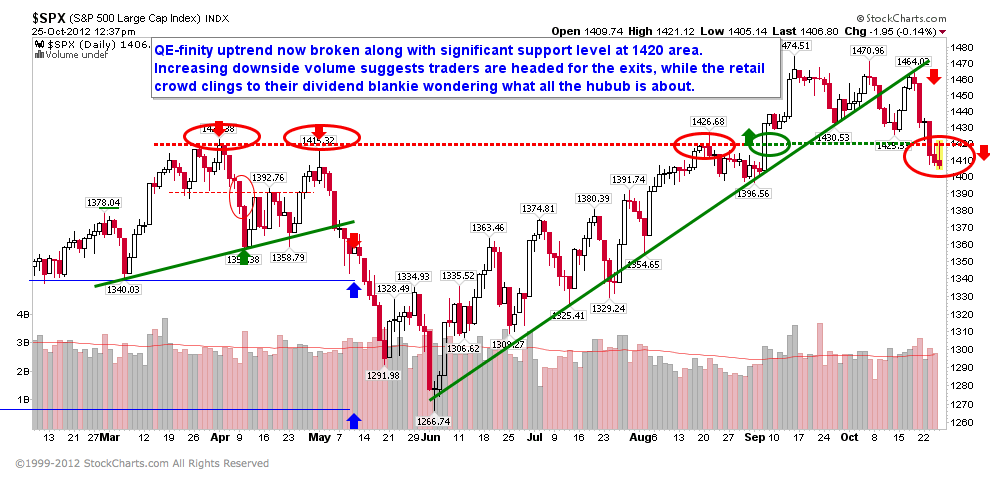
Not 6 weeks after the US Fed pledged Q’Efiniity injections, the S&P 500 has not only given back all of its initial gains made on that announcement, but has also broken below the top it forged on QE2 stimulus last spring. The Canadian TSX too is following global growth down and is now a full 16% lower than its nearest cycle peak 18 months ago in April 2011.
The catalysts for selling pressure in the 4th quarter are many in my view. Key ones include:
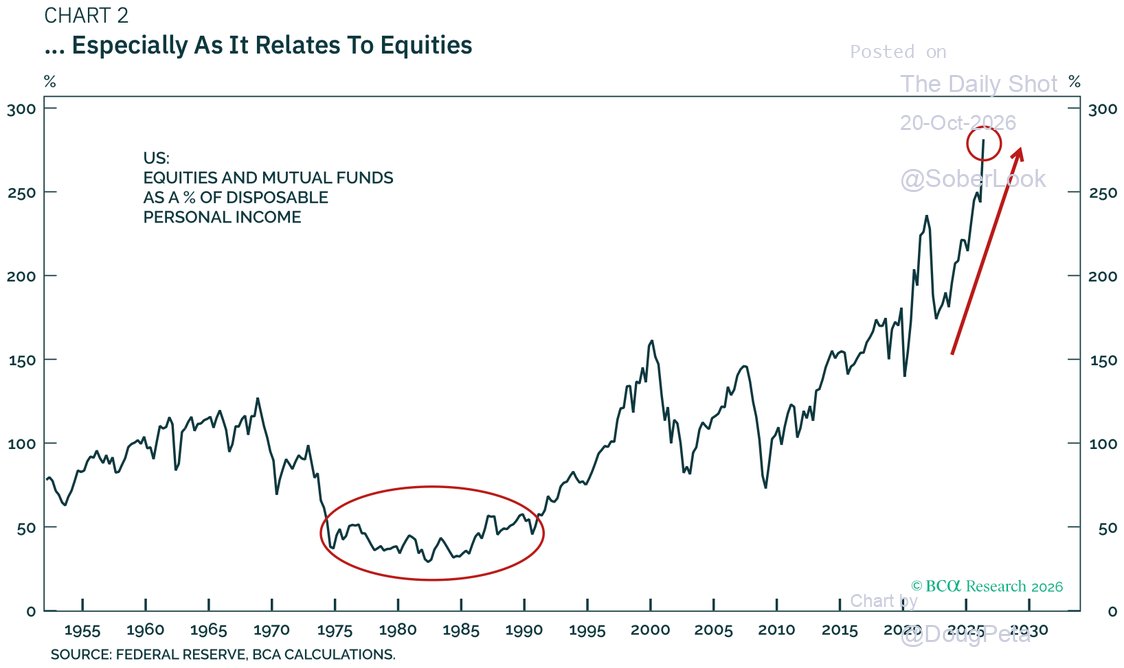
Stock and commodity prices have been over-priced on repeated central bank intervention the past 3 years and now bear little rational connection to corporate revenue and growth prospects over the next 3 to 12 months as the global recession spreads.
The low rate world is increasingly forcing savers to consume income and capital to pay their bills. After 15 years of losing money in stocks, few today are happy with risk or banking on long-term hopes.
Global markets were negative year-to-date for the first 6 months of 2012. This followed a flat and negative year in 2011. Money managers and individual investors who saw a short rebound in account values on central bank stimulus July through September, and have the ability to lock that in by reducing market exposure, are keen to take the Fed gift and do so in order to report calendar year “returns” for 2012.
US investors face the prospect of a dramatic jump in the capital gains tax rate in 2013. Selling before the end of 2012 reduces tax risk. Capital gain tax rates in 2013 may well be higher–in any case, they certainly won’t be lower.
The outcome of the US election is polling ‘hard to call’. It could result in a protracted tabulation period a la 2001, before a clear winner is announced. Meanwhile the debt ceiling looms once more and could require negotiations in the midst of the electoral storm. In every outcome, the US faces a fiscal drag of 1-1.5% in early 2013 even assuming they delay the ‘fiscal cliff”. Current stall speed growth becomes negative quite easily in this scenario.
Reasons to continue holding stocks in these conditions?? I can think of a few:
Hope and a prayer that central bank injections will be able to hold off asset deflation a while longer.
Ignorance of secular bear cycles.
Long-always advisers and managers who are motivated by their own fee income to keep client capital in risk markets at all cost. Even when the prospects of loss far outweigh the probabilities for lasting gains.
“An explosive critique about the investment industry: provocative and well worth reading.”
Financial Post
“Juggling Dynamite, #1 pick for best new books about money and markets.”
Money Sense
“Park manages to not only explain finances well for the average person, she also manages to entertain and educate while cutting through the clutter of information she knows every investor faces.”
Toronto Sun