
S&P breaks QE2 support

Not 6 weeks after the US Fed pledged Q’Efiniity injections, the S&P 500 has not only given back all of its initial gains made on that announcement, but has also broken below the top it forged on QE2 stimulus last spring. The Canadian TSX too is following global growth down and is now a full 16% lower than its nearest cycle peak 18 months ago in April 2011.
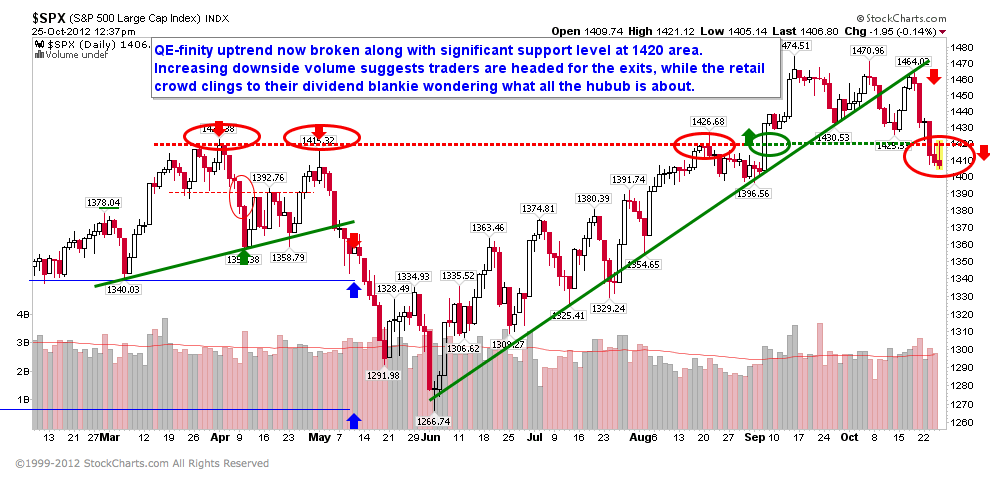

Source: Cory Venable, CMT, Cory Venable Investment Counsel Inc.

The catalysts for selling pressure in the 4th quarter are many in my view. Key ones include:

  1. Stock and commodity prices have been over-priced on repeated central bank intervention the past 3 years and now bear little rational connection to corporate revenue and growth prospects over the next 3 to 12 months as the global recession spreads.
  2. The low rate world is increasingly forcing savers to consume income and capital to pay their bills. After 15 years of losing money in stocks, few today are happy with risk or banking on long-term hopes.
  3. Global markets were negative year-to-date for the first 6 months of 2012. This followed a flat and negative year in 2011. Money managers and individual investors who saw a short rebound in account values on central bank stimulus July through September, and have the ability to lock that in by reducing market exposure, are keen to take the Fed gift and do so in order to report calendar year “returns” for 2012.
  4. US investors face the prospect of a dramatic jump in the capital gains tax rate in 2013.  Selling before the end of 2012 reduces tax risk. Capital gain tax rates in 2013 may well be higher–in any case, they certainly won’t be lower.
  5. The outcome of the US election is polling ‘hard to call’. It could result in a protracted tabulation period a la 2001, before a clear winner is announced. Meanwhile the debt ceiling looms once more and could require negotiations in the midst of the electoral storm. In every outcome, the US faces a fiscal drag of 1-1.5% in early 2013 even assuming they delay the ‘fiscal cliff”. Current stall speed growth becomes negative quite easily in this scenario.

Reasons to continue holding stocks in these conditions?? I can think of a few:

  1. Hope and a prayer that central bank injections will be able to hold off asset deflation a while longer.
  2. Ignorance of secular bear cycles.
  3. Long-always advisers and managers who are motivated by their own fee income to keep client capital in risk markets at all cost.  Even when the prospects of loss far outweigh the probabilities for lasting gains.

Posted in Main Page | 11 Comments

PBS Frontline: Climate of Doubt

How does climate change factor into Decision 2012? Here is a direct link.

Watch Climate of Doubt on PBS. See more from FRONTLINE.

Posted in Main Page | 6 Comments

Those who oppose disclosure must be overcome

Through all the complexities of human life, I subscribe to a basic principle: transparency is the best policy. The only way that adults can make informed, reasoned choices in life is to have the facts. When a person or group opposes transparency and disclosure I believe their motives are dishonest and should be over-ruled. This goes for the financial industry which has notoriously spent millions lobbying against rules requiring transparency of fees and conflicts of interest. See: Hidden mutual fund fees need clear disclosure for a recent review of such issues.

It also goes for the food industry which has been vigorously opposing our right to be informed about the food we consume. They must not win this one.

“At this very moment, Monsanto and other pesticide companies are spending more than $1 million a day to convince California voters that it’s not in their best interest to know whether the food they eat is genetically engineered. And Henry I. Miller is their guy.

If you live in California today, he’s hard to miss. You see him in TV ads, hear him in radio spots, and his face is all over the expensive fliers that keep showing up uninvited in your mail box. Initially, the ads presented Miller as a Stanford doctor. But he isn’t. He’s a research fellow at a conservative think tank (the Hoover Institute) that has offices on the Stanford campus. When this deceptive tactic came to light, the ads were pulled and then redone. But they still feature Miller telling the public that Prop 37 “makes no sense,” and that it’s a “food-labeling scheme written by trial lawyers who hope for a windfall if it becomes law.”

Actually, Prop 37 makes all the sense in the world if you want to know what’s in the food you eat. It was written by public health advocates, and provides no economic incentives for filing lawsuits.

Who, then, is Henry I. Miller, and why should we believe him when he tells us that genetically engineered foods are perfectly safe?

Does it matter that this same Henry Miller is an ardent proponent of DDT and other toxic pesticides? Does it matter that the “No on Prop 37″ ads are primarily funded by pesticide companies, the very same companies that told us DDT and Agent Orange were safe?”

See: This man is lying about your food.

When industries wish to advance self-serving business models against the best interests of their customers, they typically buy PHD’s to thwart understanding and free choice with the clubs of big money and higher education. This is indefensible and utterly repugnant. The basic tenants of democracy, capitalism and free choice, all require disclosure. Those who seek to block this must be overcome.

Posted in Main Page | 4 Comments




