
A case of overkill

It is not just rapid hikes in the overnight rate (525 basis points in 18 months by the US Fed and 475 basis points in Canada), which are contracting credit and slowing spending through the real economy. The drop in equity and bond prices, along with the jump in fossil fuel costs and the US dollar, have tightened financial conditions the equivalent of an additional 80 basis points in the last two months alone.

US third quarter GDP (first estimate released this Thursday) was boosted by war-time style government spending, but gridlock heading into an election year makes that less likely over the next several quarters.

Canadian GDP already contracted in the first half of 2023 (-.2% annualized), and with August data due on October 31, the second half is not looking up. If the US Fed has done enough with its tightening efforts to date, the case for the Bank of Canada to be done is stronger still. No wonder the loonie has weakened against the Greenback even as oil prices bounced over the past four months.

Indeed, with defaults and bankruptcy surging through the private sector, financial tightening has already been overkill. As central banks pause, the flight to safety and hedge funds covering their shorts on Treasuries will naturally boost the buying of government bonds. This will help ease interest rate pressures, but too late to rescue highly leveraged households and companies, especially in Canada.

The segment below discusses some of these factors.

DiMartino Booth and Charles Payne Break Down the Latest Action in Bond Yields. Here is a direct video link.
Posted in Main Page | Comments Off on A case of overkill

Re-steepening yield curve signals financial trauma in motion

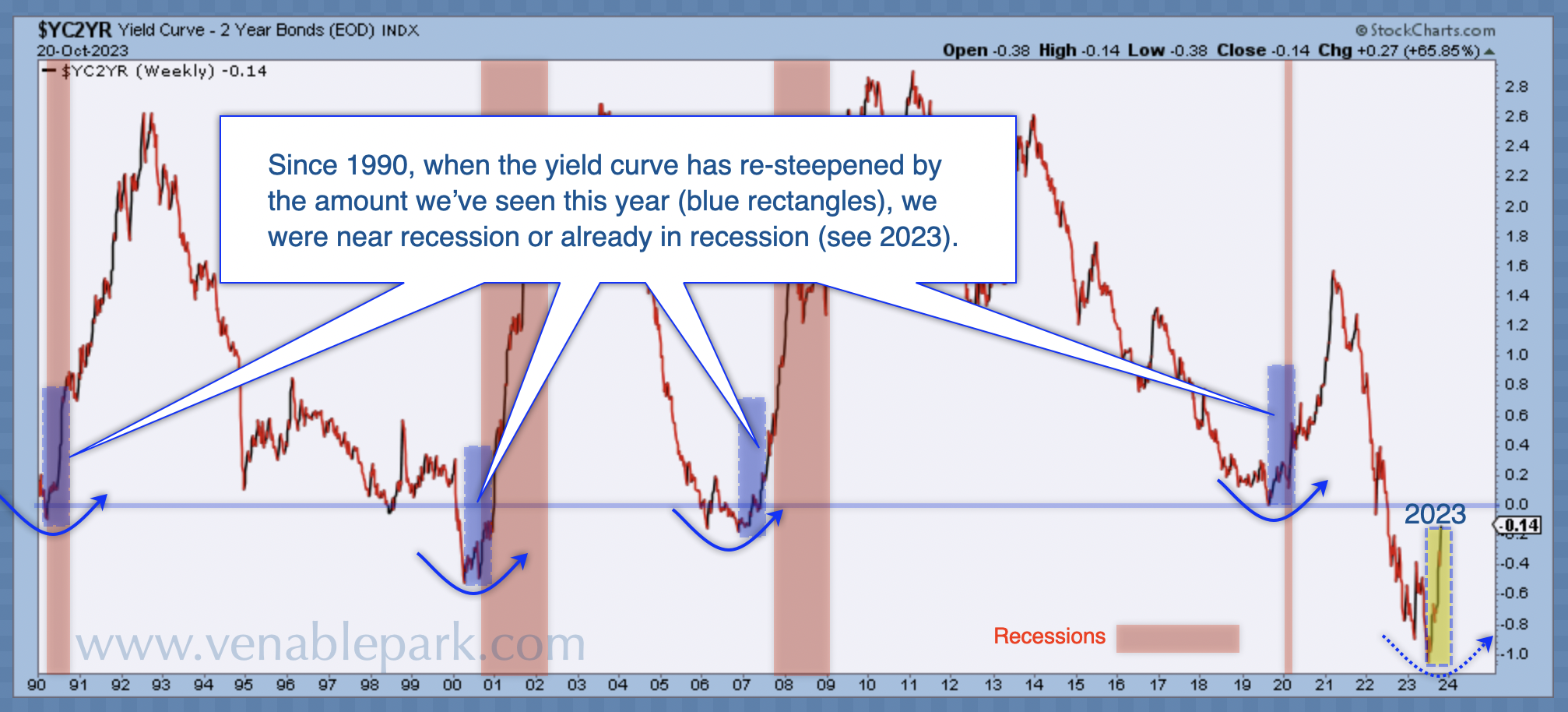
In the past few months, short-term treasury yields have risen more than long-term such that the yield curve, which has been inverted since April 2021, is now un-inverting. This move typically signals the near-term onset of recession and the worst stock market losses.

The chart below from my partner Cory Venable shows the move in the US 2-10 yield spread from a deeply negative 108 basis points in June 2023 to -22 this morning. Past re-steepening episodes are highlighted in blue, with the recessions that followed in red.

Komal Sri-Kumar, president of Sri-Kumar Global Strategies, joins ‘Squawk Box’ to discuss rising Treasury yields, with the 10-year Treasury yield breaking above 5% for the first time in 16 years, the impact on markets and economy, the Fed’s inflation fight, and more.Here is a direct video link.

Posted in Main Page | Comments Off on Re-steepening yield curve signals financial trauma in motion

Real estate getting a comeuppance

Pops and financial wipeouts are the historical norm when a billowing housing bubble meets dramatically higher interest rates. On the upside, the pendulum is finally moving in favour of renters and future buyers.

Buying housing has rarely been this unattractive relative to renting. The chart below shows that the average new US mortgage payment is now 52% higher than the average apartment rent, and this does not include all of the other costs of home ownership and maintenance. See, There’s never been a worse time to buy instead of rent:

The average monthly new mortgage payment is 52% higher than the average apartment rent, according to CBRE analysis. The last time the measure looked out of whack was before the 2008 housing crash. Even then, the premium peaked at 33% in the second quarter of 2006.

After years of ultra-lax credit conditions and favourable tax treatment, landlords and real estate investors are losing bargaining power and capital.

With homeownership out of reach for many tenants, landlords would normally be able to push rents higher. But the supply of homes to rent isn’t as tight, with a glut of newly built apartments depressing rent growth. Demand from tenants is also weaker than it was during the pandemic, as most people who were planning to move have already done so over the last two years.

Fannie Mae thinks vacancy rates in U.S. multifamily buildings will reach 6.25% in 2024, above the 15-year average of 5.8%.

This will hurt institutional investors, who have poured billions of dollars into U.S. rental property in recent years. Apartment stocks are also underperforming.

The market value of companies in the S&P 500 real estate sector has fallen 37% since the cycle peak in December 2021 and is now back to the same price level as June 2016 (chart below). A retest of the March 2020 pandemic crash low, 30% lower, remains in scope.

Posted in Main Page | Comments Off on Real estate getting a comeuppance





