This morning (so far) risk markets are continuing hope-fueled rallies as the volatility fear gauge (VIX) slumbers around complacency levels of October 2007. Meanwhile behind the present air of calm, Wall Street banks are quietly restructuring their own portfolios and counter-party contracts as they prepare for the potential exit of a country from the eurozone.
In the trading community all faith and confidence is apparently focused on the Bernank’s next trick expected at Jackson Hole on August 31. A must read for those that like facts and reality based observations is Gary Shilling’s month end missive “Global Recession” (subscription required).
For investors who like to keep their head on straight in order to actually amass and preserve life savings, John Hussman’s weekly note “Erasers” is crucial reading.
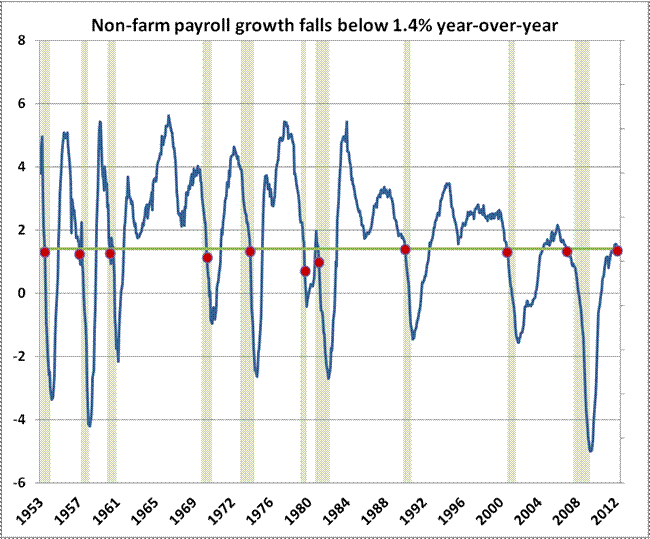
Behind the spin and whirl of last week’s non-farm payroll guestimations, it is most relevant that year-over-year growth in non-farm payrolls fell below 1.4% in April, and has remained weak since then. As the chart below indicates, a decline in year-over-year payroll employment growth below 1.4% has occurred just before each of the past 10 recessions, with no false signals.
 Source: John Hussman
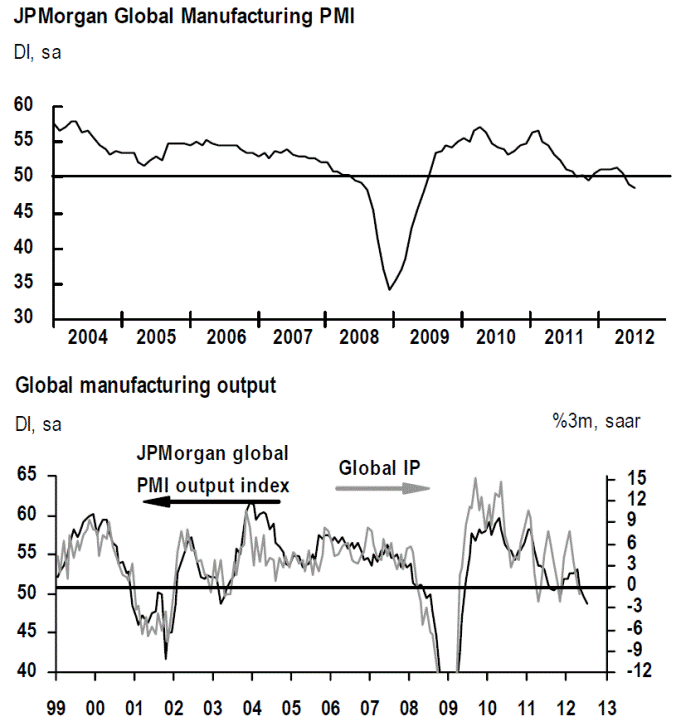
And at the same time the Global Manufacturing Index has now fallen through levels which marked the start of the last 2 global recessions.
 Source: John Hussman
Remember that successful investing does not require riding all the stock market up-legs, but it does require one to avoid the predictable price declines of bear markets heading into recessions. Sitting out of the losses is the single most important discipline of maintaining gains over a full market cycle. It is that simple. Hussman explains why:
“A typical bear market erases over half of the preceding bull market advance. It is easy to forget – particularly during late-stage bull markets – how strongly this impacts full-cycle returns. The most obvious example, of course, is the 2008-2009 decline, which erased not only the entire total return of the S&P 500 since its 2002 low, but also erased the entire total return of the S&P 500 in excess of Treasury bill yields (its “excess return”) going all the way back to June 1995 – making all of the benefit from risk-taking during the late-1990’s completely for naught. Similarly, the 2000-2002 bear market wiped out the excess return that investors had enjoyed in the S&P 500 all the way back to February 1996. The 1990 bear market wiped out the excess return of the S&P 500 all the way back to January 1987.
Recall that at the 1987 peak, the S&P 500 had quadrupled (including dividends) from the secular low of August 1982. The 1987 crash – which in terms of size was a fairly run-of-the-mill bear of -33.51% from peak to trough – was enough to wipe out nearly half of that preceding total return (do the math: [(4*(1-.3351)-1]/(4-1)-1 = -45%), and slashed the excess return that investors had enjoyed since 1982 by even more than half. This chronicle of unpleasant arithmetic can be extended indefinitely over market history. Regardless of whether stocks are in a secular bull market or a secular bear market, the mathematics of compounding are brutal where large losses are concerned.”