
Increasing the primary residence housing stock

All the talk about needing to deflate the cost of housing is finally getting serious.

This week, B.C.’s NDP government tabled the Short-Term Rental Accommodations Act that, if passed, will ban most short-term rentals that aren’t within an operator’s principal residence. Effective May 1, the new restriction would apply in municipalities with a population of 10,000 people or more and in smaller communities within 15 kilometres of a larger city.

The change would force thousands of AirBnB-style properties to convert to lower-yielding long-term rentals while negative carrying costs prompt more listings for sale. See, ‘I just hope my investment doesn’t come crashing down on me:’ B.C. Airbnb owner responds to proposed crackdown:

It will effectively wipe out the business model for real estate investors and property management companies with dozens of short-term rental listings. Under the new rules, they will have to convert those units to long-term rentals or face hefty fines.

Increasing the supply of properties for primary residence should help deflate housing costs via lower rents and home prices. While painful for investors, policy changes are necessary to bring shelter costs back in line with long-term affordability norms. Provinces like Ontario are likely to follow suit.

A decade-plus of near-zero interest rates and speculator-friendly incentives encouraged capital misallocation and a massive housing bubble. Normalized interest rates are now leading the take-back phase.

Posted in Main Page | Comments Off on Increasing the primary residence housing stock

Bonds offer capital defence, equities do not

Unlike bonds, equities offer no return of principal dates nor contractually prescribed income payments. Contrary to the investment sales hype bombarding us daily, dividend-paying equities are not capital ‘defensive.’ Defensive for whom, we should ask.

From present valuation levels, equities are priced to underperform government bonds by 6.5% annualized over the next ten years (see arrow below, courtesy of John Hussman):

“…the gap in expected returns between equities and bonds has joined the worst levels in history, matched only by extremes in mid-1929 and early-2000.” hussmanfunds.com/comment/mc2310

Komal Sri-Kumar, Sri-Kumar Global Strategies president, joins ‘Closing Bell: Overtime’ to discuss the impact of the Israel-Hamas war on inflation, what this means for fixed income returns, and more. Here is a direct video link.

Posted in Main Page | Comments Off on Bonds offer capital defence, equities do not

Pandemic buyers struggling to unload properties

Leverage on leverage on leverage, who would have thought?

John Fincham, broker at Re/Max Parry Sound Muskoka Realty, joins BNN Bloomberg to discuss the Ontario cottage market. He says that many cottage owners who bought during the pandemic are now struggling to unload those properties. And as interest rates drive down prices he says cottages located on less popular lakes and listed under $1.5 million dollars could drop by 30% in value in 2024. Here is a direct video link.

Also see: Pandemic Buyers Struggling to Unload Cottages.

As for the fantasy that “rich” Torontoians are not affected by higher interest rates and falling property prices, wait for it: Mortgage defaults and forced home sales now starting to rise in Toronto.

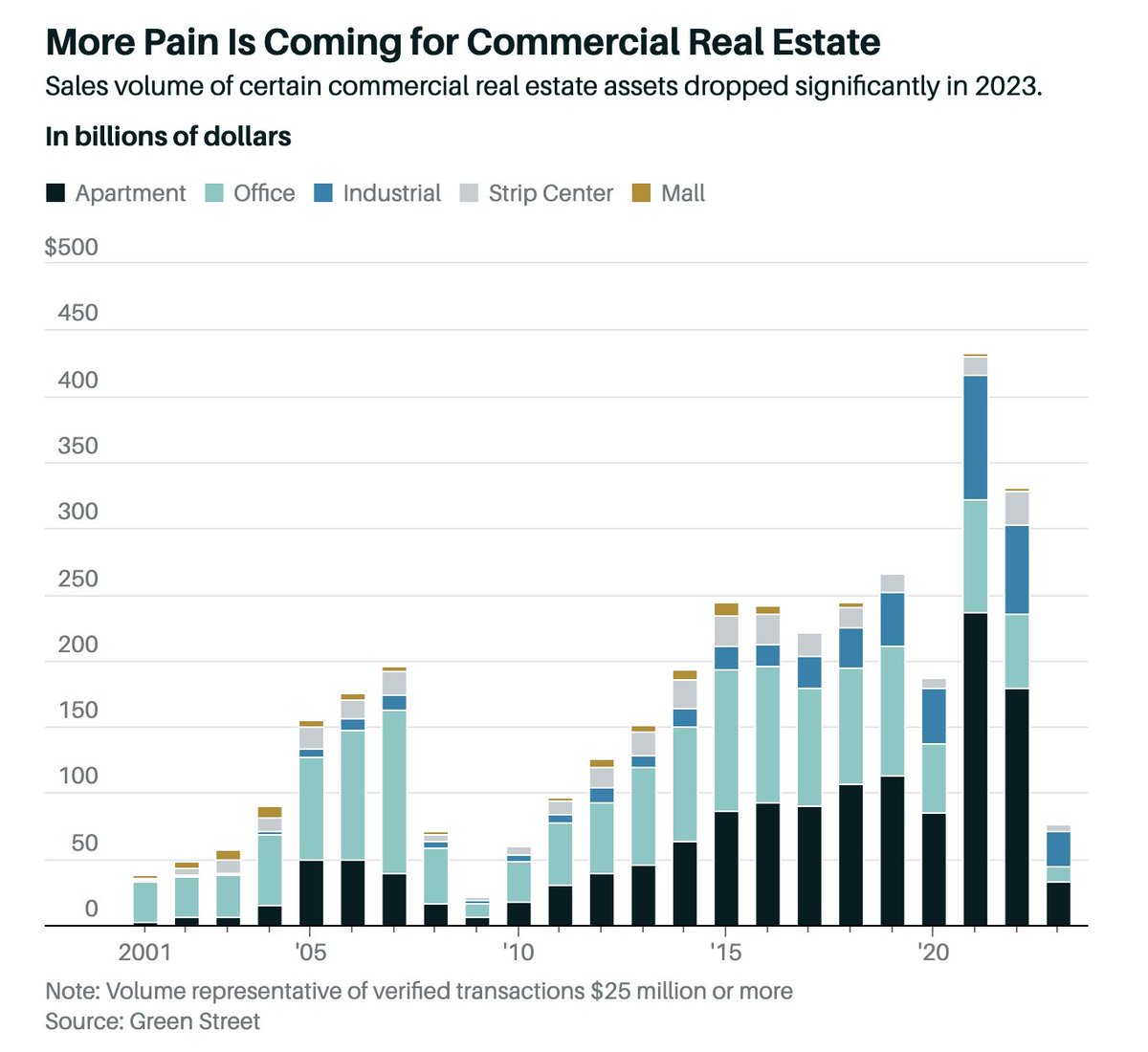
Meanwhile, commercial real estate sales volume (across all property types shown below since 2001) has fallen to the lowest level in 13 years.
And the downdraft is global; see Paris Commercial Property Deals Hit Lowest Levels in 13 years:

Property markets across Europe have ground to a halt as rising rates have increased financing costs and hit valuations. But owners are reluctant to lower their expectations after a decade of rising prices, creating wide divergence between prospective buyers and sellers.

Posted in Main Page | Comments Off on Pandemic buyers struggling to unload properties





