A couple of key lines of thought that are naive and harmful to capital yet widely perpetrated.
The first is the idea that people have been buying long bonds today for the 1-3% yields. Nope, they have been buying them as a trade–one of the rare places to put money for some capital gain while risk markets continue to plummet. If I hear one more person say something about how silly it is to “lock in money for 10 years at 1.5%” I will yak. Please understand. No one buys 10, 20 or 30 year bonds at these yields to hold to maturity. Bonds are not locked like guarantee certificates at the local bank. Bonds are the biggest, most liquid and widely traded markets in the world. Most stock pickers say they would never buy a bond– ’cause that is what they always say. Bonds are against their risk-seeking natures and usually outside their field of interest, expertise and swing-for-the-fences kind of mandate. Many have dogmatically abused the idea of owning bonds for the past 30 years. And throughout that whole time, investment grade bonds have handily outperformed stocks and commodities by a landslide with a fraction of the volatility. I am not saying bonds are a great investment for the long-term at these yields, but that doesn’t mean shelter-seeking capital will not continue to park there for a while longer yet.
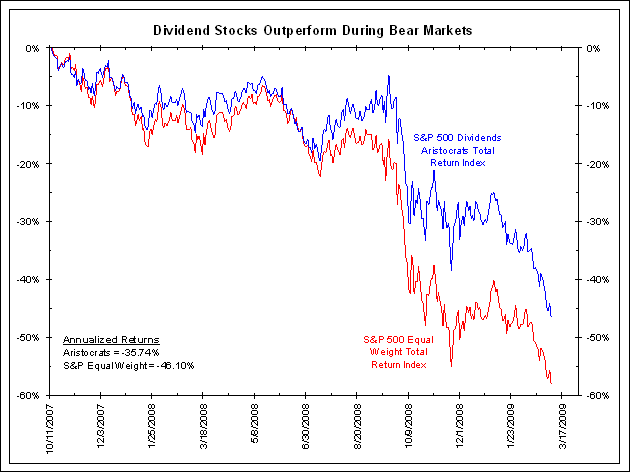
Second, dividend paying stocks are no shelter from the storm of a bear market, and certainly not when the world is heading into a global recession. Here is an important reminder of how dividend paying stocks performed during the last bear market/recession (same pattern took place in the 2000-2002 downturn). Note that dividend paying stocks fell 45% rather than the 55% of the S&P 500. Anyone want to call that defensive with a straight face?
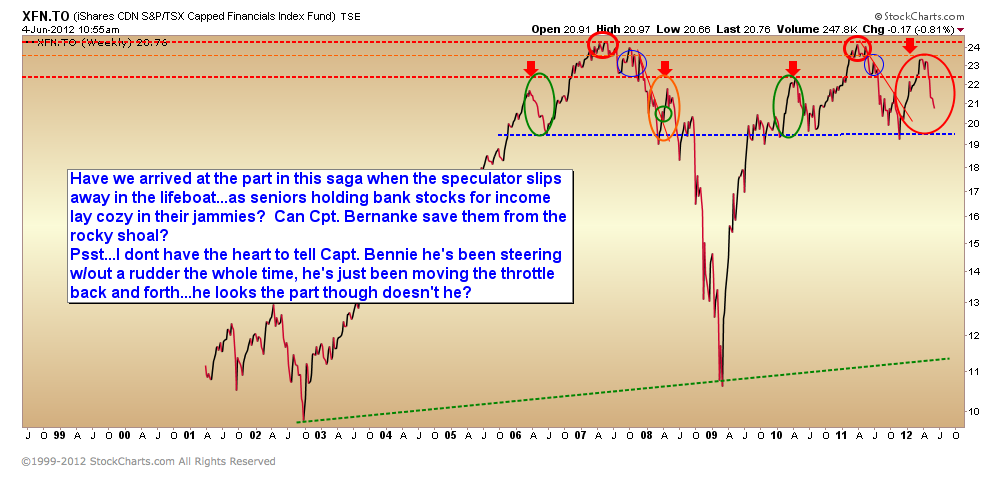
Coincident to this point is the following update on the Canadian banking sector index which is looking eerily familiar to the price action leading into 2008. As seniors and others who can least afford more losses are counseled to hold and collect pitiful dividends, levered traders have been steadily slipping out the back door. This represents a whole lot of risk for the unsuspecting and especially since the v-bottom bounce back in 2009 was a stimulus-driven-anomaly and is highly unlikely to be repeated coming off of the next bottom.
 Source: Cory Venable, CMT, Venable Park Investment Counsel Inc.