
Harvard University history professor Niall Ferguson talks about Europe’s banking crisis.
Follow






_________________________
Harvard University history professor Niall Ferguson talks about Europe’s banking crisis.
The teeter totter continues this week with the US Index breaking decisively through key resistance north of 81, currently trading around 82.40. As shown below in my partner Cory’s work, $88 remains our potential upside target. The wild card is whether further monetary intervention will disrupt the flow in the interim.
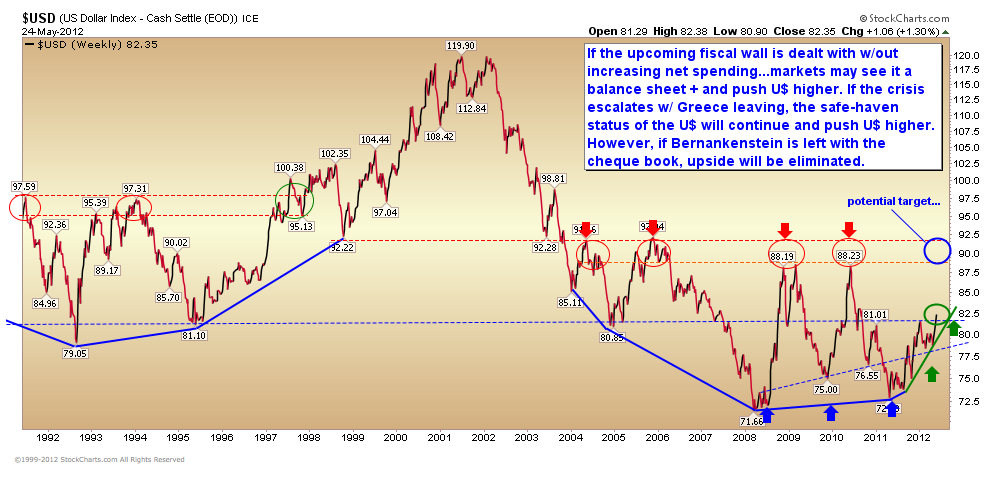 Source: Cory Venable, CMT, Venable Park Investment Counsel Inc.
On the other side of this trade, copper has fulfilled its downside promise, having given back gains made in QE2, Twist and Europe’s LTRO liquidity pumps. Here was Cory’s chart on Global Copper at the start of last month (April 9) and below it appears updated today with price having fallen to near-term support. Weak global demand as the recession spreads, suggests copper has further downside. The next near-term test in this chart is 22, marked with a circle below.
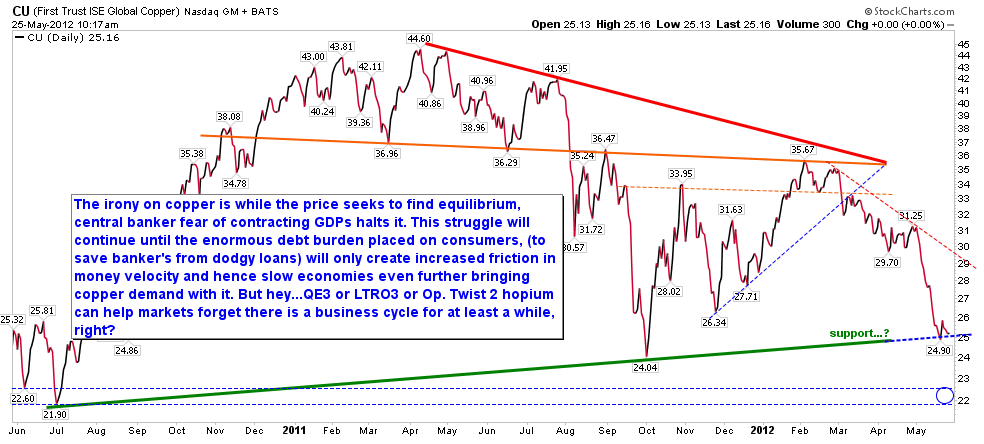 Source: Cory Venable, CMT, Venable Park Investment Counsel Inc.
I have mentioned many times, that the Germans were willing participants in building up the Eurozone credit crisis. They benefited the most from selling goods on credit to club med customers who were buying their brains out. Truthfully the Germans aided and abetted the credit bubble just as surely as did China–both enthusiastic exporters funded through various forms of vendor-take-back financing (buying bonds of customer countries insatiably, to keep the gig going).
Little discussed is the extent to which bail out efforts the past few years have also directly supported Germany. See this excellent article: Hey, Germany: you got a bail out, too.
“In the millions of words written about Europe’s debt crisis, Germany is typically cast as the responsible adult and Greece as the profligate child. Prudent Germany, the narrative goes, is loath to bail out freeloading Greece, which borrowed more than it could afford and now must suffer the consequences.
Would it surprise you to know that Europe’s taxpayers have provided as much financial support to Germany as they have to Greece? An examination of European money flows and central-bank balance sheets suggests this is so.
Let’s begin with the observation that irresponsible borrowers can’t exist without irresponsible lenders. Germany’s banks were Greece’s enablers. Thanks partly to lax regulation, German banks built up precarious exposures to Europe’s peripheral countries in the years before the crisis. By December 2009, according to the Bank for International Settlements, German banks had amassed claims of $704 billion on Greece, Ireland, Italy, Portugal and Spain, much more than the German banks’ aggregate capital. In other words, they lent more than they could afford.
When the European Union and the European Central Bank stepped in to bail out the struggling countries, they made it possible for German banks to bring their money home. As a result, they bailed out Germany’s banks as well as the taxpayers who might otherwise have had to support those banks if the loans weren’t repaid. Unlike much of the aid provided to Greece, the support to Germany’s banks happened automatically, as a function of the currency union’s structure.”
The whole article is a worth the read.


