
Pause before the storm

As Greg Ip notes in the Wall Street Journal today: “Every recession starts out looking like a soft landing. August’s moderate increase in unemployment was welcome. The risk is that plenty more are in store, which won’t be cause for celebration.

In reality, recessions are the norm following monetary tightening cycles, and unemployment rises through contractions and well into the next economic expansion. Unemployment is now increasing in Canada and the US, and central banks are intent on further job losses to reduce demand (inflation) in the economy.

For investors, it is critical to understand that the stock market has never bottomed while central banks are hiking or at their pause.  In the seven hiking cycles since 1969, the average time between the last rate hike and the stock market bottom has been 15 months, and the bulk of cycle losses happened while central banks were slashing rates again. On the other hand, government bond prices rose in the six months following the end of past tightening cycles (yields fell).

Frances Donald, global chief economist and strategist at Manulife Investment Management, joins BNN Bloomberg for her view on the Bank of Canada’s latest rate decision. Donald says the BoC doesn’t need anyone to get excited about rate cuts as it could bring inflation higher; hence the Bank remains hawkish. She adds the Bank will probably cut rates in early 2024. She says Canada is likely in a technical recession. Here is a direct video link.
Posted in Main Page | Comments Off on Pause before the storm

Jeremy Grantham on risk and opportunity

I discovered Jeremy Grantham in 2002, and he’s served as a touchstone since. His experience and insight are rare and valuable.

The slow-moving influence of rising interest rates will end up torpedoing the economy, dashing Federal Reserve expectations that a recession can be avoided, according to renowned Wall Street curmudgeon Jeremy Grantham. This interview for “Bloomberg Wealth with David Rubenstein” was recorded August 17th in Boston. Here is a direct video link.

Posted in Main Page | Comments Off on Jeremy Grantham on risk and opportunity

Real estate has earned us a drubbing

US mortgage rates (30-year fixed) jumped an extra 50 basis points this week to 7.7%, while Canadian mortgage rates are 6% plus. Higher carrying costs are causing many owners to need to maximize rental income from their properties. Short-term rentals are attractive because they have yielded more per night than long-term leases.

However, many cities are responding to unaffordable living costs by restricting short-term rentals to increase the supply of homes available for full-time occupancy. New York City is one of the latest, as discussed in the segment below with Robert Frank. Here is a direct video link.
CNBC’s Robert Frank joins ‘Power Lunch’ to discuss the new law impacting Airbnb listings in New York City, rental legislation enforceability problems, and competition for rental properties leading to record high rates.

At the same time, strained consumers and a slowing economy are cutting demand for travel and short-term rentals globally. A broader hour-plus deep-dive video on these issues is available in AirBnBust update with housing analyst Amy Nixon.

Adding insult to injury, many of today’s owners and landlords bought or refinanced their properties between 2019 and 2022 when prices were irrationally engorged via ultra-low interest rates. As a result, the costs paid compared with rental income potential left no margin of error even when interest rates were less than 3 percent. At double that, the math’s positively toxic.

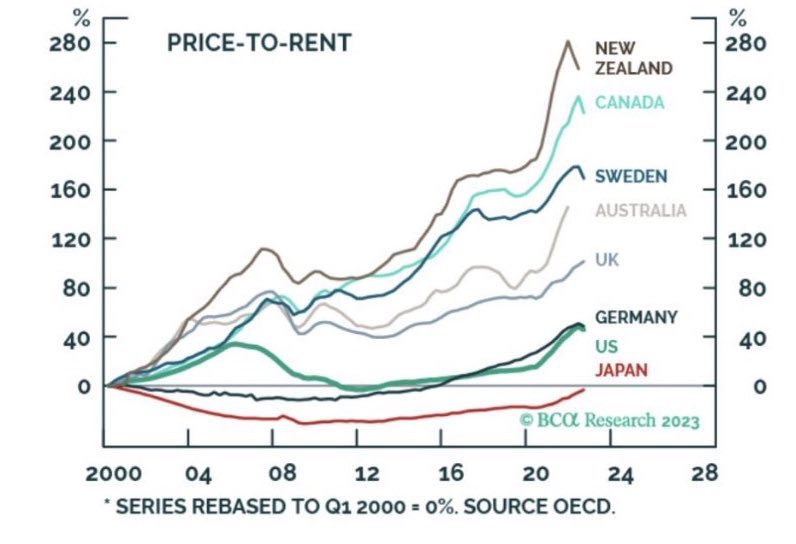
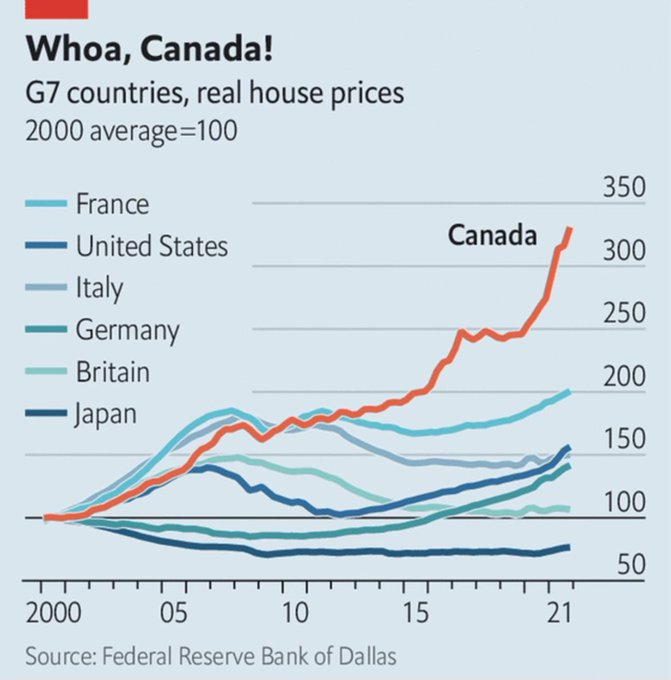
Shown below, since 2000, New Zealand and Canada have held top honours for the craziest prices relative to rents in the world. The inflation-adjusted doubling in Canadian home prices over the last thirteen years is the most garish of all G7 countries (as shown below) and much worse than the 155% average price increase in America. Further evident in this chart is the subsequent multi-year price stagnation after property bubbles burst in other countries. Japan’s bubble burst in 1991; prices then deflated for a decade, and real prices have never recovered to the ’91 peak since.
Even if central banks hold base rates here and start easing them again in 2024, years of reckless and wilfully blind financial behaviours have cast the die for a well-deserved real estate bust. The supply of motivated sellers is on the rise.  Unfortunately, real estate downturns have historically perpetrated the most severe recessions and job loss cycles.

Posted in Main Page | Comments Off on Real estate has earned us a drubbing





