Real estate has earned us a drubbing

US mortgage rates (30-year fixed) jumped an extra 50 basis points this week to 7.7%, while Canadian mortgage rates are 6% plus. Higher carrying costs are causing many owners to need to maximize rental income from their properties. Short-term rentals are attractive because they have yielded more per night than long-term leases.

However, many cities are responding to unaffordable living costs by restricting short-term rentals to increase the supply of homes available for full-time occupancy. New York City is one of the latest, as discussed in the segment below with Robert Frank. Here is a direct video link.

CNBC’s Robert Frank joins ‘Power Lunch’ to discuss the new law impacting Airbnb listings in New York City, rental legislation enforceability problems, and competition for rental properties leading to record high rates.

At the same time, strained consumers and a slowing economy are cutting demand for travel and short-term rentals globally. A broader hour-plus deep-dive video on these issues is available in AirBnBust update with housing analyst Amy Nixon.

Adding insult to injury, many of today’s owners and landlords bought or refinanced their properties between 2019 and 2022 when prices were irrationally engorged via ultra-low interest rates. As a result, the costs paid compared with rental income potential left no margin of error even when interest rates were less than 3 percent. At double that, the math’s positively toxic.

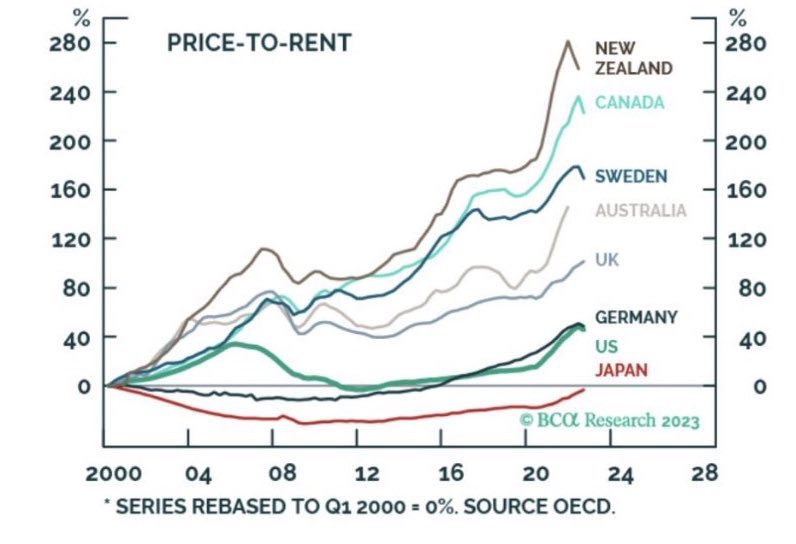
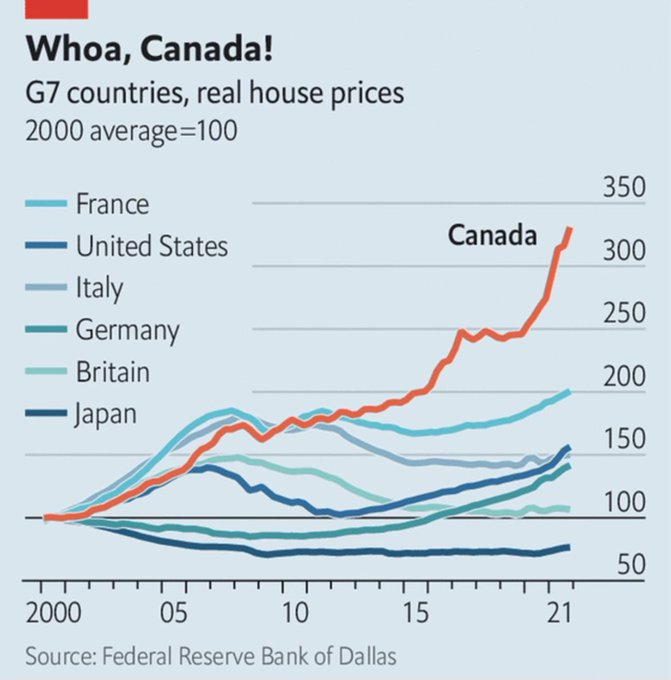
Shown below, since 2000, New Zealand and Canada have held top honours for the craziest prices relative to rents in the world. The inflation-adjusted doubling in Canadian home prices over the last thirteen years is the most garish of all G7 countries (as shown below) and much worse than the 155% average price increase in America. Further evident in this chart is the subsequent multi-year price stagnation after property bubbles burst in other countries. Japan’s bubble burst in 1991; prices then deflated for a decade, and real prices have never recovered to the ’91 peak since.
Even if central banks hold base rates here and start easing them again in 2024, years of reckless and wilfully blind financial behaviours have cast the die for a well-deserved real estate bust. The supply of motivated sellers is on the rise.  Unfortunately, real estate downturns have historically perpetrated the most severe recessions and job loss cycles.


Posted in Main Page | Comments Off on Real estate has earned us a drubbing

Extend and pretend has magnified economic shock

As interest rates soared above six percent over the last seventeen months, four of the big five Canadian banks have allowed floating-rate customers to extend and pretend by making the same mortgage payments as when floating rates were sub-2%. This has compounded solvency problems as unpaid interest adds to the debt and extends amortization periods beyond prudence.

In their latest quarter ended in July, Canadian banks reported between 23 and 29.8% of their mortgage books with amortizations greater than 30 years, up from virtually zero in 2022. Bank of Nova Scotia is the only of the big five that wisely has not allowed variable payments for floating rate mortgage customers.

Last month, the Office of the Superintendent of Financial Institutions (OSFI) proposed changes to make banks hold more capital to address risks “related to mortgages with growing balances.” Starting in 2024, lenders will hold more capital against mortgages with growing balances and loan-to-collateral values above 65 percent.

Higher capital requirements reduce lender profits and are particularly unattractive at a time when banks are also increasing their loan loss provisions.

Canadian banks are alerting customers that they must bring mortgages into conventional 25-year amortization periods by increasing monthly or lump sum payments—easier said than done for the masses. An estimated C$331 billion in home loans are due for renewal next year alone.

Higher debt-service payments are a headwind for debtors and the overall economy. Royal Bank CEO Dave McKay connected the dots last week: “The industry has a significant portion of mortgages maturing in 2024, 2025 … If rates hold, we’ll pull more disposable income out of the economy and slow it even faster.”

Less spending leads to rising unemployment and more people skipping payments of all kinds. That negative loop is underway now. Defaults and forced sales are growing.

The Canadian financial index (XFN) is, to date, -18% since peaking with Canadian home prices in February 2022. During the 2000-02 and 2007-09 downcycles (where Canadians were much less indebted and property prices much less inflated), the financial index lost about 50% of its market value.

The financial sector’s whopping 31% weight in the broader Canadian stock market (TSX) magnifies capital risk for all of the funds and portfolios designed to track it. But most overlook these dynamics until it’s too late.

Valuable investment opportunities come for those prepared and disciplined enough to wait for them. Such is the test.

Posted in Main Page | Comments Off on Extend and pretend has magnified economic shock

Higher rates freezing mobility and consumption

About seventy percent of Canadian mortgages were taken out over the last few years with a 5-year fixed term and an ultra-low interest rate that averaged 2.79%. In 2020-2021, some 40% were taken at floating rates that averaged 1.65%. Floating and new fixed-term rates are now above 6%. Eighty-five percent of US home mortgages have a 30-year fixed-term taken out when rates were less than 4% versus new term rates above 7%.

Refinancing/equity withdrawals and moving are off the table for the masses since most can’t qualify for new loans at current rates. No wonder that new mortgage applications are the lowest since 1995. See Mortgage Growth Buckles Under Weight of Rate Hikes in Canada.

The housing market is frozen as the number of people reporting it is a good time to buy a home slipped to lows seen just twice since 1960—the recessions of 1973-74 and 1981.

The trouble is that life happens and staying put is not always possible. As layoffs pick up, more people will want to move to downsize expenses or relocate for new employment.

David reviews the lagged impacts of higher rates well in the segment below.

David Rosenberg, Rosenberg Research, joins ‘Fast Money’ to talk about the U.S. economy, the impact of interest rates, slowing employment growth and more. Here is a direct video link.

Posted in Main Page | Comments Off on Higher rates freezing mobility and consumption