Bond yields moving toward a third spring test?

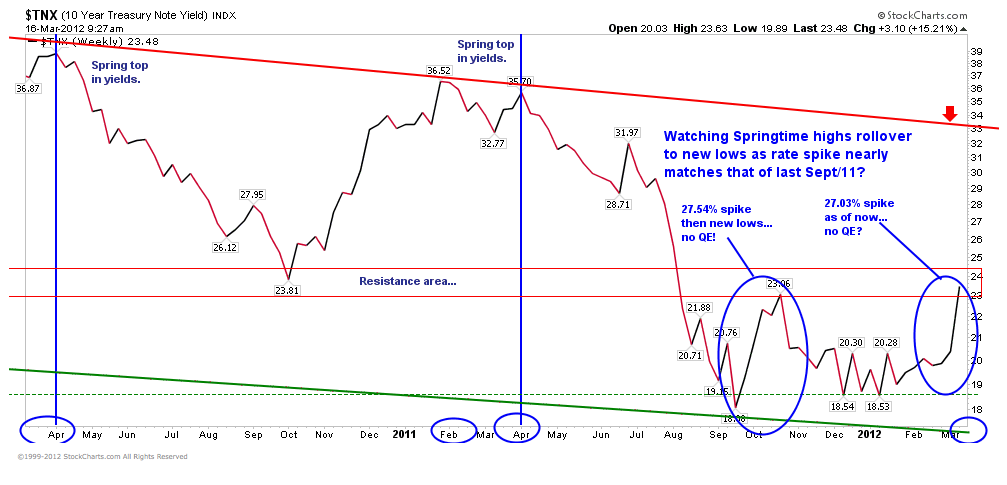
North American bond yields have broken higher over the past couple of weeks. Some suggest bond traders have been selling, disappointed that last week, at the March meeting, the Fed did not indicate another round of bond buying to follow when Operation Twist ends this June. The caveat there is that although the Fed says it has been using QE’s to buy bonds to lower rates for borrowers, in fact (as we can see in the chart of the US 10 year yield below) each time the Fed did implement a fresh phase of buying, yields actually spiked higher not lower as more QE increased hopes for economic growth and prospects for inflation. So the recent spike in yields on no new QE announcements seems counter to recent experience.  (Perhaps some are selling now in light of Bill Gross’s tweet last week to expect more QE announcements in April).  Or do markets believe the Fed’s assurances that the economy is looking stronger and does not need more QE?  Maybe.  (Although the Fed’s assurances on the economy have been dangerous and repeatedly wrong.)

The unseasonably warm winter has doubtless made some coincident economic data improve over the past few months (after seasonal adjustments that assume cold weather) and this has led some to believe that the US economy is on the rebound again. On this logic, believers may be shifting capital out of bonds and into equities. This may be, although buying volume into equities has been vapid at best.  The institutional preference to hold cash continues.

Indeed we saw a very similar counter-trend rally in rates in both the first quarter of 2010 and 2011 (see below) before falling to fresh lows. At this point, there is no way to tell how long the current bond sell-off will last, but if our analysis (and others we respect, like the ECRI) are correct in seeing evidence of a fresh economic downturn in the offing (once seasonal adjustments fall off) then we may well find the Spring of 2012 presents yet another buying opportunity for bonds while stocks set up for their next leg of disappointment.  Time will soon tell.

Source: Cory Venable, CMT, Venable Park Investment Counsel Inc.

Posted in Main Page | 2 Comments

So far, the bankers win

When Morgan Stanley (MS) said in January it had cut its “net exposure” to Italy by $3.4 billion, it didn’t tell investors that the nation paid that entire amount to the bank to exit a bet on interest rates.

Italy, the second-most indebted nation in the European Union, paid the money to unwind derivative contracts from the 1990s that had backfired, said a person with direct knowledge of the Treasury’s payment. It was cheaper for Italy to cancel the transactions rather than to renew, said the person, who declined to be identified because the terms were private.

The fact is that politicians have been fools and worse in their dealings with the banks. They literally sold the public trust to the highest lender. The banks have been sharks–it is their DNA. They never have been trustworthy advisors and yet all over the world they were handed the keys to the city while insanely rewarded and admired for their trickery. The taxpayers/voters/consumers have been complacent because they didn’t really want to know how they were getting away with more by paying less and piling into debt. The blame is on all sides here, and yet no one wants to accept their lumps.

Now after the inevitable blow up has finally hit, the politicians have been fixated on covering up their mistakes while the banks have been focused on making sure that they do not admit the losses they incurred by making bad bets. Some individual borrowers have escaped debt through default and bankruptcy, but even then we fellow taxpayers are left holding the bag for the debt because governments keep back stopping and making banks whole. The perfect fraud. Except that it is now killing the world economy. Here is the direct link.

Posted in Main Page | 1 Comment

When will we the taxpayers finally force the game to end?

The $25 billion mortgage settlement between lenders and state attorneys general won’t help nearly as many people as its touted to, Neil Barofsky, the former Special US Treasury Department Inspector General for the Troubled Asset Relief Program (TARP), tells Bloomberg Law’s Lee Pacchia. He’s joined by Matthew Stoller, a fellow at the Roosevelt Insitute, who says the government and banks delayed filing details of the settlement to give investors less time to challenge the deal in court. Here is the direct link.

Posted in Main Page | Leave a comment