
Good read on the math of the brokerage business

For those who are unaware of the math of broker “books”, this article is an enlightening read. The piece is specifically about trends at Merrill Lynch, but the overall comments are applicable to most investment brokerage firms today. Frustrated by huge volatility, and cumulative losses, retail clients have been pulling assets out of equity funds for the past 5 years. Equity allocations pay the highest fees and commissions to the brokers. Now that securitization, stealing re-hypothecating client assets and wildly leveraged proprietary trading have all become more scrutinized by regulators, the brokerage business is feeling the strain of lower fees. See: Broker Departures accelerate at Merrill Lynch.

All is not well in the land of mainstream financial advice sales. Although brokers who move a big book of clients can still barter some nice upfront bonuses for themselves. Clients, on the other hand, have not been faring well for at least 13 years since the secular bear began. But why let a little thing like harmful outcomes to clients hinder one’s business model?

Posted in Main Page | 1 Comment

Nassim Taleb on foreseeable “black swans” for the US economy

“The only candidate I trust is Ron Paul”, says Nassim Taleb, “The Black Swan” author. He also shares what he fears will be the next “black swan” event for the U.S. economy. Here is the direct link.

Posted in Main Page | 5 Comments

M2 money velocity plunges most since 1959

Pimco’s Bill Gross tweets this afternoon that the Fed is contemplating an announcement next month of QE3. He cites no source or evidence other than the assertion that the Fed will be forced to keep buying bonds that no one else wants.  The VIX has plunged today perhaps on similar rumors.   This would likely prove highly incendiary of already inflated oil prices and particularly controversial announced within months of the next US Presidential election. Many, including UK Telegraph’s Ambrose Evans-Pritchard, have argued the Fed cannot roll out more QE this year for these very reasons.  See: Global liquidity peak spells trouble for late 2012.

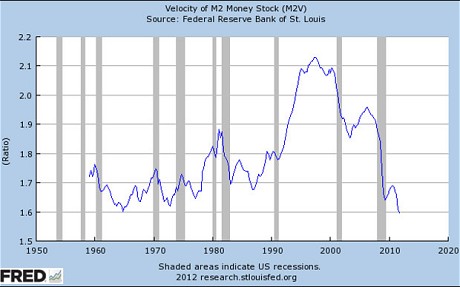
But as the Eurozone moves deeper into recession and Chinese exports plummet, perhaps this next chart is the fire under the Fed. US money supply, both M1 and M2 have flattened so far this year, even contracted slightly in recent weeks, while velocity has plunged, with the M2 gauge dropping below 1.6 last week for the first time since records began in 1959 as shown in the chart from the Federal Reserve Bank of St Louis below.  The manic swings of the dying credit bubble continue to plague and haunt the global economy.

Posted in Main Page | 5 Comments