Conditions least favorable for equities since 2007

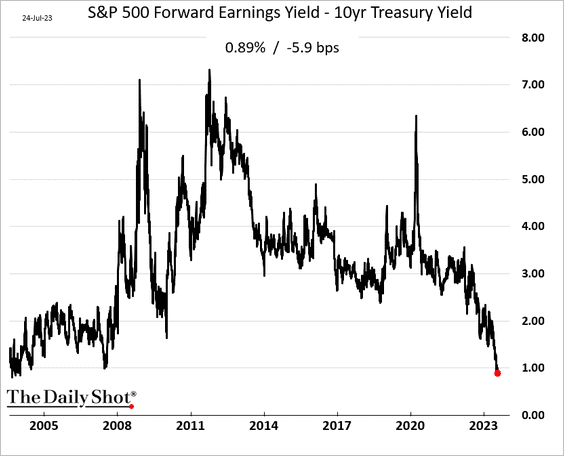
For those who pay attention to risk/reward dynamics, the prospective compensation for equity risk over Treasury bonds is today the lowest since the market peak in 2007-08 (S&P 500 forward earnings yield minus the ten-year Treasury yield).


David Rosenberg, founder and president of Rosenberg Research, talks about the lasting effects of Covid-19 stimulus checks on the American economy. Here is a direct video link.
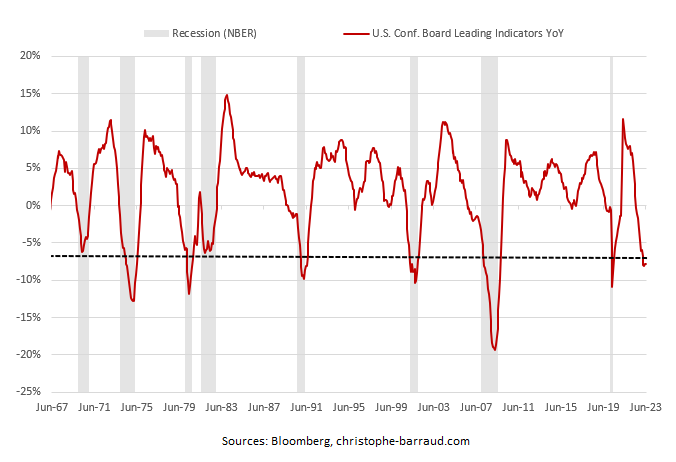
As David mentions in the clip above, the US Conference Board Leading Economic Indicator (LEI below in red since 1967) contracted year-over-year in June for the 15th consecutive month, signalling the onset of recession (grey bars) for the 9th time in 56 years. Historically, the average time from the LEI peak to the start of a recession has been 13 months.
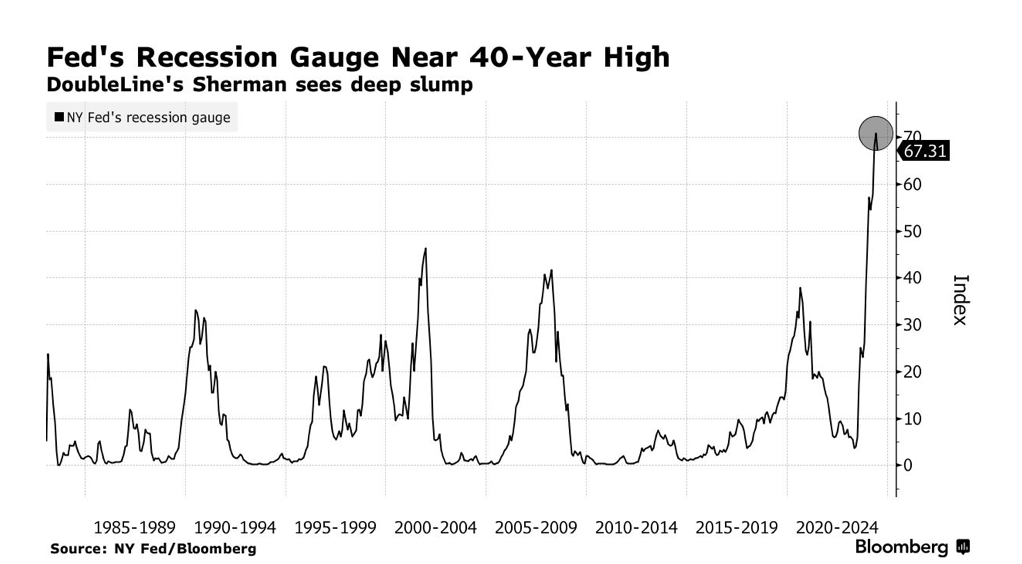
Similarly, the NY Fed’s recession probability gauge (shown below since 1980) has spiked to the highest in more than 40 years.
DoubleLine Capital’s Jeffrey Sherman noted the case for Treasuries this week as follows:

“A multitude of economic indicators we look at are flashing either warning or recessionary signals,” said Sherman, deputy chief investment officer at asset manager DoubleLine, in an interview. “By the time they cut, it will be 100 basis points.”

Ten-year US yields are 3.9%, having dipped after breaking above 4% several times in the past year as markets wrestle with when global central banks will end the steepest rate-tightening cycle in decades. Short-dated yields are still much higher, an inversion that historically has signaled recession, and Sherman is not taking that lightly.

…”The bond market is telling the Fed that they’ve overtightened and they will have to cut rates,” said Sherman. “But the Fed will be a little late to cut, maybe in an emergency meeting. But the idea that the Fed is going to cut 25 or 50 basis points and that’s going to solve everything isn’t going to be the case.”

Posted in Main Page | Comments Off on Conditions least favorable for equities since 2007

Canadian equity market: high capital risk amid falling earnings

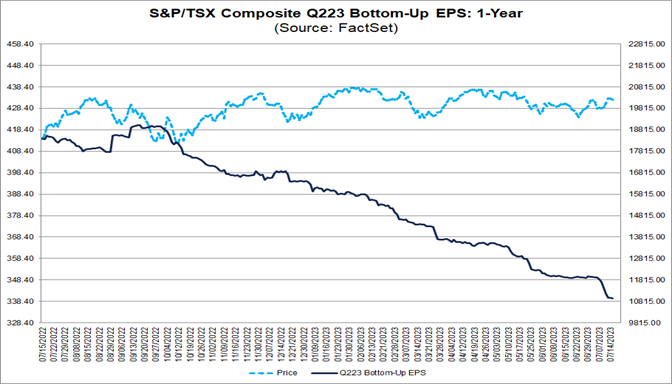
Canada’s TSX index has rebounded 6%, year-to-date, while its corporate earnings have contracted. As of today, the S&P/TSX Composite is expected to report a Q2 (year-over-year) earnings decline of -20.4%, compared to the estimated (year-over-year) earnings decline of -17.4% on June 30 and the estimated (year-over-year) earnings decline of -12.5% on March 31. See Canada Earnings Season Preview: Q2 2023:

If -20.4% is the actual decline for the quarter; it will mark the largest earnings decline reported by the index since Q3 2020. It will also mark the third straight quarter in which the index has reported a year-over-year decline in earnings.

…At the sector level, eight of the eleven sectors recorded a decline in estimated earnings during the quarter, led by the Materials (-11.7%), Energy (-10.2%), and Utilities (-8.7%) sectors.

…Looking ahead, analysts expect a decline in earnings of -7.9% in Q3 2023 but growth in earnings of 2.9% in Q4 2023. For all of CY 2023, analysts are predicting a decline in earnings of -9.6%.

Offering less for more: the TSX price is shown in blue below since July 2022, with one-year earnings per share estimates in black. Either earnings need to surprise to the upside over the next few quarters, or prices have more downside work to do. With cash alternatives able to earn 5% and recession odds at 100%, over-valued equities remain unattractive.

Posted in Main Page | Comments Off on Canadian equity market: high capital risk amid falling earnings

Moody’s: financial conditions pose growing threat to non-banks

A new report from Moody’s highlights the clear and present risks posed by “less regulated and transparent parts of the global financial system.” In particular, financial institutions carrying “more leverage, less liquidity and weak risk management will find it harder to navigate the cycle.” But wasn’t this time supposed to be different? See Shadow Banking Stress Lurks, Moody’s warns:

Tighter financial conditions make it tougher to generate strong returns and secure funding, the report noted.

These challenges are particularly acute for shadow banks that “adopted leverage-driven investment strategies or took on maturity risks when funding was inexpensive and abundant,” it said. Also, investment funds “face liquidity risks from redemption runs or margin calls triggered by falling asset values or weaker portfolio performance,” it said.

These issues could also spill over to the real economy, particularly in markets where shadow banks provide a larger share of funding to certain sectors, such as the small business and real estate sectors, which is the case in the U.S., the U.K., Korea and Brazil, Moody’s noted.

Posted in Main Page | Comments Off on Moody’s: financial conditions pose growing threat to non-banks