Canadian equity market: high capital risk amid falling earnings

Canada’s TSX index has rebounded 6%, year-to-date, while its corporate earnings have contracted. As of today, the S&P/TSX Composite is expected to report a Q2 (year-over-year) earnings decline of -20.4%, compared to the estimated (year-over-year) earnings decline of -17.4% on June 30 and the estimated (year-over-year) earnings decline of -12.5% on March 31. See Canada Earnings Season Preview: Q2 2023:

If -20.4% is the actual decline for the quarter; it will mark the largest earnings decline reported by the index since Q3 2020. It will also mark the third straight quarter in which the index has reported a year-over-year decline in earnings.

…At the sector level, eight of the eleven sectors recorded a decline in estimated earnings during the quarter, led by the Materials (-11.7%), Energy (-10.2%), and Utilities (-8.7%) sectors.

…Looking ahead, analysts expect a decline in earnings of -7.9% in Q3 2023 but growth in earnings of 2.9% in Q4 2023. For all of CY 2023, analysts are predicting a decline in earnings of -9.6%.

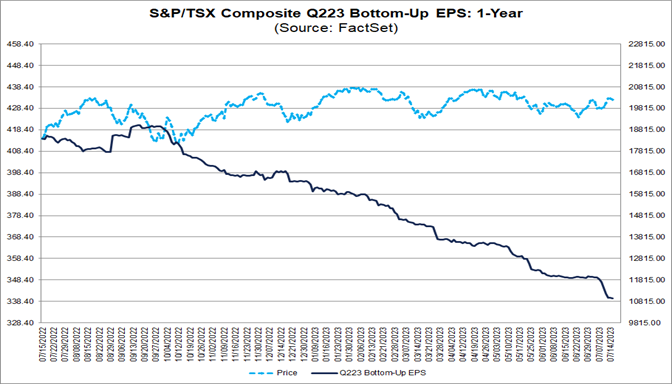
Offering less for more: the TSX price is shown in blue below since July 2022, with one-year earnings per share estimates in black. Either earnings need to surprise to the upside over the next few quarters, or prices have more downside work to do. With cash alternatives able to earn 5% and recession odds at 100%, over-valued equities remain unattractive.
Posted in Main Page | Comments Off on Canadian equity market: high capital risk amid falling earnings

Moody’s: financial conditions pose growing threat to non-banks

A new report from Moody’s highlights the clear and present risks posed by “less regulated and transparent parts of the global financial system.” In particular, financial institutions carrying “more leverage, less liquidity and weak risk management will find it harder to navigate the cycle.” But wasn’t this time supposed to be different? See Shadow Banking Stress Lurks, Moody’s warns:

Tighter financial conditions make it tougher to generate strong returns and secure funding, the report noted.

These challenges are particularly acute for shadow banks that “adopted leverage-driven investment strategies or took on maturity risks when funding was inexpensive and abundant,” it said. Also, investment funds “face liquidity risks from redemption runs or margin calls triggered by falling asset values or weaker portfolio performance,” it said.

These issues could also spill over to the real economy, particularly in markets where shadow banks provide a larger share of funding to certain sectors, such as the small business and real estate sectors, which is the case in the U.S., the U.K., Korea and Brazil, Moody’s noted.

Posted in Main Page | Comments Off on Moody’s: financial conditions pose growing threat to non-banks

Fat pitches and market cycles

Near-zero interest rates and trillions of asset buying by central banks (QE) enabled twelve years of increasingly deranged financial behaviour between 2011 and 2023. In the process, gambling became an international preoccupation, and investable assets were traded to uneconomically high valuations.

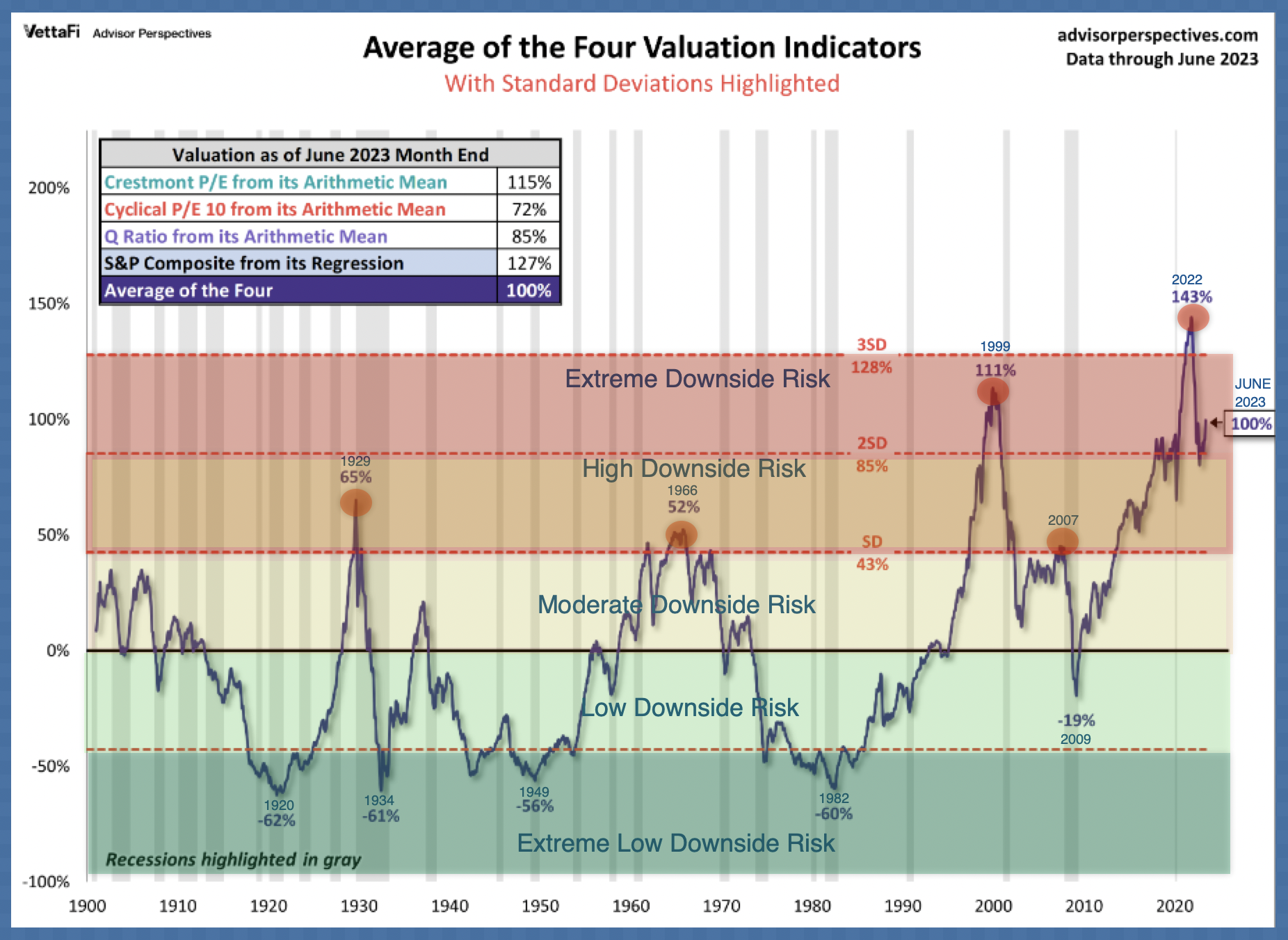
A global standout, at the market peak in 2022, the S&P 500 index (shown below since 1900) traded at 143% of a historical valuation mean composite (above three standard deviations) and surpassed the 111% top seen in the 2000 cycle and the 65% zenith reached in 1929. You can read more about the components here.

As in the 2007 and 2000 cycle tops, the US and Canadian central banks are now holding base rates in the banking system at around 5%. Different this time, they are contracting liquidity even more by rolling billions off their balance sheets (QT) monthly.

While mean reversion began in 2022, so far, equity valuations remain 100% (more than two standard deviations) above the historical mean and still within the extreme capital risk zone (red band above)—don’t take it from me; look at the chart with your own eyes. While the pandemic-inspired freefall in March 2020 was dramatic, it was too short and shallow to crush speculative mania and restore longer-term investment prospects.

From past valuation extremes, normalized interest rates sparked protracted market loss cycles that finally resulted in buying opportunities with income yields above 8% and capital risk low/extremely low on the historical scale (yellow and green bands above).

To repeat: it’s not just that avoiding bubbles and buying near cycle lows locks in rich-income yields for years after that; it also dramatically reduces the likelihood of capital losses and years of gut-grind trying to recover.

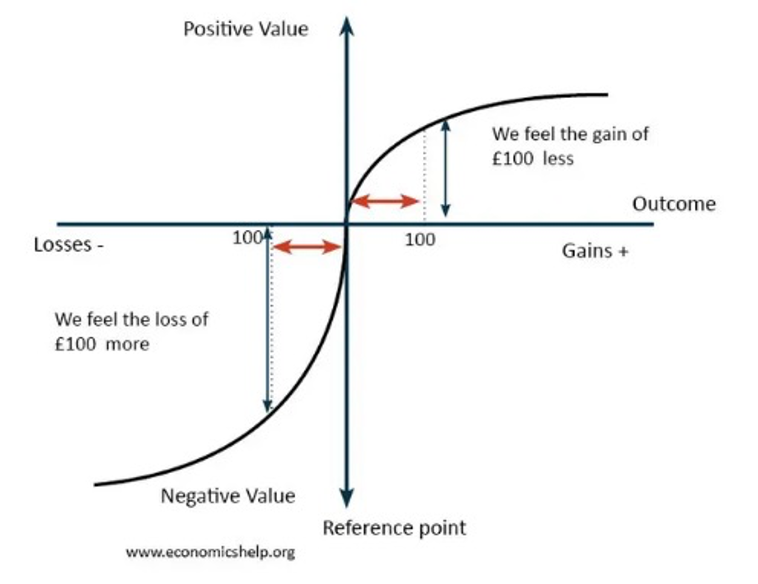
It’s essential to realize that psychological studies and life experience confirm we humans feel the pain of loss much more acutely than the joy of a fleeting gain. Most of us will bail after extended losses and never make them back.

Buying extremely-overvalued assets is too expensive in every way. Fat pitches take time to materialize, but not waiting for them makes no sense.

Posted in Main Page | Comments Off on Fat pitches and market cycles