
Higher debt costs are economic death by a thousand cuts

Fed minutes on Wednesday telegraphed that voting members plan another 25 bps rate hike this month and 25 more by November. Market implied rates are shown below in blue versus expectations last week (pre-minutes) in orange. While rate cuts are expected to follow from December 2023 through September 2024, the magnitude of easing anticipated is significantly less than the 500 bps delivered in response to the 2001 and 2008 recessions.
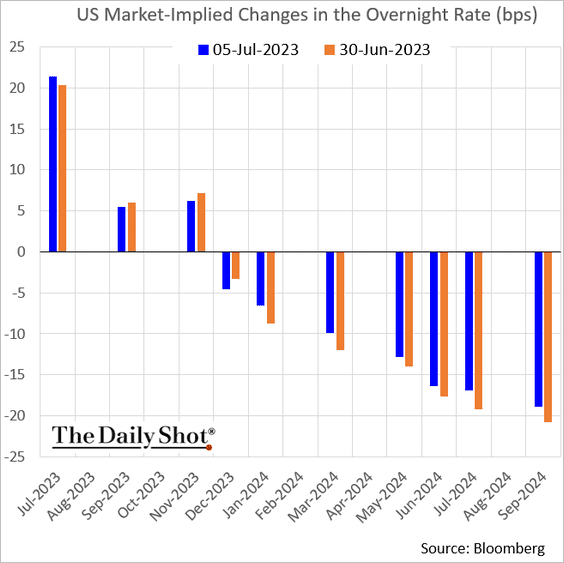
But conditioned by two decades of extreme monetary interventions, corporate debt and equity markets have, so far, mostly whistled past the prospect of higher rates for longer.

Amid record indebtedness., most are banking that a return to zero-rate policies will rescue them again in the not-too-distant future. While rate cuts are the base case through 2024, higher for longer is too–and that’s not priced in. See Higher for longer rates are a death threat. Investors don’t want to hear it yet:

There is an old joke: An optimist jumps from the roof and shouts, “so far, so good!” when passing the first-floor window. Corporate-debt markets are at risk of a similar delusion, particularly where private equity is involved.

Companies will find it expensive to refinance debts they took on during a decade of ultralow interest rates, perhaps more so than expected.

Issuance has now fallen for junk bonds, Dealogic figures show, but not for leveraged loans, which have floating rates and are traditionally the more popular instrument for private-equity buyouts. This is another sign that companies are waiting for rates to fall again before issuing more fixed-rate paper.

If central banks don’t oblige, the extra leverage will weigh. This is particularly true of junk-rated private firms, whose bonds tend to be riskier than those of listed corporations according to classic measures of sustainability such as interest cover and debt-to-equity. Often, private owners build up debt in order to extract more dividends.

Peter Boockvar, Bleakley Financial Group CIO, discussed the implications in the segment below. Here is a direct video link.

Posted in Main Page | Comments Off on Higher debt costs are economic death by a thousand cuts

When doves cry

The US Fed expects a “mild recession”, and plans to keep rates higher nonetheless. That resolve will be tested as the lagging unemployment rate moves higher through 2024.

Fed Minutes Show Concern Over Inflation, Job Market — DiMartino Booth with BNN Bloomberg. Here is a direct video link.
Posted in Main Page | Comments Off on When doves cry

Insolvency bull market

Insolvency trustees are the financial undertakers. They endured a bear market when easy credit enabled extend and pretend habits for the masses. Now the undertakers are entering a boom time as their phones “ring off the hook.”

Hoyes, Michalos published Canadian stats through the end of May and included this chart.
Other trustee firms are also feeling the love.

Bryan Gelman, president of Albert Gelman Inc., joins BNN Bloomberg to give his perspective on rising business insolvencies in Canada. He says the rate of insolvencies he is seeing at his firm is the most in 20 years. Here is a direct video link.

As Charles St-Arnaud, chief economist with Alberta Central, explained on BNN this week, it’s early days in this trend as insolvencies tend to peak 12 months after the start of a recession. See Insolvencies on the rise amid interest rate squeeze: Former Bank of Canada economist:

“What’s starting to be concerning is the trend; Insolvencies are very much a lagging indicator of the economic cycle. Usually, they tend to peak 12 months after the start of a recession. We still haven’t started a recession. The question is, when are they going to peak, and how bad will it be?”

While Canadian financial shares are off an average of 17% since peaking in February 2022, it’s important to understand that a recession-style default cycle is not yet priced in. CIBC Asset Management Portfolio Manager Natalie Taylor explained this month:

The biggest source of earnings variability for banks during a recession is the increase in credit costs, Taylor said, which can spike to two to three times the current levels.

Previous downturns have led to an average decline of 15% to 20% in bank earnings, she said, compared to the mid-single-digit decline embedded in consensus estimates.

With financial shares making up more than 30% of Canada’s TSX stock index, the downside for Canadian equity portfolios is more significant than most appreciate.

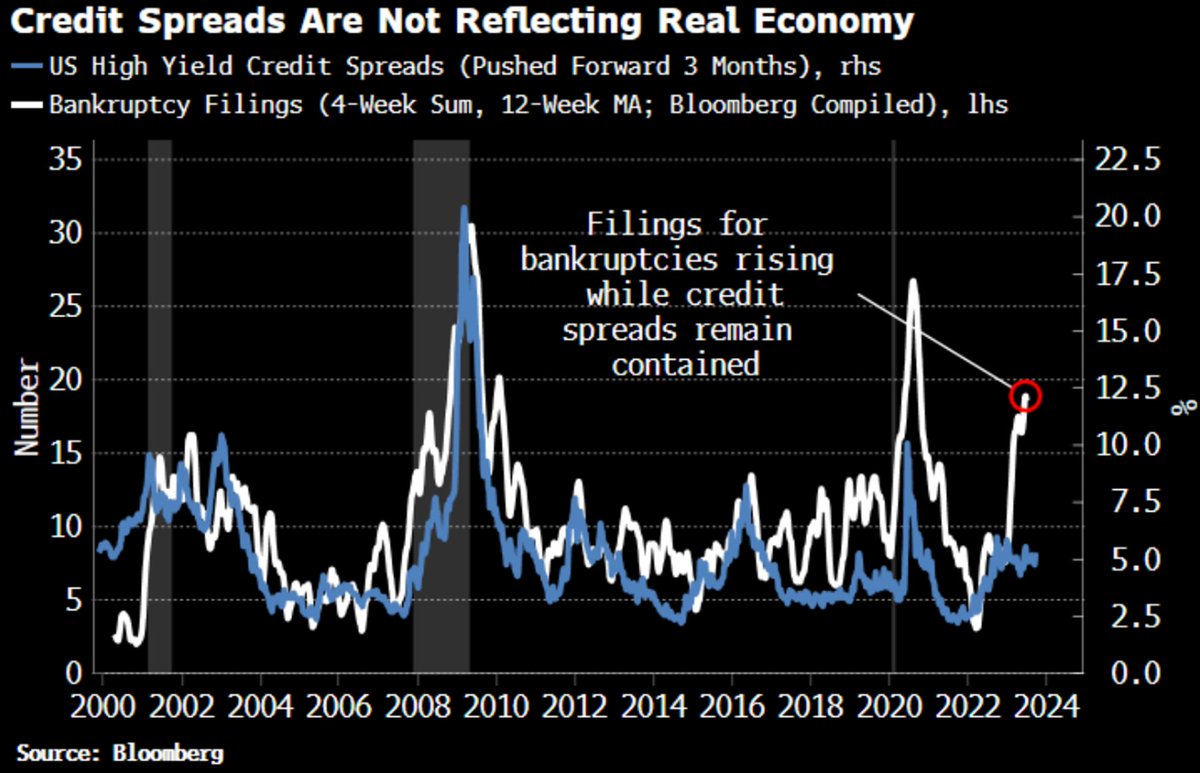
Small business optimism is the lowest since 2008, but distress is also evident in publicly traded companies. By the end of May, there were 286 public US company bankruptcy filings in 2023 (white line below since 2000)–the worst first five months since 2010 (as lagging bankruptcies were peaking after the 2008-09 recession).

As with bank shares, the unfolding credit crunch is not yet priced in. Credit spreads for higher-risk debt remain too low (blue line below) and are destined to catch up with insolvency trends in the months ahead (junk bond prices have further falling to do).

Posted in Main Page | Comments Off on Insolvency bull market




