Canadian insolvency leaping

Pandemic-era debt deferrals, government handouts and easy credit all worked to kick insolvency problems down the road. Now many are out of extend and pretend options.

Doug Hoyes, co-founder of Hoyes, Michalos & Associates, joins BNN Bloomberg to discuss the record number of consumer proposals in Canada. He says that the upward trend in insolvency is a continuation from before the pandemic and COVID-19 related debts only exacerbate the problem. Here is a direct video link.

See Consumer Insolvency Update, March 2023:

Canada-wide volumes were up 36.2% year-over-year and 27.6% higher than in February 2023. Year-over-year Ontario insolvencies increased by 31.6% and were 28.1% higher than in February.

The acceleration in consumer insolvencies is now reaching the higher end of our predicted overall growth of 20% to 30% for 2023. We would not be surprised to see insolvencies continue to grow at these, and possibly even higher rates in the coming months.

Homeowner insolvencies have now returned to pre-pandemic levels. Our Homeowners Bankruptcy Index was 3.9% in March 2023 and remains above 2022 levels.
Posted in Main Page | Comments Off on Canadian insolvency leaping

The loudest, least-skilled financial influencers are most followed

A paper from the Swiss Finance Institute‘s working paper series tracked data from more than 29,000 finfluencers on financial social media site StockTwits and came to some predictable conclusions. Those with the least skill tend to be the most followed. The democratization of finance? Not so much; see, Investors flock to loudest, least skilled voices on social media, finds research:

“Social media has gained great importance in recent years for sharing and acquiring information,” the paper stated.

“An important question is whether competition among users of social media platforms is such that followers can easily identify skilled […] finfluencers and drive out unskilled finfluencers from the market for social information. We find that the answer is no.”

The researchers — from the University of California, Berkeley, Rice University and the University of Lausanne — found that finfluencers who provided the worst advice were the most active and had the greatest following.

…skill was “effectively ignored” when it came to influence. Skilled finfluencers were less active and also tended to take more negative positions. The anti-skilled most often created overly optimistic beliefs.

“Surprisingly, unskilled and anti-skilled finfluencers have more followers, more activity, and more influence on retail trading than skilled finfluencers,” the paper said.

Now add that even those with the education and experience to be actual experts most often work for firms that sell long-always investment products and portfolios. Hence, why so few offer valuable financial insight and management services. And the few who do tend not to attract the masses. Word.

Posted in Main Page | Comments Off on The loudest, least-skilled financial influencers are most followed

Contracting credit leads economy and equities lower

Eyes on the recessionary bear prize. Valuable investment opportunities are in the making.

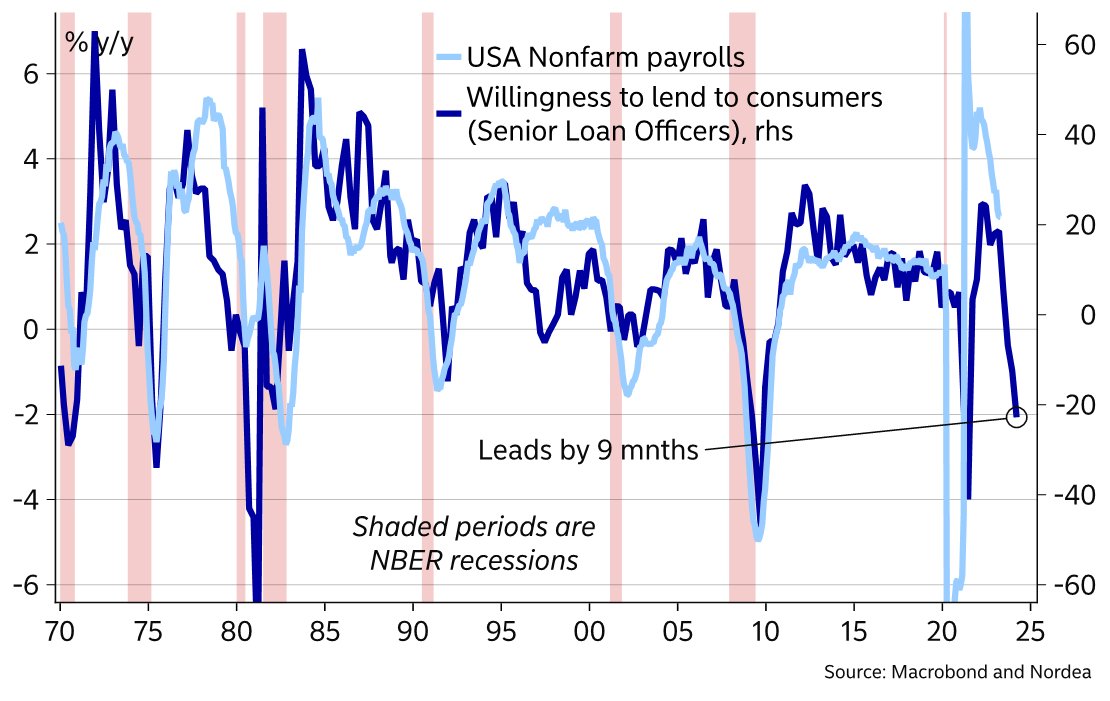
Peter Boockvar, Bleakley Financial Group CIO, joins ‘Squawk Box’ to discuss the results from the Fed’s quarterly Senior Loan Officer Opinion Survey, and why a recession is likely unavoidable. Here is a direct video link.

The chart below shows the Senior Loan Officers Survey (willingness t0 lend to consumers in dark blue) versus US nonfarm payrolls (light blue) and recessions (in pink) since 1970.

Next, we see that the ISM purchasing manager’s index (in yellow below since 1999 courtesy of ISABELNET.com) is leading corporate earnings (blue below) lower over at least the next 6 months.

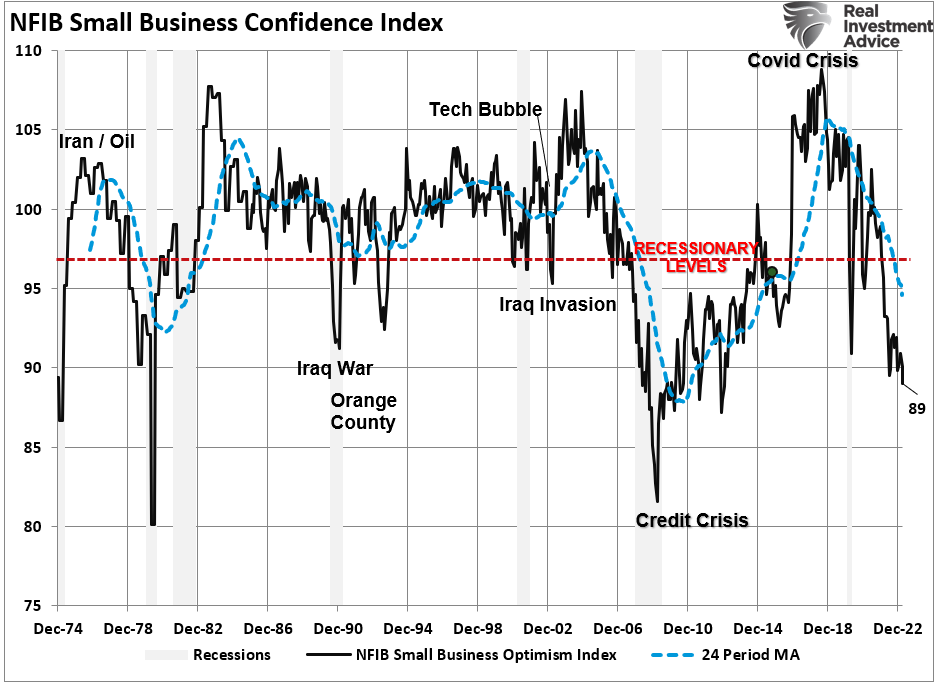
The NFIB Small Business Confidence Index now lower than during the pandemic shutdown, is at levels seen during past recessions (below since 1974 via Lance Roberts).

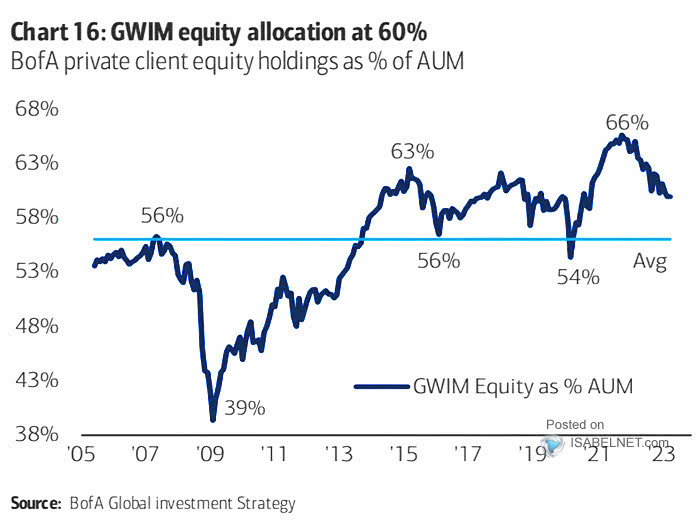
Lastly, we have the allocation to equities in retail portfolios (below since 2005 ). Down from the peak in 2022, but at 60%, still well above the 40% range typical of bear market bottoms. Most are still heavily risk-exposed, heading into a recessionary bear market. This is goin’ leave a mark for years to come.

Posted in Main Page | Comments Off on Contracting credit leads economy and equities lower