Blocked exits intensify the urge to get out

After the 2008 financial crisis, more than a decade of zero-interest-rate policies drove an explosion in private credit products and funds that were initially marketed to institutions and pensions under the oxymoron of safe ‘high-yield’.

Then, from March 2022 to May 2023, a record succession of central bank rate hikes took the US Fed rate from .25 to 5.25% in 14 months.

In the liquidity crunch that followed, stock prices dove, credit markets froze, and real estate entered an ongoing mean reversion. Needing cash, private funds shifted their marketing focus to retail investors as the next pool of necessary greater fools. It worked for a while.

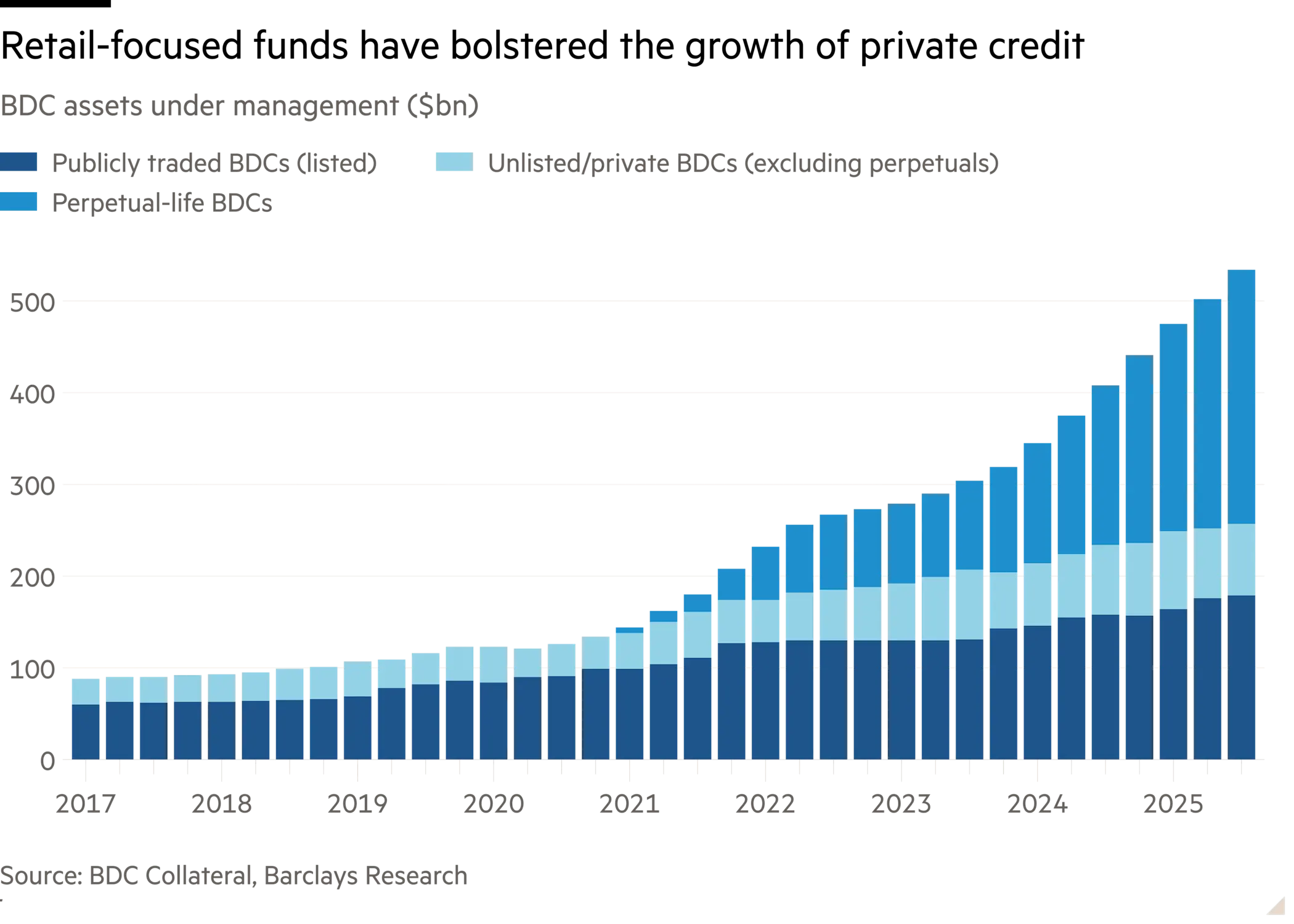
Private credit vehicles, known as semi-liquid funds, were an engine of growth for giant private investment firms, including Blackstone, Ares Management and Blue Owl, providing lucrative management fees and helping quadruple assets in BDCs [Business Development Companies] since 2021 (charted below).See, Investors ditch private credit funds on rising worries over bad loans:
Many affluent retail investors were drawn to the space by the high dividends on offer, with annualised total returns eclipsing 8 per cent over the past decade, according to S&P Global. The recent cuts as well as asset sales at some funds “reignited credit-cycle fears” across private credit, said Paul Johnson, an analyst at KBW.

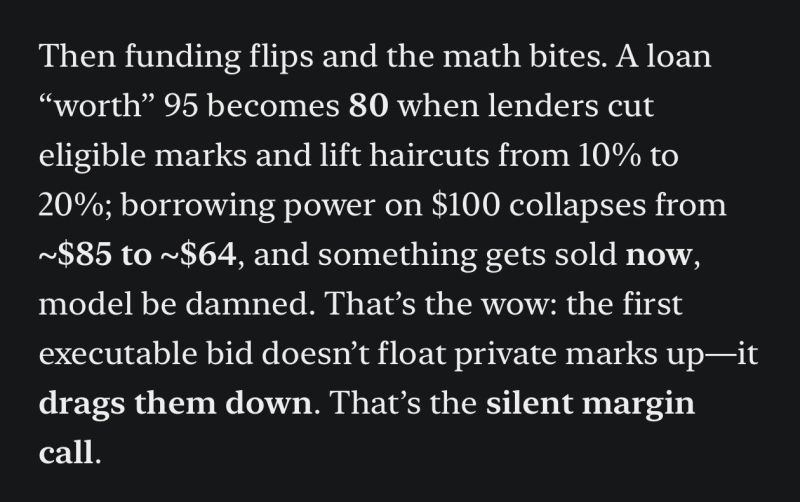
Fast forward to 2025, and investors began trying to exit private credit funds as they took losses on bad loans, and concerns intensified that AI would wreak havoc on the software companies they had financed. In response, funds have increasingly gated withdrawals and income distributions. As usual, blocking exits intensifies panic and increases the urge to get out.

Once more, investors are learning that there is no such thing as a free lunch or safe high yields. While would-be-sellers swamp willing buyers, asset prices are headed lower. The clips below discuss some of the contagion risks.

Dan Rasmussen, Verdad Capital founder, joins ‘The Exchange’ to discuss the state of the private credit market. Here is a direct video link.

“This will be a shakeout. I don’t think it is going to be short-term,” Marc Rowan, CEO and co-founder of Apollo Global Management, says during a discussion with Bloomberg News Editor-in-Chief John Micklethwait at Bloomberg Invest. Here is a direct video link.

Posted in Main Page | Comments Off on Blocked exits intensify the urge to get out

Shocks are part of life; sentiment coming into them matters

Macro shocks are a constant throughout time. The market impact is often dramatic in the short-term. Longer-term, outcomes vary depending on the level of optimism that was priced in when the shock hits.

Coming into 2026, most asset markets were exhibiting excessive optimism -pricing the best of all possible outcomes. Just one example: the S&P 500 came into the year trading at 28x its trailing 4Q 2025 earnings — among the top 4 most euphoric episodes since 1900 (shown below, courtesy of B of A). Historically, periods of sharp mean reversion have always followed. Sentiment tends to be contagious.

Other global markets have been less optimistic than US large cap stocks, but in comparison to delirious, less crazy can look relatively better, and still be irrational.

Canada’s TSX index has a very small tech sector and yet, the ‘risk-on’ Canadian stock market leapt with tech-soaked US markets into 2026.  The NASDAQ (below in red since 2024) peaked in October 2025, while the TSX (in black) rose into January. Both are selling off today, and although fossil fuels are up sharply, the energy-heavy TSX is down more than broader US markets.

While the US dollar is up sharply against the basket of global trading partners, it’s weaker versus Canada’s loonie. The thinking is that higher oil prices may keep the Bank of Canada from further policy easing.  It’s a question of how deeply Canada’s economy and stock prices contract. With Canada’s housing market now in its 4th year of mean reversion, the Bank of Canada’s resolve to hold is still to be tested.

Periods of rapid leverage expansion often appear like progress until liquidity tightens. Like recent years, in the mid-2000s, structured credit markets grew rapidly outside traditional banking channels, supported by reckless lending and wilfully blind underwriting assumptions. Stress began in narrow segments before spreading more broadly in 2007–2010.  The NASDAQ (below in red) peaked in October 2007, while the commodity-centric TSX held up to June 2008. Both then collapsed in unison as risk-on markets imploded through March 2009.

In the last tech buble, the NASDAQ peaked in March 2000 and the TSX in August 2000; again both then tanked together into the fall of 2002.

None of us can know what happens next in world events. But that’s always true. What’s different this time is that capital risk has rarely been higher, and after a period of record over-valuation, the masses have a painful payback period due.

Posted in Main Page | Comments Off on Shocks are part of life; sentiment coming into them matters

Private Equity’s Dry Spell Worse Than 2008 Crisis

Private equity returned fewer profits to investors for a fourth straight year as the industry sat on $3.8 trillion of unsold assets and struggled to raise money for new funds.

Distributions as a percentage of net asset value remained at 14% last year — the second-lowest level since the depths of the 2008 financial crisis, according to a new report from Bain & Co. And the duration of the rut is even more severe than what private equity firms faced then. Here is a direct video link.

Also see, Private Credit Fund Is Selling $477 Million of Assets at 94% Value as Industry Worries Continue.

Posted in Main Page | Comments Off on Private Equity’s Dry Spell Worse Than 2008 Crisis