
Operation ‘break things’ to continue

Hiking the US Fed funds rate a further .75 yesterday, now 3 to 3.25% (from 0 to .25% in March), Chair Powell acknowledged that unemployment will rise, adding: Nonetheless, we’re committed to getting inflation back down to 2%.” Powell reiterated that his board plans to raise US base rates a further 1.25% (4.25 to 4.5%) by year-end.

The Fed’s GDP growth forecast was lowered to just .2% in 2022 and 1.2% in 2023 and well below the 2.5% US GDP growth capacity estimate–a whopping slack in resource utilization. This is the closest a central bank will ever come to acknowledging an incoming recession. 

The US dollar index (DXY) leapt 1% to a 20-year high above $111, and stock and commodity markets slumped, with every S&P 500 sector lower on the day.

The US 2 and 30-year Treasury yield curve inverted 58bps, the most since 2000, with short-term yields rising and long-term rates rolling over on the weakening economic outlook.

Word to the wise: historically, equity markets have not bottomed until after the Fed abandons its tightening plans and slashes rates again for several months, dropping short yields and re-steepening the yield curve.

If December 2022 ends this hiking cycle, followed by loosening efforts again in the first half of 2023, it could suggest a stock market bottom sometime in late 2023. Only time will tell.

The last six months of falling asset prices have been about rising interest rates (lower discounted cash flows), negative real wages and slowing consumption (sales). The following six will likely be focused on negative earnings trends and financial contagion, with credit strain and defaults spreading through highly levered corporations and households globally.

As central banks now break the asset bubbles they helped to form, the return of principal is back in vogue, and the yields for cash and the most secure bonds–the highest since 2007–offer an attractive harbour from capital implosion. This is when North American government bonds typically outperform.
Posted in Main Page | Comments Off on Operation ‘break things’ to continue

The recession is already here

Worthwhile overview of many key economic trends now in motion…

Danielle DiMartino Booth of Quill Intelligence believes it’s obvious that a recession is already upon us, and it might only get worse from here. She joins Jay to discuss inflation, supply constraints, the housing market and, perhaps most importantly, how to protect your wealth in our current economic environment. Here is a direct video link.

A note regarding the discussion about investing in companies with high free cash flow: high free cash flow and low debt significantly increase the likelihood that companies (and households) make it through periods of recession and other adversity–essential. It does not mean asset prices will not lose value during bear markets and take years to recover your entry price (even if the companies survive long-term).

Before buying any investment, it is essential to consider the years it could take to recoup our principal and ensure that it works within our overall investment plan and risk tolerance. Individual bonds (not funds or ETFs) have prescribed maturity dates and semi-annual interest payments. There are zero assurances with things like real estate, commodities, cryptocurrencies, and equities. Eyes wide open.


Posted in Main Page | Comments Off on The recession is already here

2022: three quarters of pain and counting

As we start the third week of September, with the US Fed’s much-telegraphed rate hike on Wednesday (+.75 with some 30% betting odds of a full percent!), markets are peaked. Bitcoin (-71%) continues to lead the crypto Ponzi down the back side of heartbreak hill.

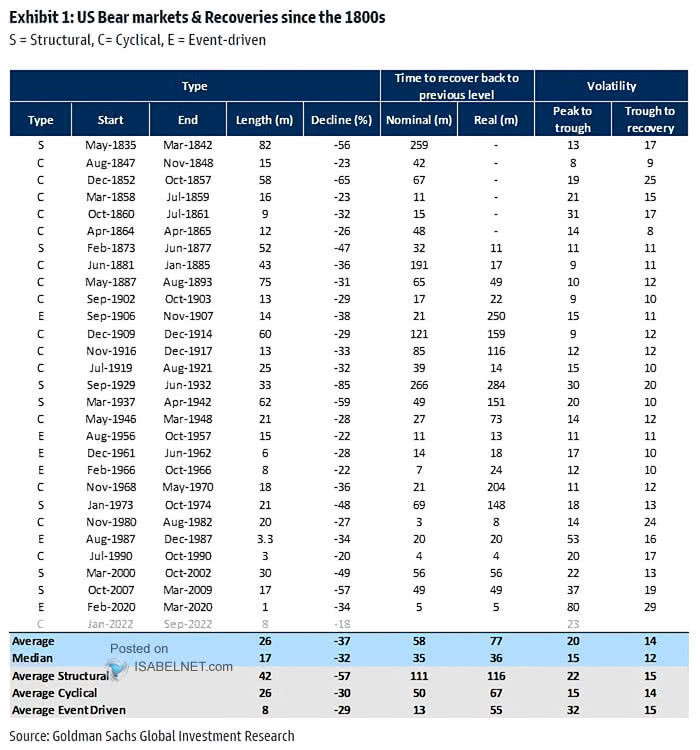
So far, the S&P 500 -20%, the Nasdaq -29%, and the Russell 2000 -27% are about halfway through drops seen during previous recessionary bear markets (most recently 2008, 2000, 1980-1982 and 1973-74, as shown below courtesy of IsabelNet.com). To date, Canada’s TSX -13% is just a quarter through the price correction experienced during those precedents.
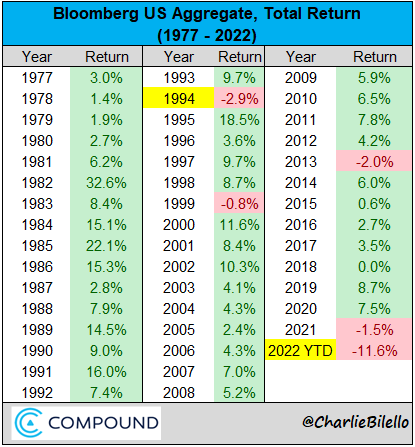
Different this time, the aggregate bond index -13.1% over the past 21 months (the US below courtesy of Charlie Bilello), has clocked its worst total return since 1970.
It is typical for lower-grade corporate credit/bonds to lose value with falling equity markets and rising defaults. On the upside, investment grade bonds are one of the rare assets that have historically rebounded near the end of central bank tightening cycles and into the depths of recessions, with solid return years always following past losses (as shown above). Of course, bonds held through interim market declines are required to pay interest semi-annually and return principal (face value) on the stated maturity date. Equities offer no such assurances.

Cash reserves have been the most valuable portfolio buffer this year; unfortunately, as usual, most came into this downcycle with less than 5% cash.

The discussion below offers further insight into the inflation-driving and deflating monetary policy cycles and why investment-grade bonds remain a rarely valuable allocation port for retirement funds during recessionary storms.

This week I spoke with Dr. Lacy Hunt, executive vice president of Hoisington Asset Management and author of both “A Time to Be Rich” and “Dynamics of Forecasting: Financial Cycles, Theory and Techniques.” We discussed the consequences of the Federal Reserve’s actions, the impact of higher interest rates, and the durability of inflation. Here is a direct video link.

Posted in Main Page | Comments Off on 2022: three quarters of pain and counting





