
Desjardins: Canada the most debt sensitive economy in the world

Canada comes into this global downturn with a world-leading real estate bubble (property values accounting for some two-thirds of household net worth) and record-private debt levels at a whopping $7 trillion (households and businesses) in an economy tracking about $2.6 trillion in GDP.

A bursting debt bubble in a poorly diversified economy largely dependent on unsustainable demand for housing and fossil fuels leaves Canada among the most rate-sensitive economies in the world today.

Now, inflation-chasing central banks have ignited the greatest rate shock in at least four decades. Moreover, their hikes since March are only starting to move through the economy and will continue to do so over the next two years. A similar multi-quarter lag will apply once central banks move to loosen monetary conditions once more.

In the video segment below, bank analyst Jean hedges his recession call with the hope it will be shallow. I do, too, though I see little evidence to support the hope.

In any event, no historical precedents suggest that a shallow recession would mean shallow losses in asset markets. Indeed, in the 2000-2003 bear market, the US experienced a shallow recession while Canada avoided one altogether. Yet stock markets in both countries halved and took years to recover to previous cycle highs.

Fast forward to 2008, Canada experienced a much milder recession than in America (because our housing market was not yet in a bubble at that time). Still, stock markets in both countries halved, bottomed together in March 2009 and took years (of near-zero rates and trillions in central bank asset buying) to recover. Realism and capital defence are highly recommended.

Jimmy Jean, chief economist and strategist at Desjardins, joins BNN Bloomberg to react to the latest interest rate decision out of the Bank of Canada. He says that it will take 6-8 quarters to see the full effects of rising rates, but the impact on the jobs market will start to show soon. Here is a direct video link.
Posted in Main Page | Comments Off on Desjardins: Canada the most debt sensitive economy in the world

Soaring buck intensifies economic downturn

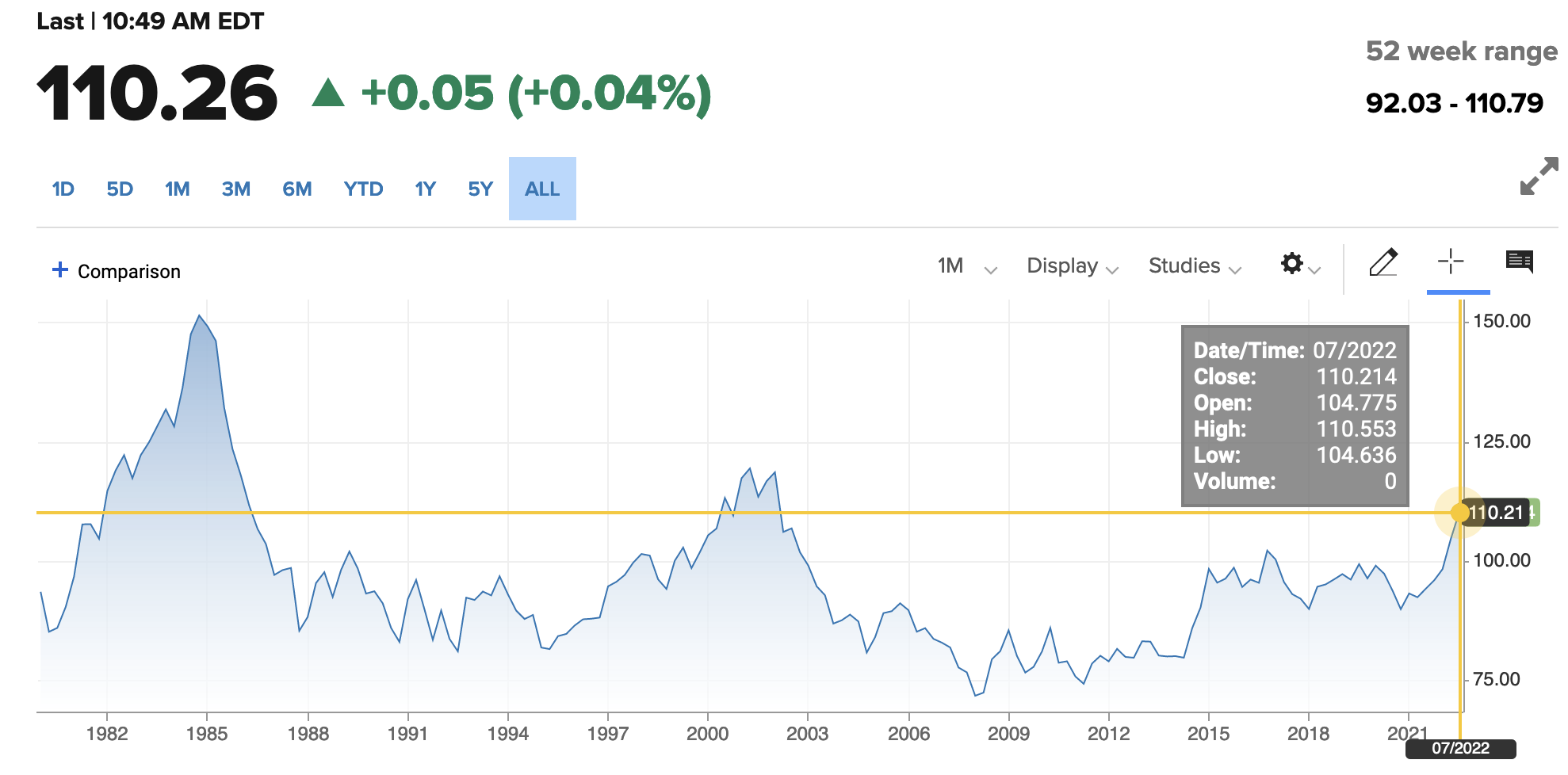
The USD Index (DXY shown below since 1980) above 110 this morning is a 20-year high not seen since April 2002.

The Euro (58% of the dollar index) is below par and at the lowest since July 2002, while the Japanese Yen (14%) is at the lowest since 1998, and the British Pound (12%) is at the lowest since 1985. The Canadian dollar (9%) at 1.3182 is the weakest against the greenback since October 2020.

Outside the dollar index, other major trading currencies are also weak. Today, the Chinese offshore yuan broke below the key 7 per dollar level last seen in July 2020. Several other Asian currencies (Malaysia and the Philippines) touched record lows today, and the Korean won hit a 13-year low.

The US dollar is the primary funding currency for global trade and financial markets, and spikes in its relative strength have historically coincided with instability and an earnings compression for US multinationals that garner some 40% of their revenues from foreign sales/currencies.

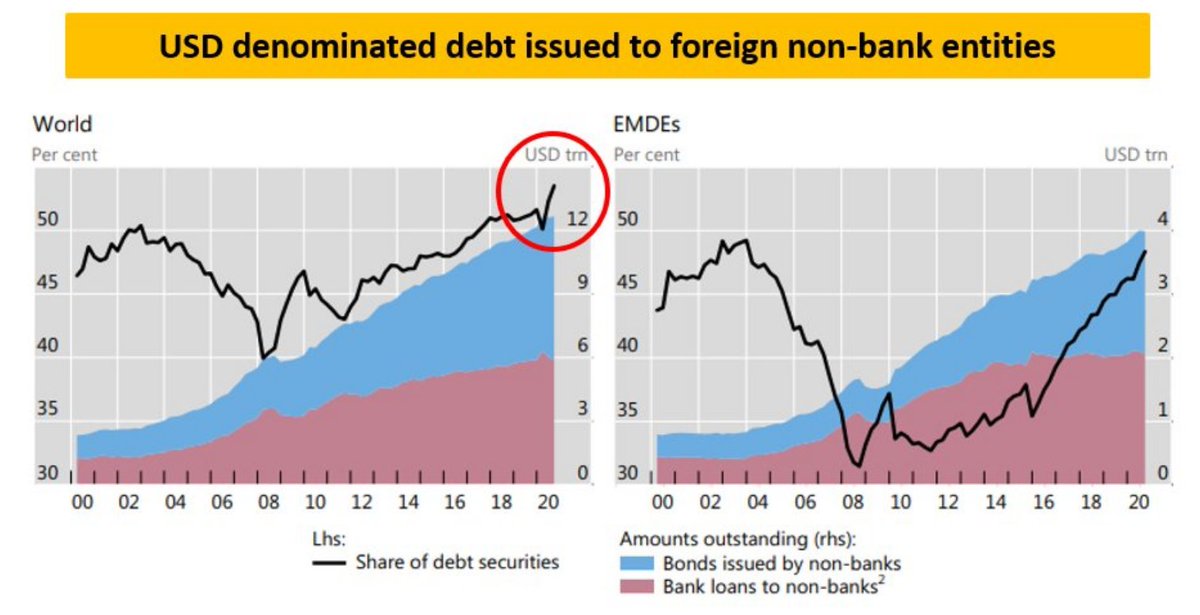
Dollar strength is disinflationary for US imports and inflationary for other economies dependent on commodity imports (nearly all priced in U$). Moreover, debt-servicing capacity for foreign borrowers of US-denominated debt drops as the dollar rises. As shown below, courtesy of macro analyst Alfonso Peccatiello, the level of USD-denominated debt globally is higher today than at any time in the last 22 years and near a 20-year high for emerging market/developing economies.

Economic downturns are self-propelling as they reduce spending and American import demand, sending fewer greenbacks into foreign coffers and intensifying the dollar cash crunch globally. Naturally, commodity demand and prices are already tanking along with shipping rates and supply bottlenecks.

A 16% increase in the dollar index from October 1996 to April 1998 led to debt defaults in Asia and Russia. The subsequent Long Term Capital Management (LTCM) implosion in September of 1998 prompted the Greenspan-led Fed to broker a deal to backstop financial intermediaries and markets. The ‘central bank put’ has persisted through a stream of increasingly extreme central bank interventions in the 24 years since.

Far from backstopping risk markets this time, though, central banks are reacting to the late-great inflation spike of 2020-2022 with the most aggressive monetary tightening efforts in 4o years.

As the Bank of Canada hiked its policy rate to 3.25% today–up 300 basis points since March–and the highest since 2008, the Canadian dollar and Canadian Treasury yields turned lower along with Canada’s economic outlook.

Recession and job losses are set to replace inflation as the dominant concern in 2023.

Posted in Main Page | Comments Off on Soaring buck intensifies economic downturn

Quantitative Tightening is supposed to step up 5.5x this month

Happy September!!

Starting now, the US Fed is to run off its balance sheet (reduce liquidity in the banking system via ‘Quantitative Tapering’) by $95 billion a month–double the amount they were supposed to have been withdrawing (QT) since the start of June.

In reality, though, rather than shrink its holdings by $45 billion a month for June, July and August, the Fed reduced by a total of $52 billion ($17 billion per month). So, this month, stepping up to $95 billion will not be doubling the QT rate to date but rather a 5.5x increase in the liquidity withdrawal rate.

Hedgeye analyst Josh Steiner makes some lucid observations about this in Still Feeling Bullish?:

So, as a reminder, the Fed has QT’d to the tune of $52B in total over the last 3 months (a ~60bps reduction in its securities holdings) and the S&P 500 is down ~4.1% over that timeframe. In the four months between now and year-end the Fed is supposed to QT by $380B, a roughly 450bps reduction in securities holdings.

No doubt, tightening resolve will eventually crumble with housing, commodity, stock and corporate debt prices. But, with the US midterm elections coming up on November 8 and consumer price inflation (lagging indicator) recently measuring at 40-year highs, inflation is the primary bogey now. Propping up asset prices is a distant and conflicting goal to that.

Posted in Main Page | Comments Off on Quantitative Tightening is supposed to step up 5.5x this month





