
Rapid rate change just starting to be felt

A key point regularly missed is that monetary policy moves at a multi-quarter lag through the economy. That means that the rapid rate hikes year to date have just started to be felt and will continue to slow spending and growth through 2023. This will be the case even if central banks stop hiking and ease again in the months ahead. The segment below elucidates further.

Stephanie Pomboy reacts to today’s latest data on retail sales, Fed rate hike outlook, jobs, credit conditions & inflation. In her words, it’s difficult to see anything other than stagflation reigning for the rest of the year. Here is a direct video link.

Consumer stress (measured as the increase in food, gas and mortgage rates) graphed below since 1972 (courtesy of The Daily Shot) has already seen a larger, faster increase than preceded the 2001 and 2008 recessions/market meltdowns.

While the stock market has begun the repricing process, as shown below since 1935 (courtesy of ISABELNET.com), it has historically not bottomed (yellow bands below) until the S&P 500’s trailing price to earnings valuation (PE) plus CPI inflation sum below 20.
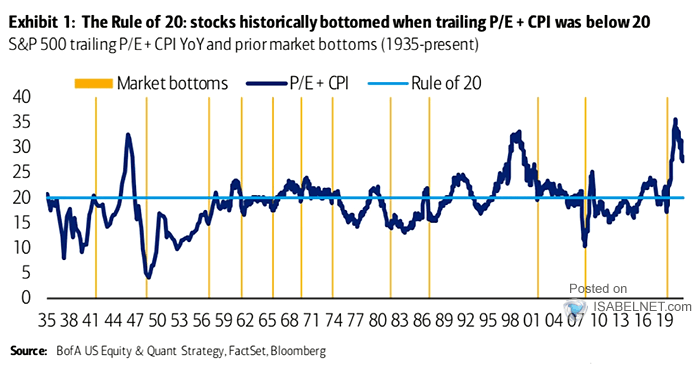
As of August 12, the S&P 12-month trailing PE was 22.75 (from 31.31 a year ago), with the latest CPI reading at 8.5% in July; the sum of the two remained above 30. This reading (based on trailing earnings) is doubtless understated because it assumes that record corporate earnings of the past year will continue despite higher input costs and a contracting economy–whistling past the graveyard indeed. S&P 500 earnings dropped an average of 30% during the past five profit recessions since 1989. As earnings mean revert, history assures that stock prices and valuations will eventually follow lower.


Posted in Main Page | Comments Off on Rapid rate change just starting to be felt

Recessions: best prepared for than ignored

Recessions are a regular resetting part of economic cycles measured as a multi-quarter decline in five key indicators: real gross domestic product (GDP), income, employment, manufacturing, and retail sales.

While recessions always bring down commodity prices and inflation, they are dreaded because they also reduce revenues, profits, employment, asset prices, and the ability to service debt.

While central banks (investment purveyors and politicians) infamously never see the “R” word coming, once financial conditions have been left too loose for too long, it is typical for tightening efforts to coincide with economic contraction. Downturns led by real estate (like now) have traditionally coincided with the deepest recessions and bear markets on record.

The Bank of Canada (BOC) hiked base rates a full percentage point in July–the largest one-time increase since 1998–now up ten-fold to 2.5% from .25% just five months ago. The U.S. central bank issued a second .75% hike even as U.S. data confirmed two back-to-back quarters of negative GDP growth in the first half of 2022—a reliable indicator of recession since 1947.

For three decades, the theory was that ultra-low interest rates helped borrowers to save on interest costs. In fact, low rates enabled the masses to go deeper into debt. Last year, BOC research acknowledged that low-interest rates inflated home prices and attracted capital to counter-productive financial speculation.

This month, Desjardins Securities Inc. joined Royal Bank to warn that Canadian homes could lose as much as a quarter of their value as market declines play out faster than anticipated. It bears noting that real estate prices have historically taken years to recover following major correction cycles.

Since 1900, oil price spikes have always held the seeds of economic demise as resulting financial strife spawns demand destruction and disinflation. From January 2021 to May 2022, the price of oil (WTIC) rose 110%, helping U.S. inflation jump from +1.4% to +9.1% by June (+8.1% in Canada). The last five times that US CPI rose above 5%, the economy ended up in a recession (demand contraction).

Unsurprisingly, the latest EIA data shows that U.S. gasoline consumption is 6% year-over-year (YoY) and 19% from prepandemic 2019 levels. Highway traffic volumes are –1.7% YoY, and U.S. passenger traffic is 93% of where it was preCOVID19 (Mobility data).

This morning, oil (WTIC) is trading -30% since March–below $87 a barrel– and back where it was in January before Russia invaded Ukraine; while economically sensitive “Dr. Copper” has fallen 28% (to the level it was in the spring of 2008 just before dropping 55% into October 2008 as the world economy contracted).

Semiconductors, found in all manner of manufactured goods, also offer leading insight into the demand cycle. Last week, Chinese chipmaker Semiconductor Manufacturing International Corporation said demand had slowed sharply from consumer electronics makers. The Taiwan Semiconductor Manufacturing Company expects an inventory correction that will last until late next year. This week, U.S. chipmakers (Intel, Nvidia and Micron) warned of a sudden demand downturn causing them to slash CAPEX plans despite the passing of a long-awaited law hoping to subsidize a massive leap in domestic chip manufacturing capacity.

Recessions are officially declared by backward-looking data months after they have started (and sometimes after they have ended). Still, it’s prudent to note that the real-time indicia of recession are today as pronounced as they have ever been.

While stocks and risk-seeking financial behaviours have revived since June, their endurance prospects from here are low. The masses are cash-light and debt-heavy with what savings they do have loaded into highly leveraged, over-valued assets. If you are one of those, it is not too late to take protective steps. We’ve certainly been forewarned.

Posted in Main Page | Comments Off on Recessions: best prepared for than ignored

Roubini: recession will be protracted and severe

Some key macro analyses are summarized well in this segment.

Nouriel Roubini, CEO of Roubini Macro Associates, discusses the outlook for the US economy, the path of inflation, and Federal Reserve policy on “Balance of Power.” Here is a direct video link.

Posted in Main Page | Comments Off on Roubini: recession will be protracted and severe



