2022: three quarters of pain and counting

As we start the third week of September, with the US Fed’s much-telegraphed rate hike on Wednesday (+.75 with some 30% betting odds of a full percent!), markets are peaked. Bitcoin (-71%) continues to lead the crypto Ponzi down the back side of heartbreak hill.

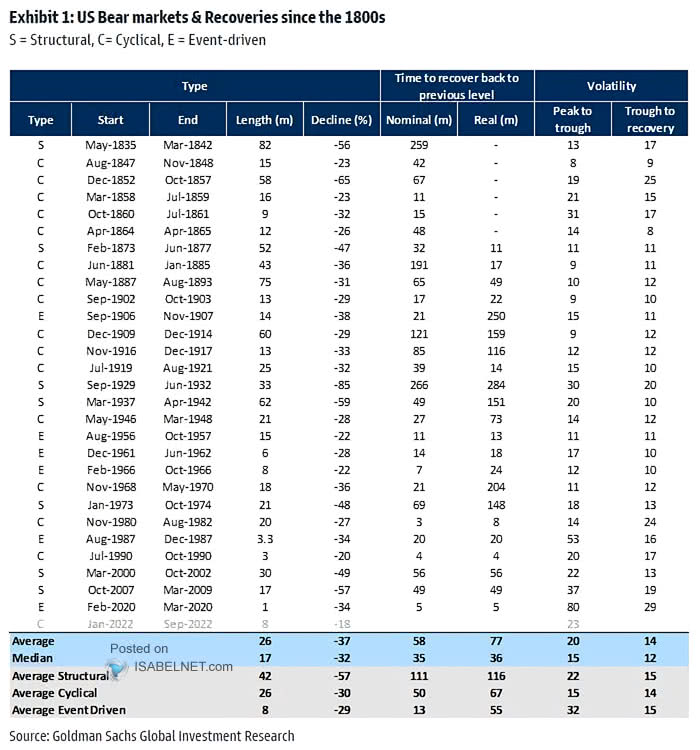
So far, the S&P 500 -20%, the Nasdaq -29%, and the Russell 2000 -27% are about halfway through drops seen during previous recessionary bear markets (most recently 2008, 2000, 1980-1982 and 1973-74, as shown below courtesy of IsabelNet.com). To date, Canada’s TSX -13% is just a quarter through the price correction experienced during those precedents.
Different this time, the aggregate bond index -13.1% over the past 21 months (the US below courtesy of Charlie Bilello), has clocked its worst total return since 1970.
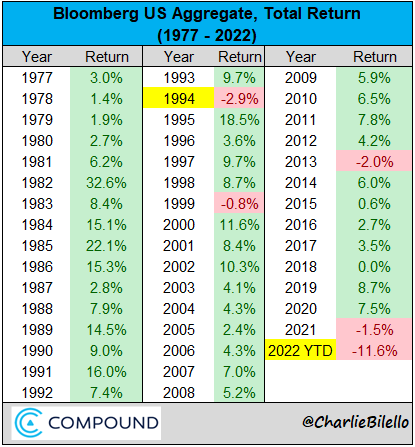
It is typical for lower-grade corporate credit/bonds to lose value with falling equity markets and rising defaults. On the upside, investment grade bonds are one of the rare assets that have historically rebounded near the end of central bank tightening cycles and into the depths of recessions, with solid return years always following past losses (as shown above). Of course, bonds held through interim market declines are required to pay interest semi-annually and return principal (face value) on the stated maturity date. Equities offer no such assurances.

Cash reserves have been the most valuable portfolio buffer this year; unfortunately, as usual, most came into this downcycle with less than 5% cash.

The discussion below offers further insight into the inflation-driving and deflating monetary policy cycles and why investment-grade bonds remain a rarely valuable allocation port for retirement funds during recessionary storms.

This week I spoke with Dr. Lacy Hunt, executive vice president of Hoisington Asset Management and author of both “A Time to Be Rich” and “Dynamics of Forecasting: Financial Cycles, Theory and Techniques.” We discussed the consequences of the Federal Reserve’s actions, the impact of higher interest rates, and the durability of inflation. Here is a direct video link.
Posted in Main Page | Comments Off on 2022: three quarters of pain and counting

Danielle’s biweekly market update

Danielle was a guest with Jim Goddard on Talk Digital Network, talking about recent developments in the world economy and markets. You can listen to an audio clip of the segment here.

Last night’s warning from global shipping bellwether FedEx that demand for freight has ‘significantly deteriorated’ highlights the major economic downturn underway. FedEx shares -22% today alone, are leading most other sectors as well as currencies lower (against the USD). See more at FedEx has the biggest drop in over 40 years.

Posted in Main Page | Comments Off on Danielle’s biweekly market update

$95 billion in monthly liquidity reduction to begin today

Starting today, the US Fed has pledged to run off its balance sheet (reduce liquidity in the banking system via ‘Quantitative Tapering’) by $95 billion a month–double the amount they were supposed to have been withdrawing (QT) since the start of June and about 5.5x the $17 billion per month they actually have withdrawn. We will soon discover whether they retain the resolve to execute amid plunging markets.

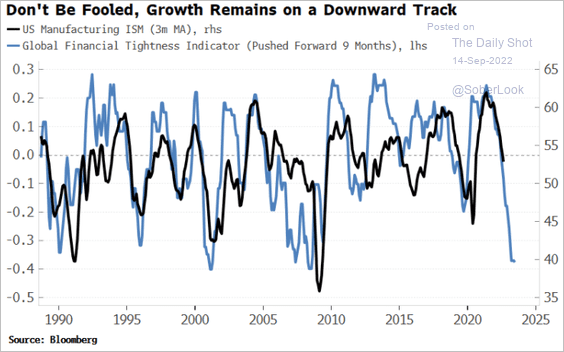
Historically, reducing liquidity is a negative for financial markets. Moreover, (shown in blue below since 1987, courtesy of The Daily Shot), it has also led economic downturns (US manufacturing ISM in black) by about nine months.


On top of QT, global central banks are following the US Fed in a rate hiking cycle that’s moving about three times faster than the ‘measured’ .25% increments typical since 1980.

Fed fund futures predict that US policy rates will move to 3%-3.25% next week and 4.25%-4.5% by early 2023 (up from 0%-.25% in March 2022!). By then, it’s feasible that the US will have reported its third and possibly fourth consecutive quarter of negative GDP growth.

Will confirmation of a US recession cause the Powell-led central bank to blink and pause its too-much–too-late tightening efforts? As today’s mounting layoffs turn into rising unemployment claims, which of the dual mandate–stable prices and full employment–will the Fed prioritize when push comes to shove?

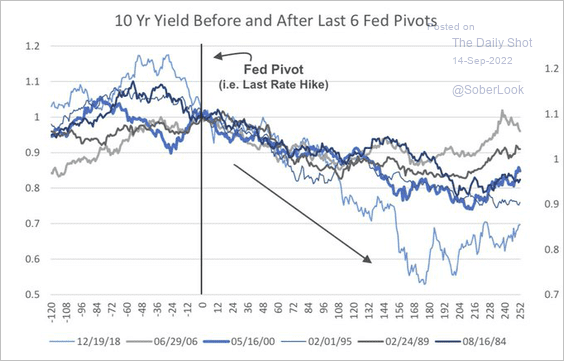
Bond yields and interest rates should be topping out if a Fed pause comes within the next six months. During the last six Fed tightening cycles (as shown below since 1984), the bond market has moved ahead of the Fed, with 10-year treasury yields peaking before the Fed’s last hike and tumbling in the months after that as investment grade bonds rose.

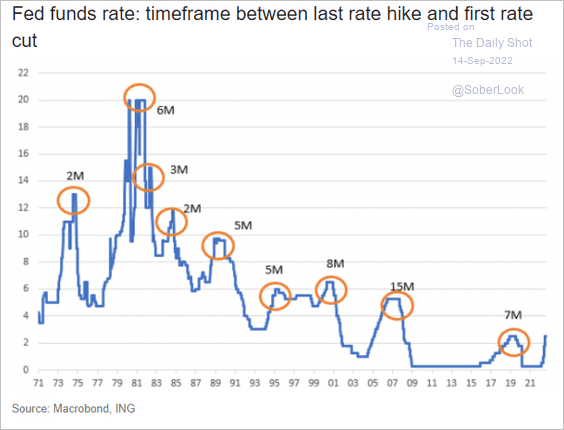
Fed rate cuts on the short-end, meanwhile, have historically not started until two to fifteen months after the last policy hike (as shown below since 1971).

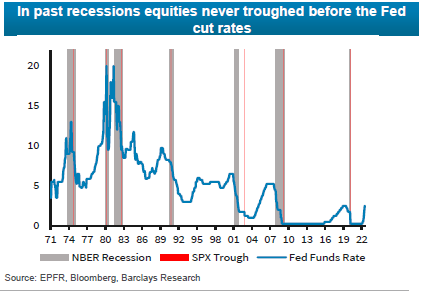
It’s worth noting that equity markets have historically not bottomed (S&P price troughs in red below since 1971) until months after the Fed has started loosening again (blue line), near the end of recessions (grey bars), when growth momentum is finally turning positive once more. #notthereyet.

Posted in Main Page | Comments Off on $95 billion in monthly liquidity reduction to begin today