
Next phase: liquidation mode

Target joined other major retailers and warned this morning that its profits will take a hit as it takes aggressive steps to eliminate excess inventory. See Target shares fall 8% as it expects squeezed profits from aggressive plan to get rid of unwanted inventory:

The retailer slashed its profit margin expectations for the fiscal second quarter to account for a wave of goods winding up deeply discounted or on the clearance rack…

Retailers from Walmart to Gap face a glut of inventory as inflation-pinched shoppers skip over categories that were popular during the first two years of the pandemic. Gap, for instance, said customers want party dresses and office clothes instead of the many fleece hoodies and active clothes the company has. Walmart said some families are making fewer discretionary purchases as the prices of gas and groceries rise. Abercrombie & Fitch and American Eagle Outfitters both reported a steep jump in inventory levels, up 46% and 45%, respectively, from a year ago from a mix of items not selling and supply chain delays easing.

Alhambra Investment strategist Jeff Snider has been charting the record build in retail inventories. Ex motor vehicles and parts (below adjusted for inflation), inventories have surged 11.5% since last October and surpassed the previous record of a 7.1% build over 20 months from 2003 to 2005 (as the last US housing bubble and refi cash outs peaked).
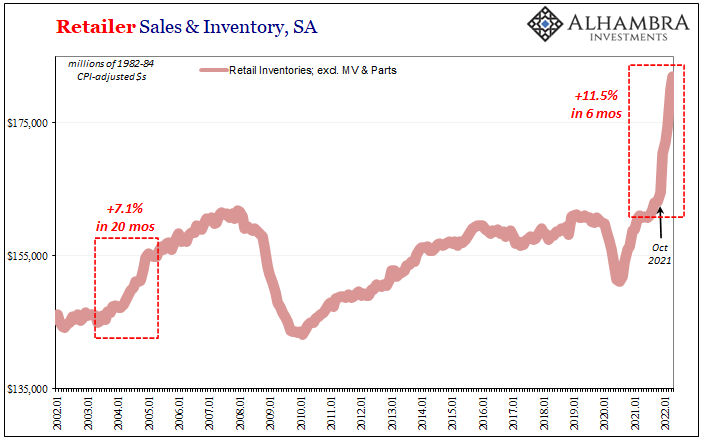
This was the fastest and largest build of excess inventory in at least 30 years. Jeff Snider discusses these developments in this video clip.

The catalysts for this downshift are higher interest rates and the fact that consumers borrowed and bought all goods during the first two years of the pandemic. Now the masses are stuff-heavy and cash-light; pent-down demand is the predictable hangover.

US auto sales have fallen 25% year over year and home sales 27%. Previous such declines have only occurred in the context of recessions.

At the same time, rising operating costs, interest rates, and weaker demand are prompting many to list existing real estate for sale. A record supply of multi-and single-family new home construction will also help to tamp down prices—# lotsmoresupplyondeck.

That’s good because real personal disposable incomes have been flat or negative in each of the past nine months, and the University of Michigan consumer sentiment index hit an 11year low in May, with consumer spending plans at lows seen in the proximity of past recessions.

As sales slump and inventories build, productivity is declining and layoffs are naturally starting to rise. As we move forward, it will be harder for many to meet their payments.

Liquidation is the next phase of this cycle, and it will help deflate the cost of living and bring deals for cash buyers. For those debt-heavy and cash-light, it’s going to be harsh.

For the first six months of this downcycle, equities, cryptos, most commodities, corporate debt and government bonds have sold off together. As the narrative moves from scarcity and inflation to surplus and disinflation, corporate profits will slump, and principal security will be in high demand. Cash and the highest-quality bonds are due to be the next hot commodities.


Posted in Main Page | Comments Off on Next phase: liquidation mode

Debt elevates stress, negatively affects health

As home prices have gone skyward, it’s increasingly less typical for people to pay off their mortgages before retiring and the proportion of non-mortgage debt outstanding has ballooned.  Research confirms that debt can have a negative effect on health, especially as we age (no surprise).

Elevated health problems and medical expenses join lost productivity to compound the costs of debt-induced asset bubbles and systemic fragility.  See In Older Americans, Rising Debt may Adversely Affect Health:

Researchers at the Urban Institute, by analyzing broad national data over nearly 20 years, have reported that indebted older adults fare measurably worse on a range of health measures: fair or poor self-rated health, depression, inability to work, impaired ability to handle everyday activities like bathing and dressing.

Those in debt were also more likely to ever have had two or more doctor-diagnosed illnesses like hypertension, diabetes, cancer, heart and lung disease, heart attacks and strokes.

“There seems a clear causal link between certain types of debts, especially at higher amounts, and negative health outcomes, both physical and mental,” said Stipica Mudrazija, a senior research associate at the institute.

Posted in Main Page | Comments Off on Debt elevates stress, negatively affects health

Not ‘there’ yet

The investment marketing world urges that every day is a valuable buying opportunity and fear of missing out is a formidable bait.

This is especially true since many participants have never lived through a typical bear market (where the average S&P 500 decline was 29% over 12 months if the economy was not in recession and 42% over 16 months when it was.)  Others have seen bear markets but have blocked out the experience (willful blindness) or chalked it up to one-off-bad-luck, unlikely to repeat–aka, this time is different.

After a decade of ‘easy money’ policies aimed at inflating asset prices at all costs, mean reversion is a much-needed value-restoration force. Many securities have made some promising downside progress, year to date, to be sure.

However, in terms of the eight indicators proven to have the best predictive power of forward-10-year real equity returns–we aren’t at enticing investment value yet. Mark Hulbert summarizes the data well in WSJ: Are Stocks Undervalued Yet?:

On balance, these eight indicators at the mid-May low stood at more than twice the average valuation of the bear-market bottoms seen in the past 50 years. And, seen in comparison with all monthly readings of the past 50 years, the average of the eight measurements was in the 88th percentile.

Mark’s summary table below shows the eight latest metrics (in blue) at the top end of the monthly distributions over the past 50 years.

While the S&P 500 trailing 12 months’ earnings per share (first line above) has come down in 2022, as of mid-May, it remained 16% above its average level at the lows of the past 50 years.

Moreover, this price-to-earnings (PE) reading is with backward-looking 12-month corporate earnings still near record highs. As earnings inevitably come off the boil, the dropping denominator will elevate this ratio until the numerator (price) tumbles significantly further–as has happened at every bear market bottom in history.

One of the most telling value indicators of the group is the average investor’s equity allocation as a percentage of their financial assets—equities, debt and cash (second blue bar above). The latest Fed data available was at the end of 2021, when equity allocations were at the 99th percentile of all readings over the past 50 years.

Infamously, the masses hold the most risk near market tops (and the least cash), so they look smartest just before they lose in bear markets and have the least ability to invest near bottoms (when prospects become the best of the decade). Doing the opposite of this behaviour isn’t easy, but it’s recommended.

History assures that financial stability and meaningful investment opportunity is earned through math-based analysis, patience and personal discipline. The lack of these is why many win for a while but end up worse.

We will know we are near a valuable cycle low when the majority is liquidating equities and thinks buying is a bad idea; not there yet.

Posted in Main Page | Comments Off on Not ‘there’ yet




