I’ve long said that people with excess savings (funds they do not need for income or spending needs), who feel more secure with some allocation to precious metals, should do so by holding physical bullion or coins rather than paper versions like precious metal company shares, ETFs or funds. And, the percentage allocated should be no more than one can afford to have in negative-carry, illiquid assets (producing no income but requiring storage and insurance fees to maintain.) In my article A Word To the Gold Bugs, I explained the rationale, responding to the precious metals mania raging in 2011.
With that caveat, this recent panel discussion at the VCRI conference is worth a listen.
Danielle DiMartino Booth and David Rosenberg join Jay Martin at the 2022 VRIC to provide guidance on where, and perhaps more importantly, where NOT to park your cash in 2022. Here is a direct video link.
Posted inMain Page|Comments Off on Where to park cash in 2022
Venture capital, private equity firms, and hedge funds (traditionally more hubris than hedged) used to be fringe players working with the high-risk pieces of ultra-wealthy portfolios.
However, as traditional investment yields (net rental, dividends and interest) tumbled through years of aggressive monetary intervention (zero interest rate policies and QE), individuals and institutions sought ‘alternatives’ for help. The money business ballooned on the opportunity to roll out increasingly complex, opaque products with rich rewards for sponsors and operators.
Venture (VC) and private equity (PE) groups typically direct capital into high-risk start-ups and private companies aimed at getting them to the next stage of funding and ultimately selling to a conglomerate or initial public offering (IPO). The timeline is typically years, and the long-run success rate for a company in their portfolio is maybe one in ten. For this reason, investor capital is illiquid, locked in for an uncertain duration and outcome.
On the other hand, hedge funds have traditionally directed their capital into more liquid publicly-traded securities that enabled their investors monthly or quarterly withdrawals. Over the last decade of low yields, their allocation choices shifted. In 2021 alone, hedge funds nearly quadrupled the annual number of private companies they invested in between 2010 and 2015, according to research by Goldman Sachs.
Many borrowed to increase leverage and magnify predicted gains. In a doomed daisy chain, they each allocated capital to many of the same entities, and funds were marketed to the general public.
As asset markets now tumble, liquidity evaporates, and the boondoggle is coming to a predictable close. Redemption requests are just starting to rise. The need for liquidity will drive the urge to sell what they can at inopportune timing. See Hedge Fund D1 Borrowed Billions for Hot Bet Now Seen Melting Down:
Across Wall Street, billionaire investors and their advisers are urgently trying to figure out how much exposure they have to plunging values in Silicon Valley unicorns and other private ventures. They’re reviewing disclosures by some of the most active buyers of those assets, including D1, Tiger Global Management, Coatue Management, Lone Pine Capital and Viking Global Investors.
Clients had been giving their money managers more leeway to buy assets that can be hard to value and slow to sell. Some firms used leverage to boost returns.
Yet valuations of many closely-held companies are tumbling even harder than the technology stocks that slumped on public markets this year. That has left hedge fund investors trying to figure out whether their money managers might suspend withdrawals, face demands from lenders to post more collateral, or — in a worst-case scenario — have to start selling investments quickly enough to drive down asset prices in a chain reaction.
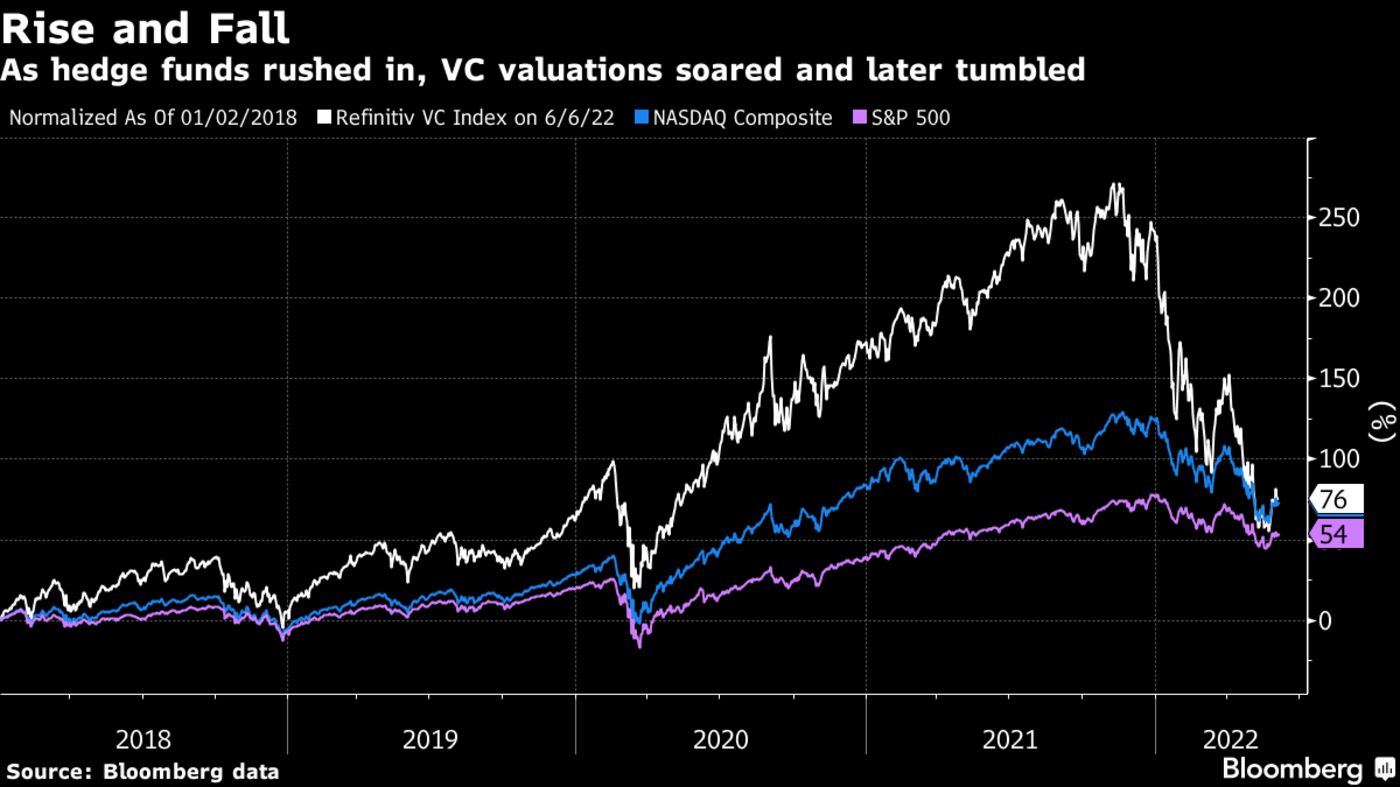
Valuation declines are starting to come into focus. Venture capital firms have watched their holdings slump enough to push the Refinitiv Venture Capital Index down 47% this year — more than double the 22% slide in the Nasdaq Composite Index of publicly traded stocks.
The recent acquisitions are part of a wave of increased activity from private-equity firms across the globe, as they search for new fields to generate yield by consolidating fragmented industries and extracting profits. In Canada, consolidators have spent billions in sectors as varied as waste management and legal software.
The approach has fuelled greater corporate concentration, which critics say will reduce consumer choice and drive up prices by driving down competition. And private-equity’s drive for efficiency could also affect the quality of care, for example by reducing the time a professional can spend on procedures.
Private-equity firms including Stockbridge Capital, Carlyle Group and Apollo Global Management have been rapidly buying up mobile home parks over the last decade, often using funding from government-sponsored lenders Fannie Mae and Freddie Mac. Once they take over, one of their first moves is to raise rent…”
Posted inMain Page|Comments Off on Easy money boondoggle coming to predictable close
The retailer slashed its profit margin expectations for the fiscal second quarter to account for a wave of goods winding up deeply discounted or on the clearance rack…
Retailers from Walmart to Gap face a glut of inventory as inflation-pinched shoppers skip over categories that were popular during the first two years of the pandemic. Gap, for instance, said customers want party dresses and office clothes instead of the many fleece hoodies and active clothes the company has. Walmart said some families are making fewer discretionary purchases as the prices of gas and groceries rise. Abercrombie & Fitch and American Eagle Outfitters both reported a steep jump in inventory levels, up 46% and 45%, respectively, from a year ago from a mix of items not selling and supply chain delays easing.
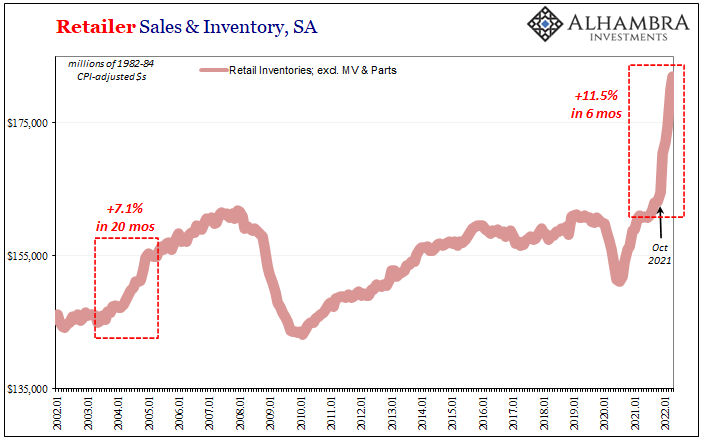
Alhambra Investment strategist Jeff Snider has been charting the record build in retail inventories. Ex motor vehicles and parts (below adjusted for inflation), inventories have surged 11.5% since last October and surpassed the previous record of a 7.1% build over 20 months from 2003 to 2005 (as the last US housing bubble and refi cash outs peaked).
This was the fastest and largest build of excess inventory in at least 30 years. Jeff Snider discusses these developments in this video clip.
The catalysts for this downshift are higher interest rates and the fact that consumers borrowed and bought all goods during the first two years of the pandemic. Now the masses are stuff-heavy and cash-light; pent-down demand is the predictable hangover.
US auto saleshave fallen 25% year over year and home sales27%. Previous such declines have only occurred in the context of recessions.
At the same time, rising operating costs, interest rates, and weaker demand are prompting many to list existing real estate for sale. A record supply of multi-and single-family new home construction will also help to tamp down prices—# lotsmoresupplyondeck.
That’s good because real personal disposable incomes have been flat or negative in each of the past nine months, and the University of Michiganconsumer sentiment index hit an 11–year low in May, with consumer spending plans at lows seen in the proximity of past recessions.
As sales slump and inventories build, productivity is declining and layoffs are naturally starting to rise. As we move forward, it will be harder for many to meet their payments.
Liquidation is the next phase of this cycle, and it will help deflate the cost of living and bring deals for cash buyers. For those debt-heavy and cash-light, it’s going to be harsh.
For the first six months of this downcycle, equities, cryptos, most commodities, corporate debt and government bonds have sold off together. As the narrative moves from scarcity and inflation to surplus and disinflation, corporate profits will slump, and principal security will be in high demand. Cash and the highest-quality bonds are due to be the next hot commodities.
Posted inMain Page|Comments Off on Next phase: liquidation mode
“An explosive critique about the investment industry: provocative and well worth reading.”
Financial Post
“Juggling Dynamite, #1 pick for best new books about money and markets.”
Money Sense
“Park manages to not only explain finances well for the average person, she also manages to entertain and educate while cutting through the clutter of information she knows every investor faces.”
Toronto Sun