
Worthwhile overview of the slowdown in the world’s second-largest economy and its global implications. Here is a direct audio link.
Follow






_________________________
Worthwhile overview of the slowdown in the world’s second-largest economy and its global implications. Here is a direct audio link.
Yesterday, US Fed head Jerome Powell ramped up talk of inflation-fighting rate hikes and aggressively reducing the Fed’s balance sheet. Bond prices have tumbled, as debt service costs leap for the public and private sectors.
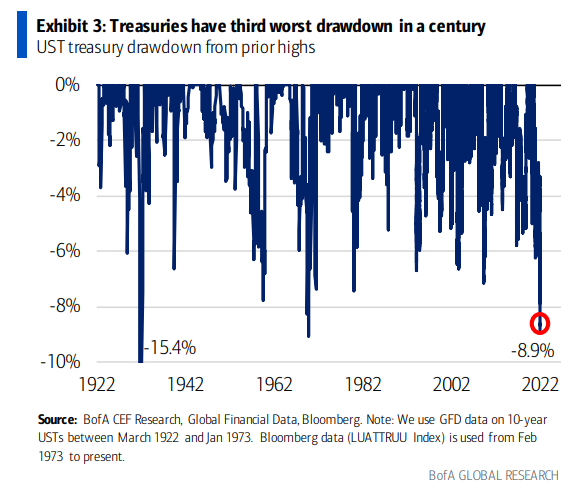
Over the past seven months, US ten-year Treasury prices (the flip side of yields) have seen their third-largest drawdown of the last century (as shown below). Touching 2.187% this morning, the US two-year Treasury yield (up from 1.80% last week and .149 last June) was just .16% below the ten-year–a fresh cycle low and the narrowest spread since the last recession began in 2020.
 The US thirty-year bond at 2.59% (up from 1.20% in July 2020) is lower than the 20-year as the curve has inverted at 30-20, 3-10 and 5-10 terms.
Along for the rise in yields, the 30-year US mortgage rate is up to 4.72% from 2.75% in November 2021, just as the median listing price reached $392,000 in February (from $300,000 in March 2020) As shown below, higher prices and mortgage rates have combined for a 28% leap in homeownership costs–the fastest and largest since 1987.
Due to rising prices and rising mortgage rates, we’ve just seen the biggest year-over-year spike (+28%) in the cost of owning a home in at least 35 years. https://t.co/H4p1RcpNxV pic.twitter.com/VavRe9uKIO
— Bespoke (@bespokeinvest) March 21, 2022
In Canada, five-year Treasury yields have rocketed to 2.237% from .78% in August 2021, taking the five-year fixed mortgage rate above 3.5% at all major banks from 1.5% in early 2020. Over the same time, the median home price is up about 64%, from $530,000 to $870,000 nationally, making housing affordability positively grim.
While fixed mortgage rates move with the bond market’s expectation of Fed policy, variable-rate mortgages move with the rate hikes themselves. From around 1.65% today, Canadian variable-rate mortgages should rise to about 3% over the next 12 months if the Bank of Canada delivers on the five hikes currently telegraphed. This will be a significant increase for the 35% of Canadian mortgages presently variable.
Interest rates are also on the rise on business and personal loans, credit cards, lines of credit, bank overdraft and margin interest charged on brokerage accounts. All on top of the spike in food and gas prices.
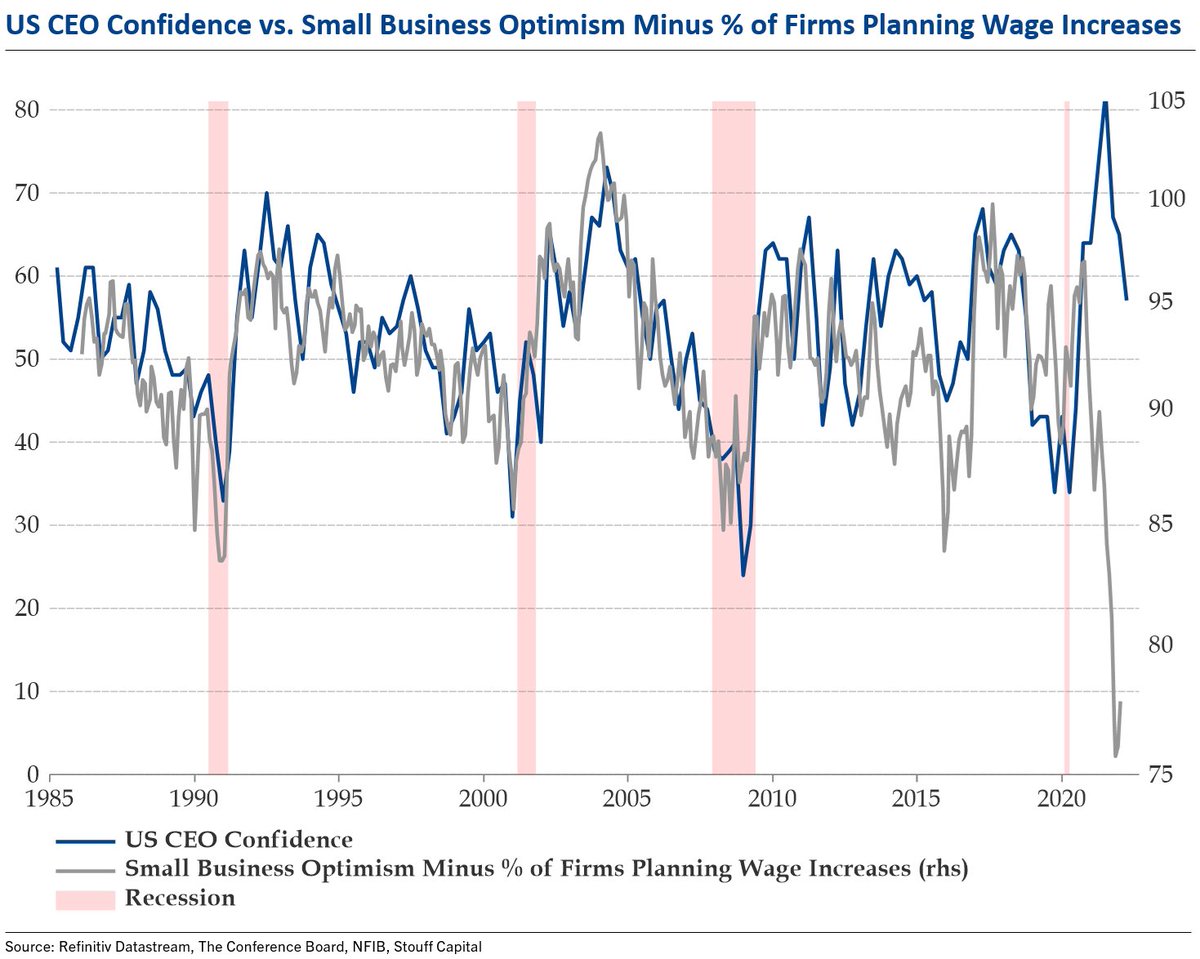
Financial stress is rising, and consumers and businesses are necessarily pulling in their spending and investment plans. Consumer confidence is slumping along with small business, and CEO confidence (below since 1985 courtesy of Julien Bittel) as free cash flow, revenue and profit margins shrink.
 There is no doubt that politicians and central banks are unnerved by the recent rise in inflation and Russia’s war on Ukraine has intensified the shock and urge to “do something!”
In reality, in our highly levered world of households, businesses and financial markets, the tightening to date has already been massive and is undermining economic momentum.
As shown below with the 10-year US Treasury yield since 2008, rates have repeatedly risen during loose monetary conditions, only to tumble again as conditions tighten and the economy and risk assets slump. We’re there again now.
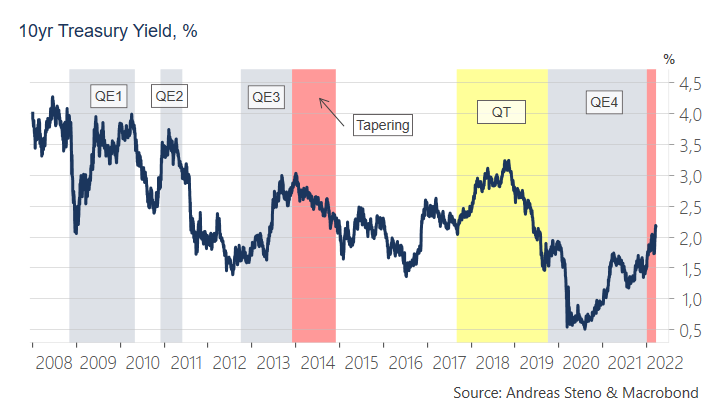 Central banks can talk up further tightening plans, but the bond market has already done their work. As the economic downturn intensifies, growth and inflation expectations will tumble with yields as Treasury bonds rebound, and policymakers shift back to trying to revive borrowing, animal spirits and asset prices. That could take years for the many who will suffer financial setbacks between here and there.
The price of the average Canadian home hit $816,720 in February, its highest level on record (Canadian Real Estate Association).
The $816,720 average selling price is up 20 percent compared to last year’s level. In the most populated areas of the Greater Toronto and Vancouver areas, the average selling price exceeded $1 million. Without these two cities, the national average price was also a record high at $638,720.
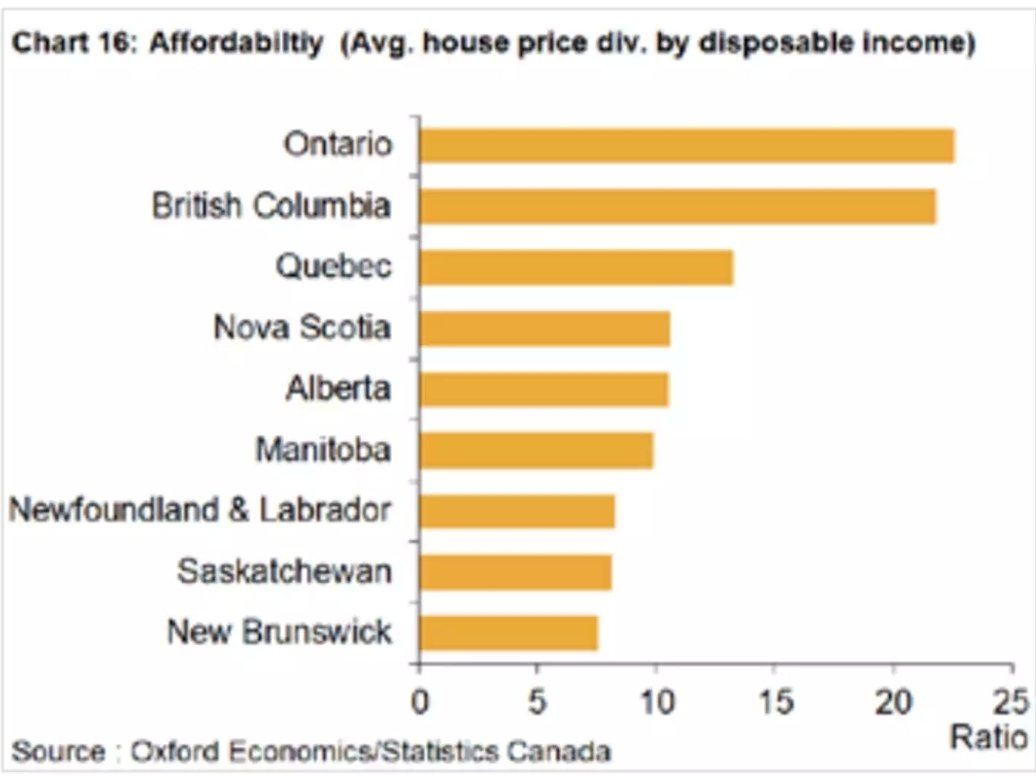
The average house price divided by disposable income is a precarious 23 in BC and Ontario (chart below). Many have necessarily given up on homeownership dreams. Many of those who do own are so indebted that they cannot meaningfully accumulate savings for other critical goals like retirement, education, emergency funds and new business creation. All of this has a long-term economic drag on households and the economy.
 After doubling with the oil patch boom from 2004 to 2008, Calgary home prices fell 25% and largely flatlined for 15 years to 2020 (a typical historical pattern that followed past housing booms in Canada and other countries). Then, over the past year, relative value has attracted inflows (average price in Calgary $487,000 per CREA), and benchmark prices in the city leapt almost 9% in the past three months–the fastest clip since the heady days of 2006.
As with everything, high prices ultimately become the cure for high prices and this credit and speculation-driven cycle is unlikely to end differently than the hundreds that have preceded it globally. Those who lever in late are likely to suffer one way and another.
Institutional investors and funds hoover up existing homes, pushing up prices and rents while funding new supply at a record clip (see Wall Street’s favourite suburban housing bet is getting crowded). The value of building permits in Canada hit $11.2 billion in November—the highest ever recorded. New private housing units under construction in America hit a 49-year high in January, with 1.543 single- and multi-family units in process—the most since 1973. Population-adjusted this matched the peak of the U.S. 2004-2007 building frenzy. In January, the 1.899 million U.S. building permits were also the highest since December 2006.
Bank of Montreal economist Robert Kavcic noted last week: “Demand has been boosted by expectations of rising prices and a last-ditch effort to lock in cycle-low mortgage rates. But sentiment can change in a hurry, and this market could find balance very quickly the moment that it senses softer prices.”
While prices in Canada’s hot housing market continue to hit record highs, experts predict they could cool down if the supply increases alongside further interest rate hikes. Here is a direct video link.


