
Treasury bonds outperform during falling growth and inflation

U.S. consumer credit expanded $18.9 billion in January while retail sales slid 1.9%.
As in December, consumers are borrowing to cover basic needs and make ends meet as their interest costs are rising.  No wonder U.S. consumer sentiment is at a decade low.

As stocks continue through a much-deserved bear market, corporate bonds are, as usual, dropping along for the ride.  As bond prices fall, yields on the riskiest CCC issues have risen 33% since July (from 6.6 to 8.8%), while BB issue yields are up 51% (3.1 to 4.7%).  We expect yields to widen further as default and liquidity risk are priced back into corporate security prices.

At the start of tightening cycles, it is typical for liquidity to drain out of all asset classes.  But as the economic slowdown picks up steam and available cash contracts, default risk becomes the dominant concern.  That is when government bonds become the most attractive asset class on offer, and safety-seeking inflows drive up their prices as everything else drops.

I explain this stuff all the time.  Sometimes, it’s nice to see others take a stab.  Lance makes a solid effort in the clip below.  Here is a direct video link.

PIMCO co-founder, Bill Gross, explained these dynamics well in his January 28, 2008 market letter as follows:

“…early is a portfolio manager’s best maxim. In this case it has nothing to do with birds getting the worm or being the first runner out of the starting blocks, but more about being positioned when markets move into crisis mode. Risk assets in a highly levered, finance­ based global economy can move so quickly to the downside that by the time you hear the birds chirping or see the starter’s gun smoking the race may be already half over. Admittedly, there’s a price to be paid for sitting out the frenetic last thrust of any bull market. In stocks, it comes in the form of being labelled old ­fashioned or out of touch…In bonds, it shows up as lost carry when yield spreads compress, and high-quality government bonds are shunned for derivative structures offering double-digit levered rewards. But when risk markets perceive a change in the wind—a turn in profits, a potential recession, and most importantly as was the case in mid­ 2007, an implosion in the pyramid scheme, chain letter driven structure of modern finance—then you’d better be already positioned. Exit doors lock automatically as illiquidity and the psychological frailty of the human mind prevents quick action in order to preserve capital.”

Posted in Main Page | Comments Off on Treasury bonds outperform during falling growth and inflation

Homeowners expect to keep winning

Average Canadian home prices have increased 40% since the Pandemic began.  For a bit of context, that’s the equivalent of about eight years of the long-term average price appreciation in just two.

Still, as unusual as housing gains have been, 64% of Canadians recently surveyed expect the value of homes in their neighbourhood to increase further over the next six months.  The historical average on this question is about 40%.  Just 5.6% of respondents expect prices to fall, the lowest on record.  See:  Canadians deepen faith in red-hot housing while rate hikes loom.

The problem with cyclically-blind expectations is that they’re inherently unreasonable and end up disappointing, eventually.  In the meantime, financial plans get based on misinformed assumptions that pile borrowing, spending and capital allocation decisions onto flawed foundations.  A reliable recipe for frustration and loss.

Posted in Main Page | Comments Off on Homeowners expect to keep winning

Housing elephant fills our economic room–see it

Many believe that home prices will continue to rise year over year on a never-ending stream of able and willing buyers.  This has never been true historically.  Most people borrow heavily to buy real estate, so prices have always followed credit cycles up and down.

After ending its Q.E. injections to the banking system in October, last month, the Bank of Canada (BOC) blinked and did not increase its overnight lending rate from the emergency lows of March 2020, as widely expected.  Central banks are under great pressure to hike as the cost of housing, food and energy have jumped over the past two years.  A total of five BOC rate hikes is the consensus forecast for 2022 taking Canada’s base lending rate from .25% now to 1.50% by year-end–a 500% increase over 9 months.

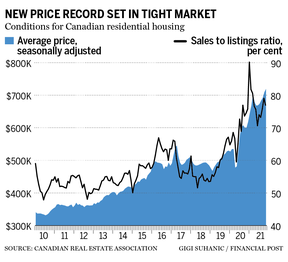
Of course, without the BOC making any hikes, Treasury Bond prices, on which fixed mortgage rates are based, have already sold off enough that fixed mortgage rates in Canada are back to where they were in 2016.  The problem is that as shown on the left, home prices have about doubled nationally since then, so affordability is a problem even with 2% mortgage rates.  See Average home price in Canada hits all-time high of $720,850.

Any hikes that are made in 2022 will increase carrying costs on business and personal loans, lines of credit, HELOCs, and variable-rate mortgages.  Half of the mortgages taken on in Canada last year were variable.

These conditions are full of risk for borrowers, lenders and the overall economy.  But with most of the nation’s economic growth dependent on the inflating property sector over the past decade, few are able or willing to acknowledge the property elephant now filling our economic room.  And of course, as usual, the commission-engorged realty sector sees only more upside–forecasting a 9.2% increase in average residential sale prices (twice the long-term norm) across Canada in 2022.

Last week, Canada’s federal banking regulator described the housing market as being in the late stages of a “speculative fever,” and warned that prices could plunge by as much as 20% in some markets with negative implications for investors in the properties and securities markets.  See Banking watchdog warns housing prices could plunge 20% when ‘speculative fever’ breaks:

Canada’s housing market has been setting records for the better part of a decade, led by Vancouver and Toronto. The frenzy has spread to other cities during the pandemic, as demand for bigger houses, or cheaper ones than can be found in major centres, caused Toronto-like price increases in places such as Ottawa, Montreal, and Moncton, New Brunswick.

Investors took note and jumped on the opportunity to turn a profit. Routledge said a “speculative boom” in housing has added extra heat to the market. Typically, investors account for about 15 per cent of home sales, but currently they are responsible for about 22 per cent of sales, he said.

“Even though that seems like a little bit, it’s quite significant incremental demand into the system,” Routledge said.

However, investors’ interest in the housing market likely is about to decline. “With rates going up, with the general recognition that, ‘Boy, housing is pretty fully valued,’ I’m not sure your expected return in the housing sector … I think a smart investor would think twice and maybe look at other outlets,” he said.

Former CMHC head Evan Siddall issued similar warnings before he was bullied into apologizing and finally stepped down in 2020.

We highly doubt that central banks will follow through with even a third of the tightening presently forecast, before tanking asset markets and financial strain prompt them to pause and seek new stimulative prods for buyers.

Some believe this means home prices can continue to rise because interest rates will remain low indefinitely.

But here’s the thing, even if rates stay low, property increases in line with long-term historical norms of 5% per year would be a problem for highly levered families and investors who are presuming the continuation of abnormal capital gains.  Just a few years of flat prices would be a huge negative for these participants too.

Mean reversion back to historical appreciation norms–some combination of double-digit price declines and/or a decade-plus of stagnant prices–would be a catastrophe.  And yet, this is the most probable outcome.   Preparing for this is responsible and wise.

Posted in Main Page | Comments Off on Housing elephant fills our economic room–see it




