China’s economy is struggling as its outrageously leveraged property sector, which has driven some 25% of its GDP growth over the past decade (and the lion share of global commodity demand), works through a well-earned bust cycle.
After years of raising funds through bond issuance to yield-desperate buyers, Chinese property developers are heavily indebted and, since last summer, many have been defaulting on payments to bondholders. Their bond prices have slumped, and repayment strain on dollar-denominated debt intensifies as the greenback rises on tightening talk from the U.S. Fed. See China property shares slump as planned U.S. rate hikes add to woes.
After being repeatedly burned in fleeting rallies since the China stock bubble first burst in October 2007, investors doubled down on the property sector in the past few years, and government policies encouraged them to do so (as similar policies have done in Canada and other countries).
Bullish as always throughout, the product-promoting finance sector has predicted that China’s stocks, bonds and real estate could only go up; to no avail. See, Wall Street’s bet on Chinese markets is going all wrong.
 Responding to weakness in the domestic economy, the Chinese central bank reversed its short-lived 2021 tightening bias this month to cut overnight lending rates for the first time since April 2020.
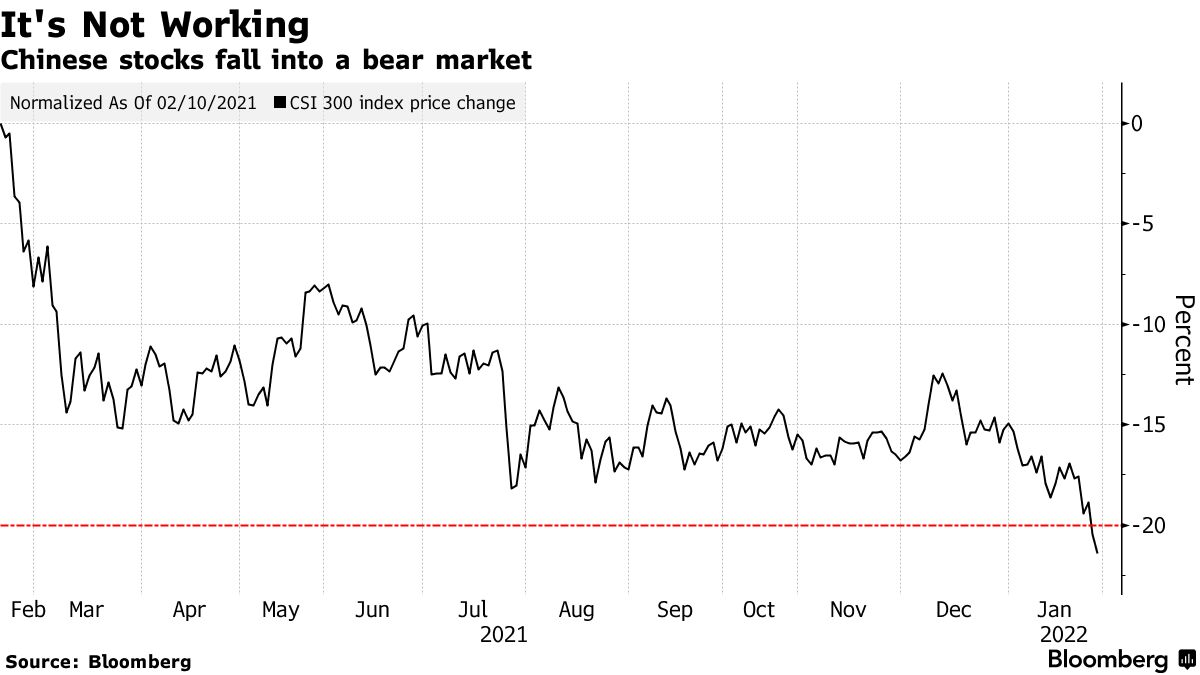
Chinese stocks have slumped in response, down 20% in January despite central bank assurances, state media appealing for calm, and some of China’s largest mutual funds publicly committing to buy their own equity-focused products. Ponzi-finance looks to be deservedly losing believers–and not just in China.
As domestic construction stagnated, Rosenberg Research points out this morning that the Chinese government spent the last year stockpiling commodities and their buying, as usual, helped to boost prices and inflation expectations in financial markets.
Now, Bejing is refocused on weakening its currency and increasing exports to the rest of the world. But after two years of drastically elevated goods’ consumption globally, a spending preference for services is overdue. All of this reminds us of the spending slump after the Y2K build-up ended in 2000.
A period of fewer goods consumed will be healthier for the planet and could help boost household saving rates. But it’s also a negative for economic growth in China and many export-dependent countries, including Germany and Canada.
As the supply of most goods now moves to overwhelm demand, these shifts are deflationary for consumer prices and asset markets like commodities (see Hard Assets: Are they a trap in the making?) and stocks, not just in China. See WSJ Fewer Goods are less good for the stock market:
So what might happen in the year ahead, if the pandemic loosens its grip and a greater share of spending shifts to the services sector as a result? Historically, when services spending seriously outpaces spending on goods, the stock market has often struggled as happened in the early 2000s, for example, when the S&P 500 declined for three years in a row.
It isn’t clear the past offers much of a guide, however, since periods of weakness in goods spending relative to services spending have usually been associated with weakness in the economy at large. On the other hand, the fact that the Fed looks as if it will soon be raising rates—something it typically doesn’t do during periods of economic weakness—is an additional reason for stock investors to be concerned.