Fuses lit for the next financial implosion

Inflation fears and a belief that the U.S. Fed will start tapering its bond purchases in November and hiking policy rates in 2022 have caused bonds to sell-off over the past two months (yields rising).  It’s likely to be short-lived as even modestly higher rates weigh on a slowing global economy and any tightening resolve will prove transitory when animal spirits slump once more.

Even if central banks delay action, receding fiscal injections from governments in 2022 will equivalate to several percentage points of tightening.  And, as shown below, the negative stimulus impulse is set to detract some 7% of GDP from the world’s largest economies. A. Gary Shilling reviews the hard place of monetary policy amid present asset bubbles in The Federal Reserve Confronts an almost impossible task:

The Fed risks tightening to the point that it precipitates major financial problems and a recession. Also, a big rate hike could well reveal bankruptcy-inducing excess debt levels in a number of financial sectors, while areas that have seen excessive speculation, such as cryptocurrencies, SPACs and individual investors tied to Robinhood Markets Inc. are vulnerable.

With emergency income benefits ending and payment deferrals expiring, higher interest rates, energy and shelter costs have already round-tripped consumer expectations back to the pre-vaccine lows of last November (as shown below).  Some note that the extent of this deterioration suggests that the U.S. is already back in recession if the history of consumer confidence repeats.  It makes sense that the fastest most artificially inseminated recovery in history could be followed by one of the quickest returns to recession.  Of course, recession declaration only takes place months after the fact, in retrospect.

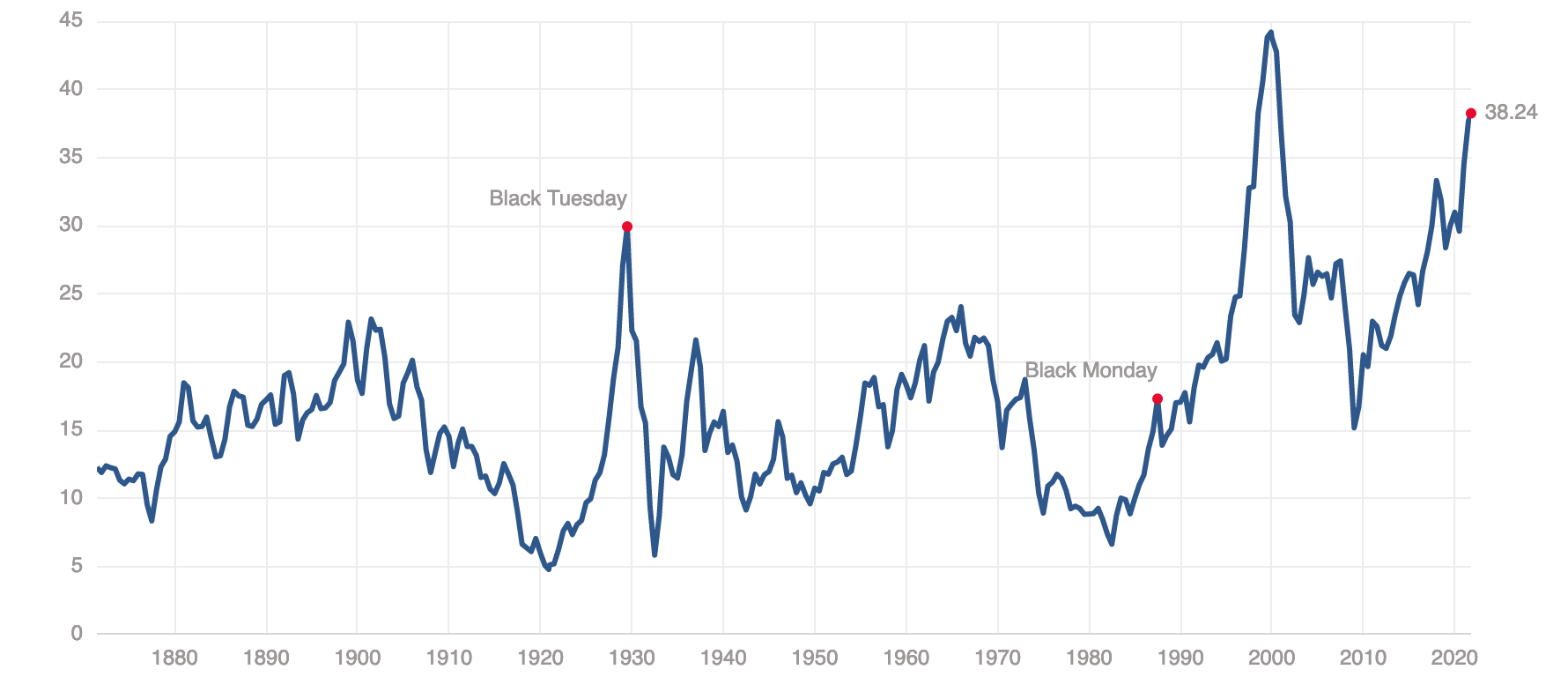
Either way, from the grotesque stock valuations today, a spectacular downcycle looms.  As shown below in blue since 1900, the aggregate of four historically informative S&P 500 valuation metrics stands an eye-popping 166% above the long-term mean.  Simply breathtaking.  Lesser overshoots have been followed by brutal mean-reversion periods lasting years thereafter.
It’s hard not to be both horrified and cautiously excited for what opportunities will be afforded in the next financial implosion.  The fuses have already been lit.

Posted in Main Page | Comments Off on Fuses lit for the next financial implosion

Finance is a world of wolves dressed as shepherds

As central banks have pumped liquidity into financial intermediaries with every market stumble since 2008, the finance sector has become more affluent and bolder than ever.  In the process, long-established cornerstones of prudent capital management are considered redundant, dumb, even cowardly.

As shown below, hidden and not, fees generated from trading stocks globally amounted to more than $185 trillion in 2020, an 8-fold increase from $22 trillion in 2015.  In the process, the average holding period for publically traded shares has fallen from 9.7 years in 1980 to was just over seven months (.6 years).  Everyone’s a trader now.

Even though studies have repeatedly confirmed that frequent trading and high investment fees are negative for capital owners over time, these are the facts.  But you’ve got to be brave; at least that’s what the marketing memes urge us.

As leaks spread about the predatory business models of social media companies looking to addict their users, some are making the connection with financial-tainment and the pandemic of gambling now sweeping the world.  Lives are being messed, as usual. See  Traders phone up gambling helplines as game-like broker apps spread:

“The user experience is converging and the line between gambling and investing, which was already pretty fluid, has almost been completely erased,” said Keith Whyte, executive director of the National Council on Problem Gambling, among the groups reporting more calls from stock traders to their help lines.

The US Securities and Exchange Commission (SEC) is said to be investigating the extent to which brokers’ and investment advisers’ “digital engagement practices” — including so-called gamification — assist or undermine small investors.

The outcome should be a no-brainer.  But with the companies reaping huge activity fees dominating regulators and legislators, we should not hold our breath here.  That is, not until the next big wipe-out devastates retirement accounts, at least.  Even then, given the action-lite precedent to date, who knows.

A seductive trading portal ironically named Robinhood that sells its customer ‘flow’ to predators reflects the ethical dark ages in which we now function.  The devolution of Canada’s Wealthsimple and other so-called Robo-advisors is another vivid marker.

Robo-advisers started out saying they were all about helping retail customers avoid emotional allocation choices to build their savings with less risk and lower fees.  But there’s not enough profit in that, especially when founders and executives are gunning to hit personal liquidity events through initial public offerings.  Rapid fee growth is the target, so promoting transactions and the highest-fee products are the natural migration.  See Why Wealthsimple went from preaching low-fee, low-risk investing to pushing stock trading and crypto:

To understand what that could mean for Wealthsimple, simply look at the fee schedule. The company’s robo-clients often pay 0.5 per cent annually, while crypto traders pay 1.5 per cent to 2 per cent per transaction (although Wealthsimple must split that fee with other parties).

Stock trading and crypto are also popular with younger users, which has always been Wealthsimple’s target market but proved to be a tough nut to crack.

There’s no doubt this will end badly for most of the users.  But intermediaries and dealers in finance have all carefully structured themselves to avoid liability for customer outcomes.  That’s the dominant and most profitable business model.  Pretending to be shepherds is how wolves attract the most sheep.

Posted in Main Page | Comments Off on Finance is a world of wolves dressed as shepherds

Overbuilding and leverage suggest deflationary forces still dominate

After rising 90% from its March 2020 low, the Bloomberg Commodity Spot Index (below), which tracks 23 energy, metals and crop futures contracts, yesterday surpassed its previous all-time (fleeting) highs touched in 2011 and 2008.

Oil and gas prices (which make up 39% of the CRB index) have led the way, even as less cartel-manipulated commodities have fallen since May:  iron ore is -47%, copper -13%, palladium -36%, not to mention lumber -63%.  One thing is for sure, higher fuel costs, especially heading into the northern hemisphere winter, will crimp the consumer discretionary spending upon which developed economies presently depend.

China has used some 40 to 50% of many minerals and agricultural products globally over the past two decades.  First, to build products for western exports (as China joined the WTO in December 2001), and then, since the 2008 financial crisis, to build out domestic infrastructure and property development.

As excesses have become glaring and socially destabilizing, Beijing now seeks to reduce financial leverage with restrictions on the amount developers can borrow and, yesterday, with a new ban on loans to speculate in commodities.  As shown below, since 2013, the Chinese credit impulse (movement of credit through the banking system in dark blue) has been contracting since last spring and typically leads global commodity prices with a lag of 12 months.  The present levitation in commodity prices stands ominous. As property development has become the most significant driver of China’s economy in recent years (responsible for an estimated 29% of GDP), China itself has driven the largest share of global economic growth, about a third overall.

Within the property sector, Chinese residential spending (construction, renovation and transaction costs) accounted for a record 10% of its GDP in 2020, as shown below, and compares with just over 6% for this sector at the peak of America’s 2007 housing bubble.  Unfortunately, Canada shares the dubious distinction of a similar 10% of GDP now coming from residential property spending of late, as I explained here in Lethal levels of financial leverage are highly contagious. While Treasury yields have risen with energy prices over the past two months, higher interest rates are a growth-depressing headwind for highly levered economies.  The deflating world economic surprise index (below in blue) suggests the run-up in rates (US 10 year yield in red) should be short-lived. As demand has already turned down from government-boosted spending,  a record number of tanker ships are now waiting to unload their cargo at American ports (LA port below in blue). All of this suggests that the inventory rebuilding that began in August and September (see orange below) will continue–similar to what happened in 2008 and 2000 (after the Y2K spending splurge)–and deflationary forces will resume domination over a world awash in goods and short on free cash flow.

Posted in Main Page | Comments Off on Overbuilding and leverage suggest deflationary forces still dominate