Central banks trying every trick to boost inflation

I have explained many times that central banks worry that falling inflation (disinflation) and outright deflation reduce the incentive for spending and capital flow into financial markets.

The theory goes that if consumers and businesses believe that prices will be flat or lower in the future, they have less incentive to spend today. Moreover, if savers are not threatened by the fear of inflation eroding their purchasing power, they have less incentive to buy the risky securities that financial firms and public corporations continually seek to sell them.

Even though inflation has averaged less than the official 2% target since 2007, recently, U.S. Fed head Powell threatened that he is willing to tolerate inflation above 3% if that’s what it takes to keep prices moving up.

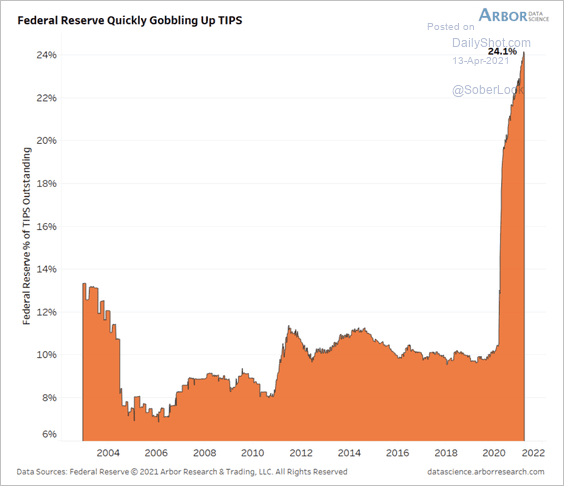
Apparently, that includes buying up inflation-linked treasuries (TIPS).  As shown below, the US Fed has gobbled up just over 24% of the outstanding TIPS market in 2021.  The principal of a TIPS increases with inflation and decreases with deflation, as measured by the Consumer Price Index. In buying these bonds, the central bank intentionally boosts their price and inflation expectations along for the ride. 
Taking the bait, commodities and corporate securities have spiked higher with inflation expectations, as individuals and trend-following funds have ratcheted up risky holdings in the hopes of outrunning capital shortfalls.

This is a familiar pattern.  Each time central banks have redoubled efforts to suppress interest rates and boost risk-appetite in financial markets, funds have flowed out of lower-risk bonds and cash and into commodities, stocks, junk debt, and other risky assets.  For a while.

Then, in a self-fulfilling circle, the incoming capital spikes commodity prices and inflation expectations and lowers bond prices, which increases bond yields/interest rates, which leads to reduced borrowing capacity and spending, disappointing growth. Then funds reverse back out of commodities and corporate assets and into perceived safe havens like government bonds and the U.S. dollar once more.

We never know the precise moment of inflection in real-time but realizing that central banks are Oz-like and knowing what inputs to measure and map is a huge help in anticipating where capital is due to flow next.
Posted in Main Page | Comments Off on Central banks trying every trick to boost inflation

High market capitalization bodes poorly for investment returns

A December 2020 paper entitled The Big Bang:  Stock Market Capitalization in the Long Run, confirms that we have been living through a highly unusual period in financial markets.

While advanced-economy stock market capitalization to GDP ratios were pretty constant between 1870 and 1990s, they tripled in what the authors call a “big bang” in the 30 years since.   This structural break’s key driver was a policy and profit shift in favour of publicly listed larger firms along with stagnating economic growth.  No free lunch, the authors find that these trends do not bode well for future investment returns or stock market stability from here:

The existence of this profit shift is consistent with the broader trend of increasing market power of large firms at an increasingly uneven distribution of corporate earnings in the US and globally (De Loecker et al.,2020; De Loecker and Eeckhout, 2018). Because these high market values reflect a distributional shift within current income rather than a high future growth potential, they do not generally signal favourable near-term prospects for the economy.

On the contrary, we show that high levels of market capitalization are typically a sign of brewing trouble, predicting low returns, low growth, and a high probability of a stock market crash.

Posted in Main Page | Comments Off on High market capitalization bodes poorly for investment returns

Sharp reflation is not the same as inflation

Persistently high inflation can reduce buying power for households when comparable increases in wages do not offset it, and wage growth has been flat for years.

However, the greater fear for central banks is that persistently low inflation, disinflation, and outright price deflation leave much less room for monetary policy (at near-zero interest rates) to prod spending, economic growth, and capital flows into corporate securities.

While pandemics of the magnitude of COVID-19 have been historically rare, they’ve tended to be deflationary, reducing consumers and consumption in their aftermath.

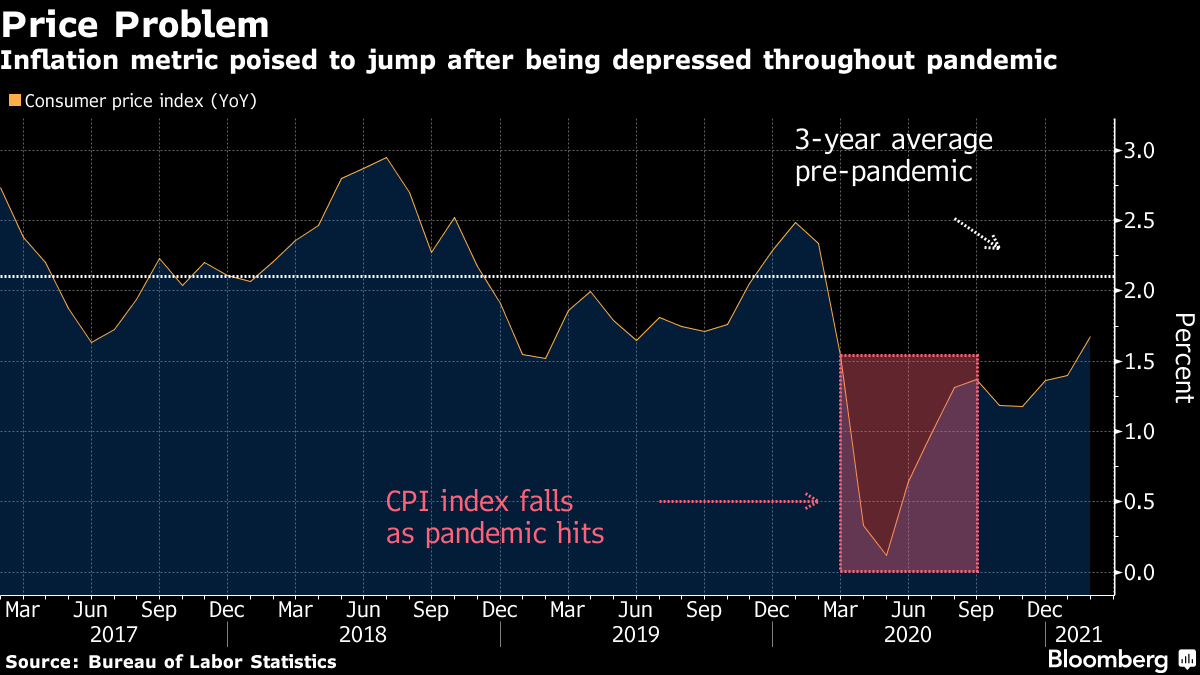
That said, in the near term, there is no question that year-over-year comparables look inflated from depression readings in the first half of 2020 (base effects), on top of recent supply chain disruptions and some pent-up demand, mostly for services.

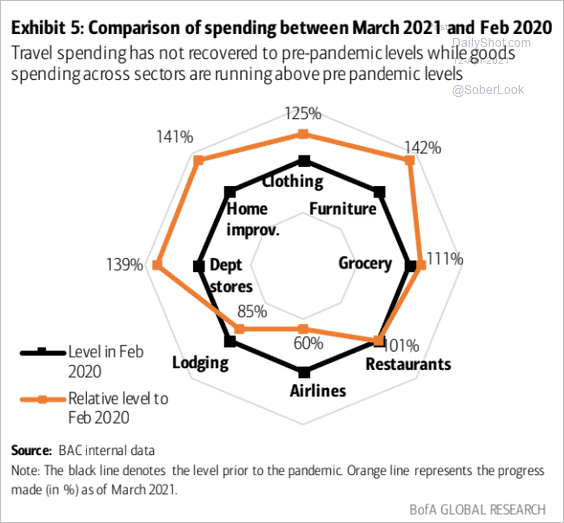
On the demand point, it is important to realize that consumer spending through the 2020 pandemic/recession has already been extraordinary, thanks to record government assistance. Bank of America credit/debit card data (charted beside) shows that March 2021 household spending (in orange) was significantly higher on key goods than February of 2020 (in black) and only lower on lodging and airlines.  The elevated consumption of goods is unlikely to continue indefinitely.

Much of the jump in prices we see in the first half of 2021 is not so much inflation as reflation from depression levels in early 2020.  This chart captures the relative change well.
While central banks and the finance sector continue to tout an inflation narrative, the case for non-transitory effects (and much higher interest rates) remains sketchy thus far.

Posted in Main Page | Comments Off on Sharp reflation is not the same as inflation