Renewable energy and EVs have cost/benefit advantage

The energy sector in southern Alberta has over $2 billion worth of renewable energy projects being built in the region.  The related new jobs and tax revenue are much needed.  See: Southern Alberta witnessing ‘unprecedented’ surge in renewable energy projects.

The renewable energy sector in southern Alberta is riding high with projects surging like never before. Taz Dhaliwal finds out what’s driving the boom.  Here is a direct video link.

This global trend is exploding because new wind and solar installations with battery storage are more cost-effective than new fossil fuel production and peaker plants.

The EU is planning to increase its offshore wind capacity by 250% with wind farms in the North Sea, the Baltic, the Atlantic, the Mediterranean and the Black Sea (creating an estimated 62,000 jobs).  See:  EU plans to increase offshore wind capacity by 250%.

The UK has committed to powering all of its homes from offshore wind and banning internal combustion engines by 2030–ten years earlier than previously planned.  See:  UK’s Green Plan backs 250,000 jobs and bans gas car sales.

Bill Gates estimates that more than 50% of business travel will disappear permanently in the post-COVID world, and the Bank of Canada is recommending that the Federal Government work with them in seizing “the climate-smart opportunities that consumers, workers and investors are looking for.”  See:  Canada needs to pick up pace on tackling climate change, Tiff Macklem says:

Macklem said the risks from more extreme and more frequent weather events are often underappreciated, while risks linked to future earnings or asset evaluations are mispriced in the context of climate change.

“The longer that persists, the greater the risk of a sharp repricing, with the potential for substantial losses for financial institutions,” he said.

Posted in Main Page | Comments Off on Renewable energy and EVs have cost/benefit advantage

Surviving a recession is the real financial superpower

Experience attests that life is full of risk, every day in every way.

Ego and spending commonly rise with income, asset prices and debt.  But humility and personal discipiline are the attributes that most define our financial health over time.

It’s not what we make–in terms of income and cyclical asset inflation–but what we retain through a lifelong series of up and down cycles.

This is a critical insight that too few comprehend and is well articulated in Surviving a Recession is the Real Financial Superpower.  Here’s a taste:

Anyone can get rich through a bull market or a period of prosperity.

You can keep getting rich in the short-term, but wealth is built in the long-term…

I don’t measure someone’s financial success during the good times. All you have to do during the good times is buy real estate or purchase stocks and you look like a winner… for a short time.

It’s whether you still have been financially savvy when the inevitable recession hits. That’s the true test.  If you hold onto your assets during a recession you’ve done well.

If you are able to buy more assets at a discount during a recession, then you’ve learned something many people don’t: how money and careful investing works.

Posted in Main Page | Comments Off on Surviving a recession is the real financial superpower

There’s no free lunch, but there are healthy choices

In our world of sub 1% interest rates on guaranteed deposits and government bonds, many people have moved their savings into principal-insecure assets in the hopes of picking up more yield nickels in front of oncoming steamrollers.

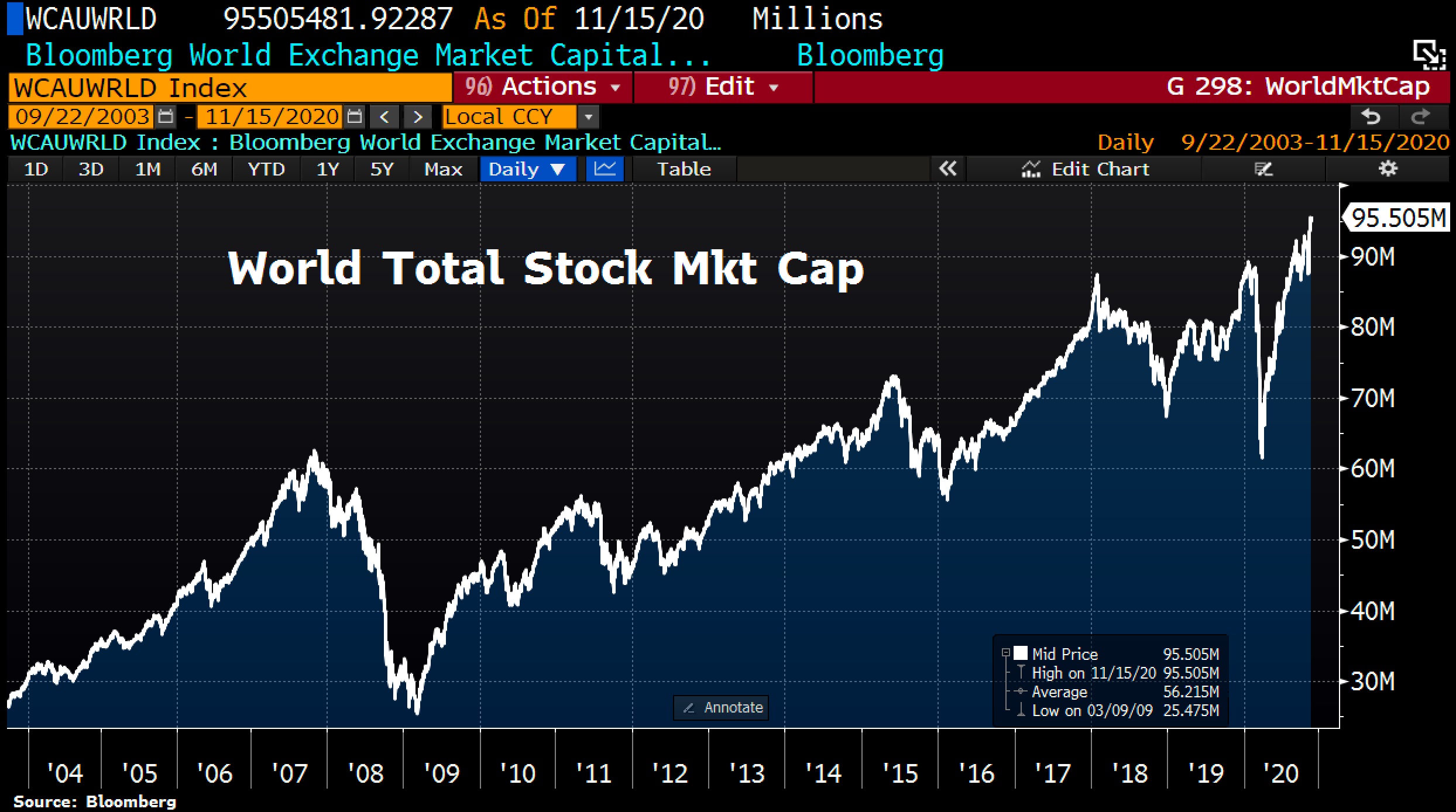
In the process, corporate asset prices have been bid to record highs once more.  As in similar fateful periods like the late ’20s, ’60’s, ’90s, and 2007, this price-indiscriminate behaviour has bought the perverse opportunity set of high capital implosion risk and still-low yields–since the higher the price paid, the lower the investment yield inherent–that’s just the math.  As shown below, global stock markets this week reached a record market capitalization (price x shares) of $95 trillion–the highest in history.

We should also note here that the one-month-meltdown between February and March 2020 returned global markets to the same level they had peaked at in 2007–13 years earlier.  And, although secular forces of gravity were stalled by central bank backstops since, a retest of March 2020/December 2007 price levels remains probable ahead.

A vaccine can’t fix any of this, but history assures us that much lower asset prices eventually will.  We should all look forward to and prepare for that opportunity.

There’s no free lunch.  Presently most items on offer at the financial product buffet offer negative health effects. Like highly processed junk food, they may look easy and attractive but will leave us in worse shape over time.

There are many healthy, life-sustaining choices, though, and they include:

  • Doing everything possible to make our mind and body healthy and productive.
  • Spending less than we make at every life stage.
  • Living debt-free.  If we need to borrow for a home or our business, getting back to debt-free as soon as possible thereafter.
  • Actively earning an income well into our 60s to cover expenses and build savings.
  • Keeping principal security as our dominant savings’ objective even when yields are low.
  • Knowing what attractive investment value looks like and not wagering our capital unless the risk-return odds are solidly in our favour.
  • Deferring Canada Pension Plan withdrawals until after 65, where possible, because we will receive 36% less income for the rest of our life if we take it at age 60 versus 65 and 42% more if we can wait until age 70. (CPP is permanently reduced by 7.2% for each year if taken between 60 and 65, and permanently increased by 8.4% for each year that collection is deferred between 65 to 70).
  • Where we need or wish more reliable retirement income than our pensions and principal-secure assets can provide–rather than betting money we can’t afford to lose in casino-like markets and schemes--we can consider using some non-registered savings to buy a life annuity with a guarantee period.  Although annuity yields are also linked to interest rates, when buying them after age 60, the guaranteed after-tax income-for-life can still be more than 4% (yes, you do have to give up the principal to buy one).

These are tangible steps that really add up over time.  As always, personal discipline is the highest yielding investment and, fortunately, it’s mostly within our control.

Posted in Main Page | Comments Off on There’s no free lunch, but there are healthy choices