The BioNTech and Pfizer vaccine announced last week was developed by the husband and wife-co-founders of BioNTech, Dr. Ugur Sahin (age 55) and Dr. Özlem Türeci (age 53), and their team, based in Germany. See The Husband-and-Wife-Team Behind the leading vaccine to Solve COVID-19:
BioNTech began work on the vaccine in January, after Dr. Sahin read an article in the medical journal The Lancet that left him convinced that the coronavirus, at the time spreading quickly in parts of China, would explode into a full-blown pandemic. Scientists at the company, based in Mainz, Germany, cancelled vacations and set to work on what they called Project Lightspeed.
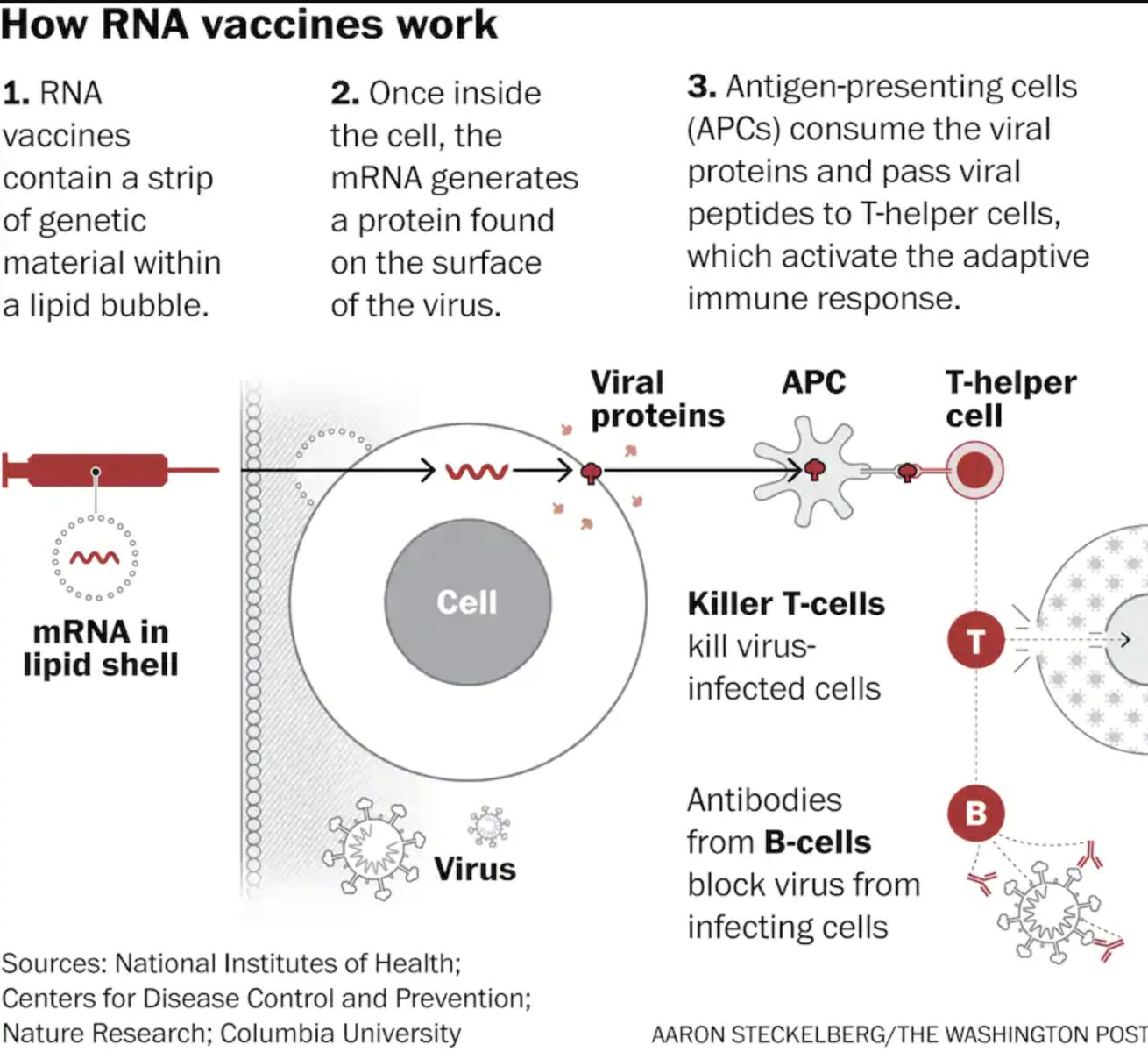
In 2001, the couple founded Ganymed Pharmaceuticals to develop drugs to treat cancer using monoclonal antibodies. In 2016, they sold Ganymed for $1.4 billion. In 2018, Dr. Sahin said at an infectious disease conference that their company might be able to use its so-called messenger RNA technology to rapidly develop a vaccine in the event of a global pandemic. The below graphic from the Washington Post shows how RNA vaccines work.
 Last year BioNTech went public–its shares doubling since June, to a recent market cap of $21 billion–making the two co-founders among the wealthiest people in Germany.
The billionaire scientists reportedly still live with their teenage daughter in a modest apartment near their office, ride bicycles to work and do not own a car.
They partnered with Pfizer to accelerate the testing and distribution of their vaccine and they’ve not yet finalized the financial details of their agreement. The reported results of their recent trials have not yet been peer-reviewed.
Mass-vaccination campaigns involve a complex network of suppliers, transporters, administrators and middle-people at the best of times. BioNTech’s has the added challenge of needing two doses per person, administered 4 weeks apart, and storage around minus 70 degrees Celsius (-94 Fahrenheit–similar to the South Pole in winter) which no hospitals, medical offices or transportation vehicles currently possess.
Speaking to the BBC’s this week Dr. Sahin said that if their vaccine succeeds it would reduce transmission of the virus – but some difficult days still lie ahead.
Here is a direct video link.
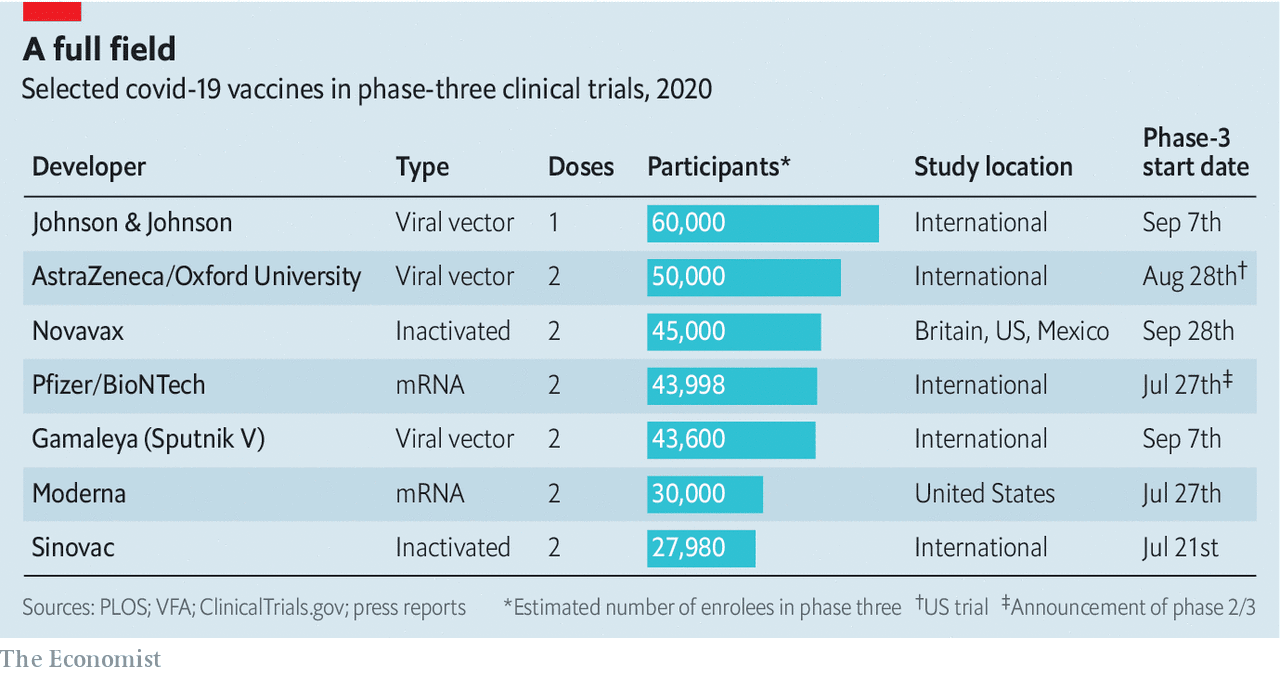
The below graphic from The Economist summarizes the seven leading vaccine contenders currently in phase three trials. Here’s hoping…In the meantime, it appears, in a best-case scenario we face another nine to twelve months of disciplined social distancing and mask use, not to mention associated financial, social and mental health challenges. Could be longer. Acceptance, patience and a longer-term mindset are key.