A Good War: Mobilizing Canada for the Climate Emergency

For some time, I’ve described the climate and pollution challenges at hand as our generation’s war effort.  Seth Klein comes to a similar conclusion in his new book, A Good War:  Mobilizing Canada for the Climate Emergency.  He joined CBC’s The Current last week to discuss.  Worth a listen; here’s a direct audio link.

There is a “new climate denialism” that is impeding efforts to fight the environmental crisis, according to a public policy expert who argues Canada must mobilize like it did for the Second World War.

“The new climate denialism is when our leaders say that they get the climate crisis, but then they don’t practise politics that aligns with what the science says we have to do,” said Seth Klein, the former B.C. director of the Canadian Centre for Policy Alternatives, and author of A Good War: Mobilizing Canada for the Climate Emergency.

“That is really the Phoney War period in which we currently live,” he told The Current’s Matt Galloway.

Posted in Main Page | Comments Off on A Good War: Mobilizing Canada for the Climate Emergency

Stock holders face capital loss and negative return prospects…no cake and eat it too

GMO co-founder Jeremy Grantham recently reaffirmed his assessment that the stock market is in a bubble.  One can own stocks in a bubble and lock in poor prospective returns, or buy them after prices burst and enjoy years of steady returns thereafter.  There is no cake and eat it too.

“The more spectacular the rise and the longer it goes, the more certainty one can have that you’re in the ‘Real McCoy’ bubble.”…

“The one reality you can never change is that a higher-priced asset will always produce a lower return than a lower-priced asset. You can’t have your cake and eat it. You can enjoy it now, or you can enjoy it steadily in the distant future but not both. And the price we will pay for having this market go higher and higher is a lower and 10-year return from the peak.”  Here is a direct video link.

John Hussman shows us the math behind Grantham’s statements this month in Pushing Extremes with the following two charts.  The first shows his Margin-Adjusted Price to Earnings ratio (MAPE), which is better correlated with actual subsequent market returns than nearly every measure tested and has enough data history to see that the valuation of U.S. stocks has never been more extreme since 1928.
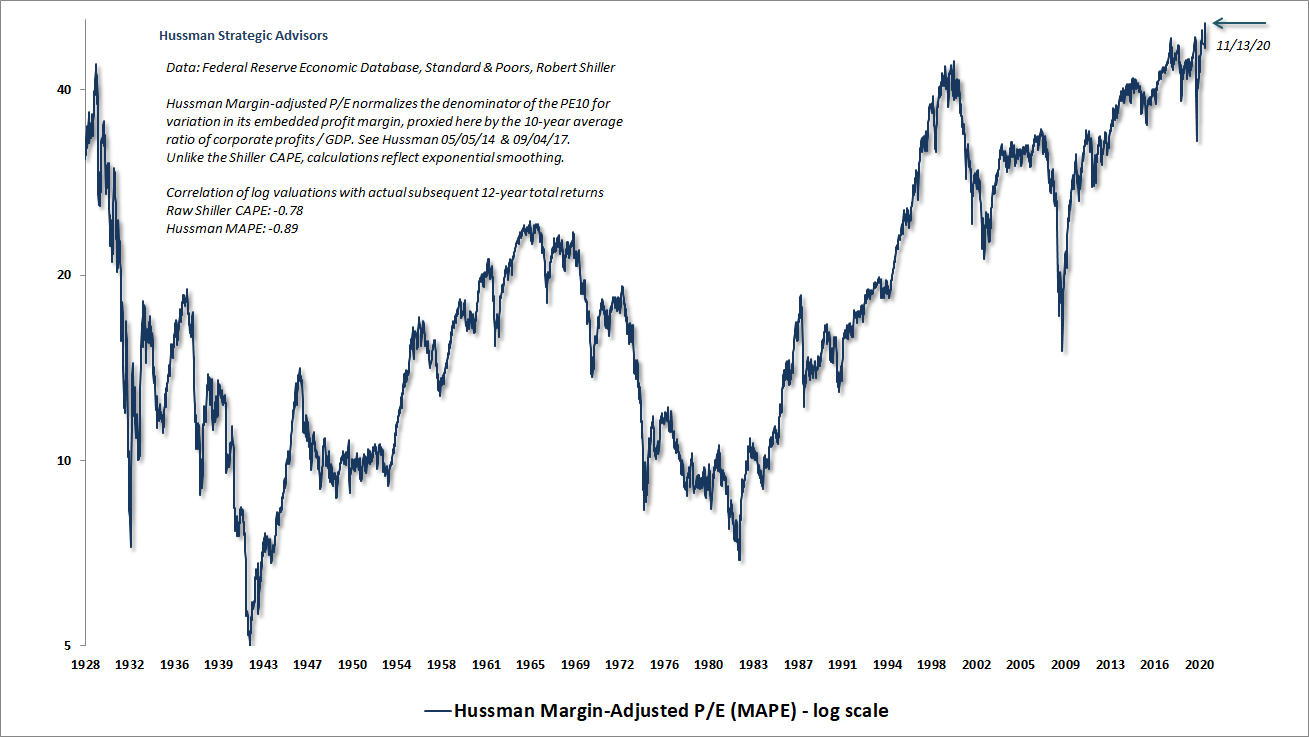
This matters because the presently extreme pricing locks in the prospects for negative annualized returns over the next 12 years, as shown in John’s second chart below.
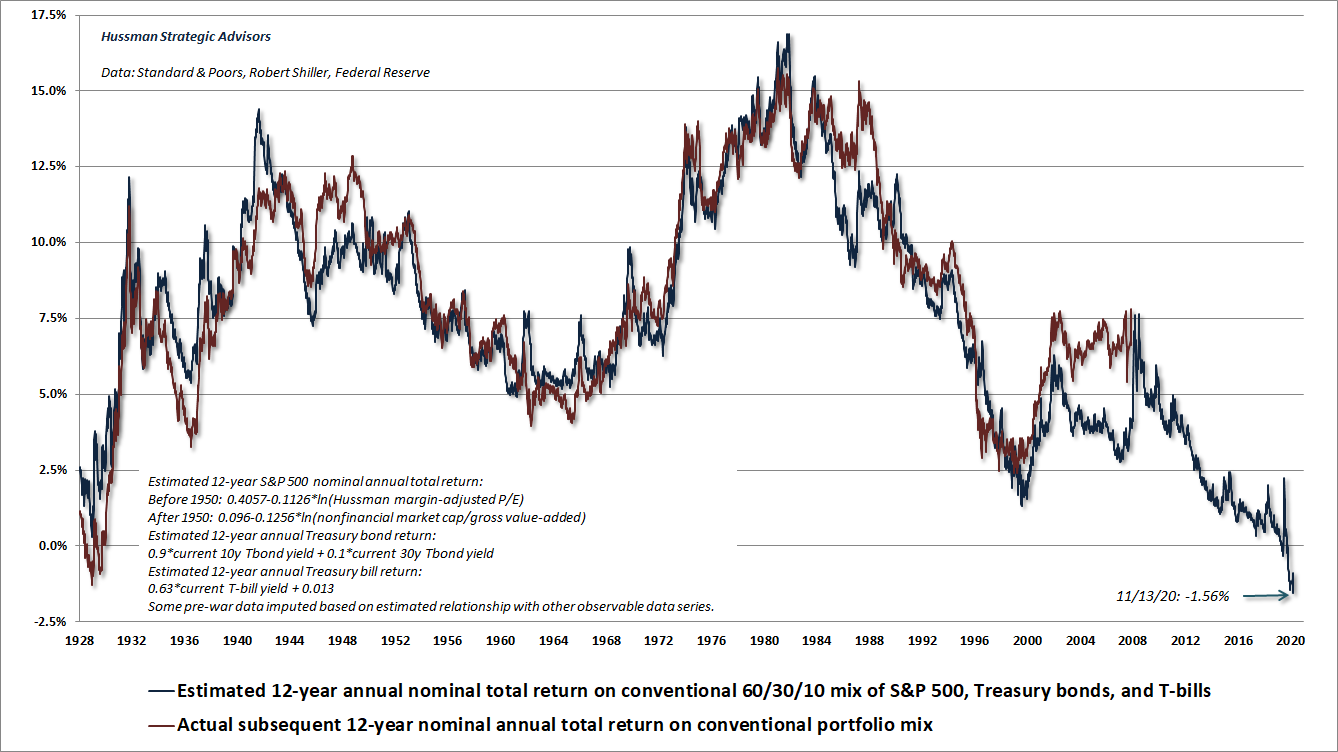
From here, the projected 12-year nominal average annual total return for a typical passive portfolio invested 60% in stocks (the S&P 500), 30% in Treasury bonds and 10% in Treasury bills (cash) is -1.56%, and the worst it has been in nearly a century of data, including the market extremes of 1929 and 2000.

A higher stock-weighted portfolio would be projected to fare even worse.  The red line (which ends 12 years ago) shows how closely the actual subsequent 12-year total return on a balanced portfolio has tracked its projected return through time.

A lack of price-discipline may look like it’s rewarding in the short run, but ultimately it is repaid in years of trying to grow back principal.  That’s just the facts…

Posted in Main Page | Comments Off on Stock holders face capital loss and negative return prospects…no cake and eat it too

Renewable energy and EVs have cost/benefit advantage

The energy sector in southern Alberta has over $2 billion worth of renewable energy projects being built in the region.  The related new jobs and tax revenue are much needed.  See: Southern Alberta witnessing ‘unprecedented’ surge in renewable energy projects.

The renewable energy sector in southern Alberta is riding high with projects surging like never before. Taz Dhaliwal finds out what’s driving the boom.  Here is a direct video link.

This global trend is exploding because new wind and solar installations with battery storage are more cost-effective than new fossil fuel production and peaker plants.

The EU is planning to increase its offshore wind capacity by 250% with wind farms in the North Sea, the Baltic, the Atlantic, the Mediterranean and the Black Sea (creating an estimated 62,000 jobs).  See:  EU plans to increase offshore wind capacity by 250%.

The UK has committed to powering all of its homes from offshore wind and banning internal combustion engines by 2030–ten years earlier than previously planned.  See:  UK’s Green Plan backs 250,000 jobs and bans gas car sales.

Bill Gates estimates that more than 50% of business travel will disappear permanently in the post-COVID world, and the Bank of Canada is recommending that the Federal Government work with them in seizing “the climate-smart opportunities that consumers, workers and investors are looking for.”  See:  Canada needs to pick up pace on tackling climate change, Tiff Macklem says:

Macklem said the risks from more extreme and more frequent weather events are often underappreciated, while risks linked to future earnings or asset evaluations are mispriced in the context of climate change.

“The longer that persists, the greater the risk of a sharp repricing, with the potential for substantial losses for financial institutions,” he said.

Posted in Main Page | Comments Off on Renewable energy and EVs have cost/benefit advantage





