This bounce is not a recovery

Two worthwhile reads this sunny August amid casino-quality financial markets:

The first is foreign affairs expert Ian Bremmer’s latest piece in Time Magazine, see:  The Next Global Depression is Coming and Optimism Won’t Slow it Down.  It includes this illuminating chart of recessionary job loss and multi-year recovery times since the 20th century.
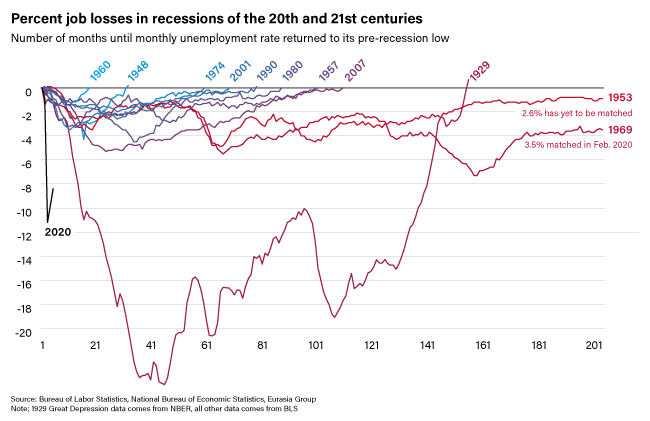
Bremmer discusses the jobs recovered so far in 2020 and adds:

Now for the bad news. First, that data reflects conditions from mid-June–before the most recent spike in COVID-19 cases across the American South and West that has caused at least a temporary stall in the recovery. Signs of corporate economic distress are mounting. And second and third waves of coronavirus infections could throw many more people out of work. In short, there will be no sustainable recovery until the virus is fully contained. That probably means a vaccine. Even when there is a vaccine, it won’t flip a switch bringing the world back to normal. Some will have the vaccine before others do. Some who are offered it won’t take it. Recovery will come by fits and starts.

He explains how depressions unfold and impact behaviour:

A depression is not a period of uninterrupted economic contraction. There can be periods of temporary progress within it that create the appearance of recovery. The Great Depression of the 1930s began with the stock-market crash of October 1929 and continued into the early 1940s, when World War II created the basis for new growth. That period included two separate economic drops: first from 1929 to 1933, and then again from May 1937 into 1938. As in the 1930s, we’re likely to see moments of expansion in this period of depression.

Depressions don’t just generate ugly stats and send buyers and sellers into hibernation. They change the way we live.

Another worthwhile article is by economists Carmen and Vincent Reinhart in the September 2020 Foreign Affairs publication, see The Pandemic Depression.  The Global economy will never be the same.  They offer important context for where we are now, and why partial re-openings and some bouncing asset prices do not signal economic recovery nor that the financial crisis has passed.  Here’s a taste:

The pandemic has created a massive economic contraction that will be followed by a financial crisis in many parts of the globe, as nonperforming corporate loans accumulate alongside bankruptcies. Sovereign defaults in the developing world are also poised to spike. This crisis will follow a path similar to the one the last crisis took, except worse, commensurate with the scale and scope of the collapse in global economic activity. And the crisis will hit lower-income households and countries harder than their wealthier counterparts. Indeed, the World Bank estimates that as many as 60 million people globally will be pushed into extreme poverty as a result of the pandemic. The global economy can be expected to run differently as a result, as balance sheets in many countries slip deeper into the red and the once inexorable march of globalization grinds to a halt.

…Some important economies are now reopening, a fact reflected in the improving business conditions across Asia and Europe and in a turnaround in the U.S. labor market. That said, this rebound should not be confused with a recovery. In all of the worst financial crises since the mid-nineteenth century, it took an average of eight years for per capita GDP to return to the pre-crisis level. (The median was seven years.) With historic levels of fiscal and monetary stimulus, one might expect that the United States will fare better. But most countries do not have the capacity to offset the economic damage of COVID-19. The ongoing rebound is the beginning of a long journey out of a deep hole.
Posted in Main Page | Comments Off on This bounce is not a recovery

US dollar stalks risk markets everywhere

After weakening since the end of March, the US dollar index had the most negative month in a decade in July as US Treasury rates slumped, government spending leapt and plunge protection teams pumped equity futures nightly.

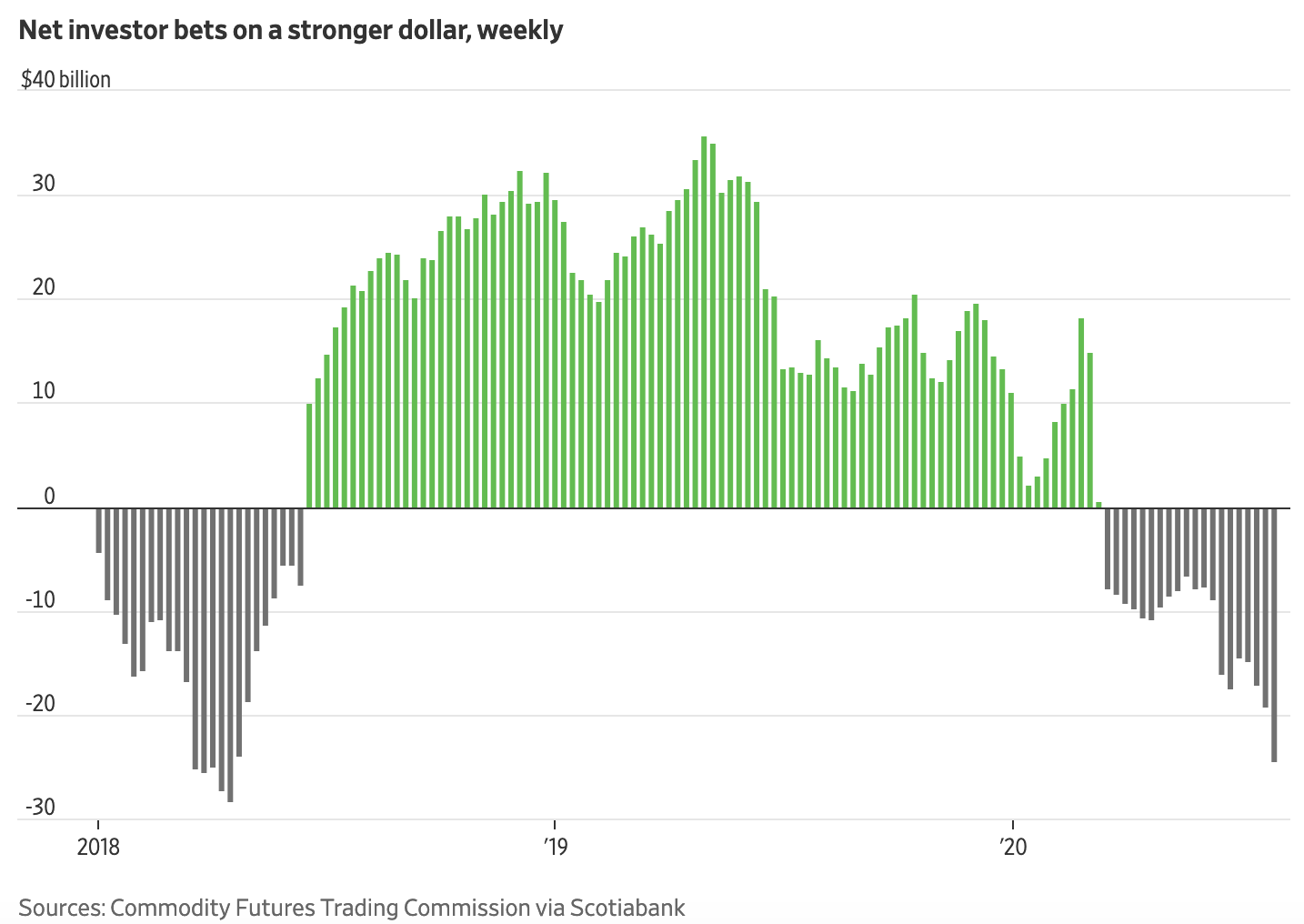
The consensus is now betting on more of the same. As shown on the left, courtesy of the Wall Street Journal, net short positions betting on a weaker greenback today are the largest since the second quarter of 2018 (just before the dollar bounced and risk markets tanked). The latest second-quarter positioning looks similar, see Behind the vast market rally: A tumbling dollar:

Hedge funds and other speculators are favoring everything from the Swedish krona to the Brazilian real, positioning for more dollar weakness. Net investor bets on a weaker dollar recently climbed to their highest level since April 2018, Commodity Futures Trading Commission data compiled by Scotiabank show.

“We are in a stage of very high momentum,” said Ed Al-Hussainy, senior interest-rate and currency analyst at Columbia Threadneedle Investments. He is betting that emerging-market currencies such as the Mexican peso and South African rand will extend their recent rebound. “Everybody is getting caught up in it.”

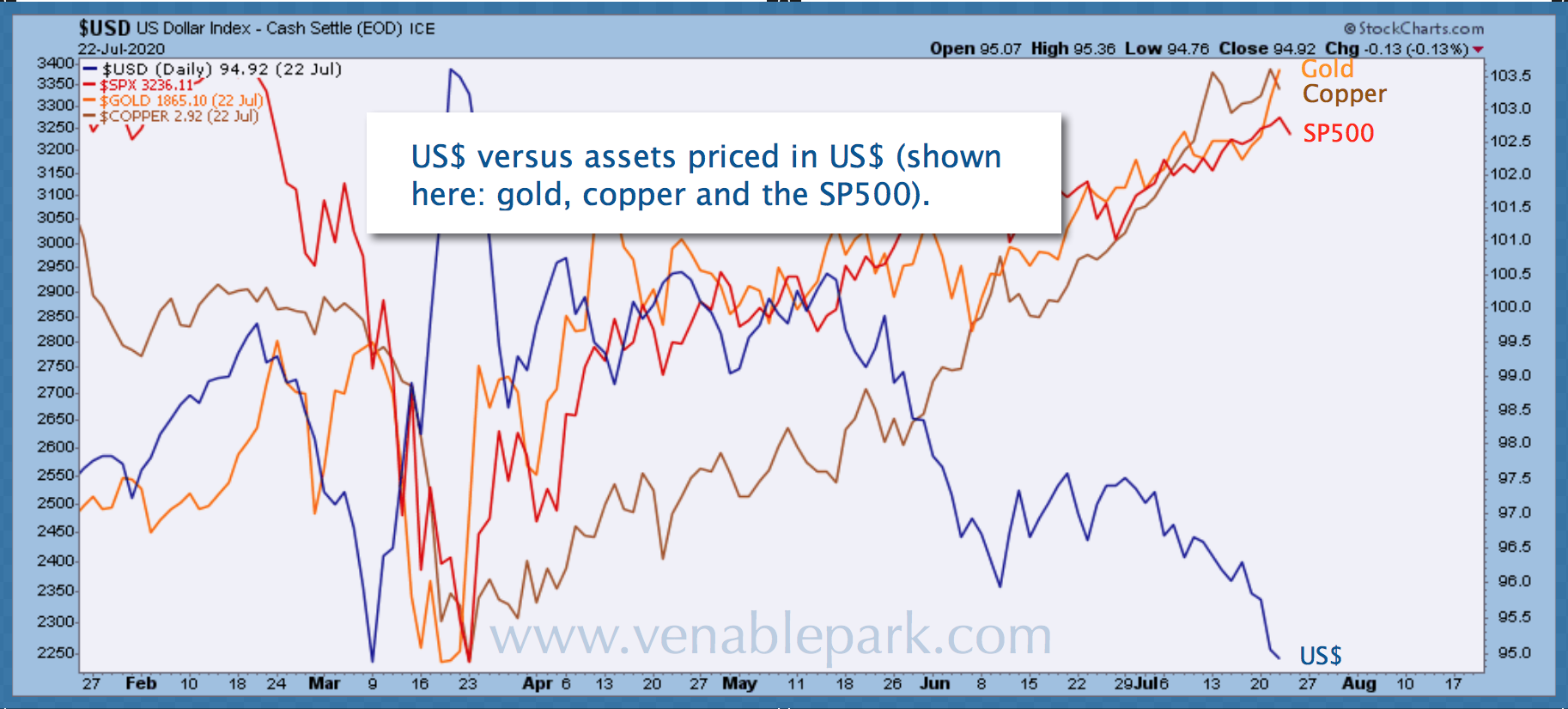
As the dollar has slumped since March (blue line below), risk assets priced in dollars have staged their typical inverse move, as shown below in my partner Cory Venable’s chart with gold bullion (in orange), copper (in brown) and S&P 500 (in red) leaping (along with most other commodities and cryptocurrencies).
What happens next should be top of the risk management agenda for everyone. The dollar is still the global reserve currency, and the next bounce from oversold conditions threatens carnage for assets on the other end of the teeter-totter.

In 2019, eighty-eight percent of global trade was conducted in the US dollar along with sixty-one percent of all foreign bank reserves and nearly 40% of the world’s loans. To make payments, debtors and buyers of goods and commodities priced in dollars need to acquire the currency through incoming trade flows or selling other assets and currencies. Less global trade means fewer dollars circulating into the hands of those needing them for payments. This is why recessions trigger waves of desperation for dollar liquidity and panicked selling of other assets to get cash.

The corona crisis has accelerated a global trade slump with an unprecedented 92.9% of countries in recession in 2020–well above the 83.8% high recorded during the Great Depression and the 54.3% average of the 15 global recessions since 1871.

The present ‘greatest recession’ is still unfolding, and the next wave of dollar strength stalks risk assets everywhere. Lest we forget.

Posted in Main Page | Comments Off on US dollar stalks risk markets everywhere

‘A huge experiment’: update on COVID-19 vaccine progress

Never before have prospective vaccines for a pathogen entered final-stage clinical trials as rapidly as candidates for Covid-19.  Hopes and stakes are incredibly high.

For an excellent update on the most technologically enabled race for a vaccine in human history read ‘A huge experiment’: How the world made so much progress on a COVID-19 vaccine so fast.  Still, even best-case scenarios require realism:

A vaccine that prevents even 50% of infections would be a massive lifeline. But experts worry there’s a disconnect between a public expecting vaccines to instantly reset their lives and what the first vaccines may actually allow. Successful vaccines will likely be restricted to frontline workers and vulnerable populations at first. It could take some time for enough vaccine to be made for everyone who wants a shot. Some vaccines might require two doses to confer protection.

“It might not be some magic bullet that’s going to stop the pandemic in its tracks, and people need to be prepared for that possibility,” said Columbia University virologist Angela Rasmussen about the first vaccines that reach people. “I really hate the term vaccine race. Because that implies there’s going to be a medal ceremony, and the pandemic is over.”

Posted in Main Page | Comments Off on ‘A huge experiment’: update on COVID-19 vaccine progress