
The WSJ Daily Shot chart below (since 1990) shows the unprecedented gap between the S&P 500 index price (red) and after-tax corporate profits (in black). The disconnect is wider today than the pre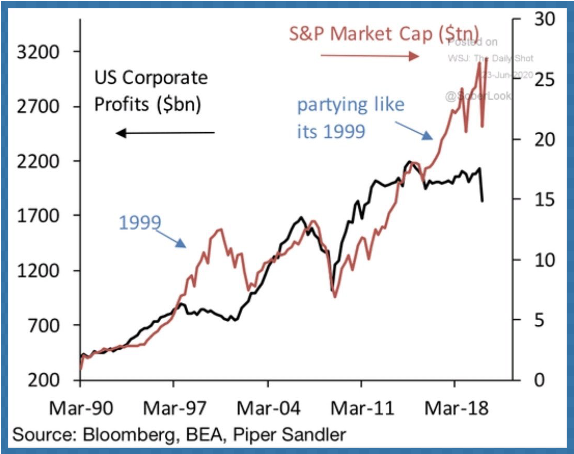 vious tech bubble top in 1997-2000.
Although bulls always urge that fundamentals are irrelevant and ‘this time is different’, it’s worth noting that stock prices have caught back down to corporate profit levels during every prior recession/bear market. This is because corporate revenues, jobs and profits cannot be manufactured by governments or central banks, but depend on consumption, corporate investment, imports and exports. All of these components tend to drop together in recessions, let alone when an unprecedented 93% of the world’s economies are in an ongoing economic contraction. Today, every country is desperate for customers all at the same time.
Over the last thirty years, progressively higher consumer spending and debt have coincided with falling corporate taxes, low savings rates, gambling preoccupation and boom-bust asset cycles. All were deleterious to present resilience as we encounter the first economic depression since the 1930s. Case in point: a decade long economic expansion, with record corporate profits and rock-bottom unemployment and interest rates, ended this year with the majority of households and businesses unable to withstand even a month of lost income.
Financial discipline is systemically deficit just as expected returns for most investable assets are nil to negative and further capital losses untenable. Adding more household debt and risky assets at extreme valuations to try and reboot spending and net wealth will not work this time, in fact, precisely the opposite.
This suggests a secular (ie., multi-year) downtrend in sales and profits for most businesses (a reliably mean-reverting series through history) with a reduction in debt (via refinancing, repayment, defaults, closures and restructuring), fewer share buybacks, lower dividend payouts, forced asset sales and a laser focus on improving efficiency and productivity. All are necessary parts of the path out of the present nightmare.









