
Non-animal food: here to stay

Growing animals to feed nearing 8 billion humans was not ecologically sustainable before the COVID-19 outbreak, now, the spreading realization that most epidemics cross to humans from animals is another factor accelerating appetite for alternative food sources.

An explosion of plant-based chefs and recipes are showing more people every week that non-animal diets can be extraordinarily delicious and healthy. In the United States, plant milk sales grew 61% from 2012 to 2018.[26] Oat milk sales increased by 250% in Canada during 2019 alone.[27]

For those still open to highly processed foods, plant-based meats have also been rapidly gaining market share. Lab-grown meats are an offering for those who can’t imagine not eating animal flesh. All of these options are the future of food. See Cell-based meat benefits include, helping save our future, advocates say:

By now you’ve likely heard about the concept: “clean” meat, they call it. A small sample of stem cells is taken from a cow or a chicken, and those cells are cultivated to make edible meat, without having to raise or slaughter an animal to acquire it. If you’re already on board with this idea, you’re part of a growing appetite for cell-based meat. If you’re still iffy, get ready to “Meat the Future.”That’s the name of a documentary that follows Memphis Meats, one of the players in the rapidly growing industry of cell-based meat. Memphis Meats is in a race to perfect its product and replicate the look, feel texture and taste of animal-harvested meat and bring it to your plate at a reasonable price. Here is a direct video link.

Posted in Main Page | Comments Off on Non-animal food: here to stay

Household behavior shifts: positive longer term, negative for economy near term

Half of the independent Canadian restaurants recently surveyed say that they are unlikely to survive the current crisis.  This is bad news for small business owners in the sector, as well as related lenders, employees, landlords, economic growth and tax collection.

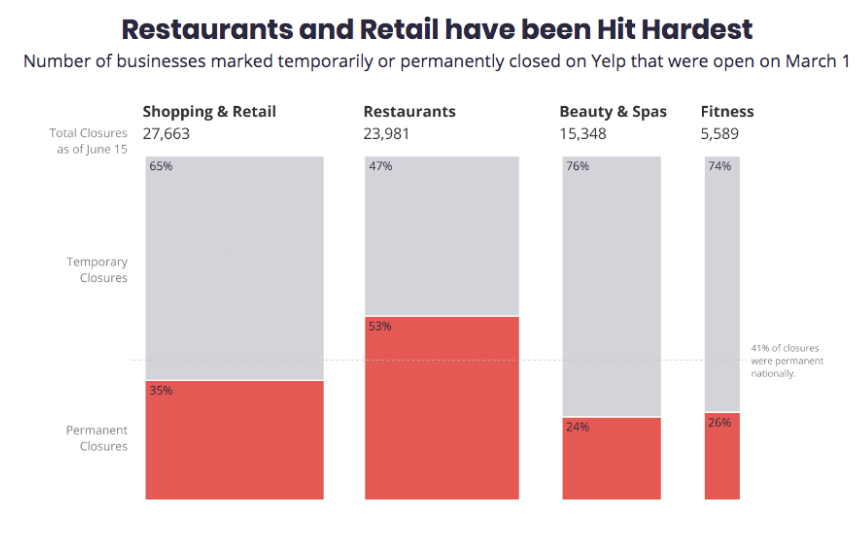
A similar trend is evident in the American data and surveys as shown in the chart below courtesy of Yelp.  Forty-one percent of business closures in the household service and retail space since March 1 have been noted as permanent, led by  53% of restaurants.

But there is also a positive side to this story for households.  The explosion in eating out and prepared food consumption over the past 15 years helped to drive a pandemic of debt and food-related illness throughout North America.  This has come at a heavy cost to family health, self-sufficiency, culture and our tax-funded sick care system.  More people preparing their own food at home also means less throwaway packaging and plastic toxins in our environment and bodies.  For more on this see:  We are all plastic people now, in ways we can’t see – and can no longer ignore.

Recent consumer surveys show that overall Canadians are feeling less stressed about their finances now than at the start of the year.  As consumer solvency trustee Scott Terrio explains in the segment below, this is because they are spending less on child care, commuting and eating away from home, but also because they are receiving emergency government subsidies and many debt payments are in deferral.  The latter two factors have bought a temporary lull before the default storm that’s building  The behavioural change toward spending less and saving more, meanwhile, is likely here to stay.  This shift was long overdue and much needed.  It is also a negative for economies like Canada and America that are today 60 to 70% reliant on consumer spending.

Scott Terrio, manager of consumer insolvency at Hoyes, Michalos & Associates joins BNN Bloomberg to discuss the MNP Consumer Debt index which highlights the importance of the Canadian government programs for the financially vulnerable and highly indebted. Here is a direct video link.

Posted in Main Page | Comments Off on Household behavior shifts: positive longer term, negative for economy near term

Next waves in motion

Classic: recurrence waves and spreading frustration with leaders as no quick fix is found.

Global coronavirus cases are now above 14 million, with deaths over 600,000. Infections are also rising in the state of Victoria in Australia with masks now mandatory starting this week in Melbourne. People are now facing steep fines if they are caught without a mask on in public. Infections continue to rise in the U.S. with record numbers also being recorded in Hong Kong and in Tokyo. Bloomberg’s Yvonne Man reports on “Bloomberg Daybreak: Asia.”  Here is a direct video link.

Posted in Main Page | Comments Off on Next waves in motion



