Embracing the timeless “Three Cs”

Having recently read several books on the history of pandemics, I am reminded that their recurrence and human behaviour have been consistent throughout the millennium.  And it is typical for incumbent politicians and policymakers to downplay spread risks in an effort to maintain power, consumer spending and the economy.

In the end, though, measures needed to end a pandemic are the same today as they have been for centuries:  social distancing, masks and hand washing.  Avoiding crowded spaces, and especially wherehttps://www.telegraph.co.uk/content/dam/global-health/2020/07/18/EcNS0dZUMAAN6v_trans_NvBQzQNjv4BqqVzuuqpFlyLIwiB6NTmJwfSVWeZ_vEN7c6bHu2jJnT8.jpg?imwidth=1280 enclosed, is a major element of the social distancing (six feet minimum spacing) needed.

In Japan and other parts of highly populated Asia, these imperatives have long been understood.  How many of us have seen travellers wearing masks in airports over the years and wondered why?  Now we know.  The public service announcement on the left from Japan’s prime minister’s office explains the “Three Cs” of spread and how risks are highest where they overlap.

Unfortunately, for all hoping that things can get back to normal soon, a couple of places where the C’s overlap most are schools and group care centers since it’s very difficult to maintain the constant six feet of spacing needed between children.

A recent UK study looked at nine interventions to reduce the spread of COVID-19 in 41 countries between January and April 2020 and found eight of them were effective but closing schools reduced the R the most (an average of 50%).  Other lesser but still effective efforts included: closing non-essential businesses (34%); closing high-risk businesses (26%); limiting gatherings to 10 people or less (28%); and issuing stay-at-home orders (14%).

The “surprisingly large role for schools” the study found may partly explain why the UK did not order a full return to office work this week and why schools and group care centers are unlikely to remain open as usual in many areas.  When they do reopen, community spread typically accelerates and the need for lockdown returns.

While the COVID-19 rate of spread has fallen in Canada in recent weeks it is still accelerating around the world, and no one is out of danger.

Half of the last big respiratory outbreaks have come with significant subsequent waves after a summer trough.  As soon as the bad weather comes and more people start staying indoors again, a resurgence of COVID-19 along with other flu should be expected (descendant strains of the 1918 influenza still circulate today–it has weakened, but no vaccine has stopped it).

Business, income and social disruptions will cause hardship, but not embracing the “Three C’s” will make the battle longer and casualties worse.
Posted in Main Page | Comments Off on Embracing the timeless “Three Cs”

Banks and borrowers not in quick recovery

While the tech and the precious metals sector have to date recovered sharply from the first leg of the 2020 market plunge, other more economically reflective sectors like financials, energy and real estate investment trusts are not feeling the same optimism and remain mired in a bear market.  See Blackstone to shutter real estate income fund for a taste of what’s unfolding.   As the Trump admin works daily to prop up the stock market as key to its re-election bid in November, a financial pandemic continues to undercut the real economy and national income.

Dick Bove spent decades as a US bank analyst and was traditionally very bullish on the sector. His new position as a strategist evidently affords him a wider scope to acknowledge downside risks and his comments on BNN this week offer some big picture insight on US banks and the economy.  Here is a direct video link.

An important caveat I would add:  while JP Morgan is widely considered ‘best of class’ in investment banks and Bove praises CEO Jamie Dimon, the bank’s share price remains 40% below its February high, and the giveback and write off part of this credit cycle is only just started.  A similar story is playing out for Canada’s ‘best in class’ banks.

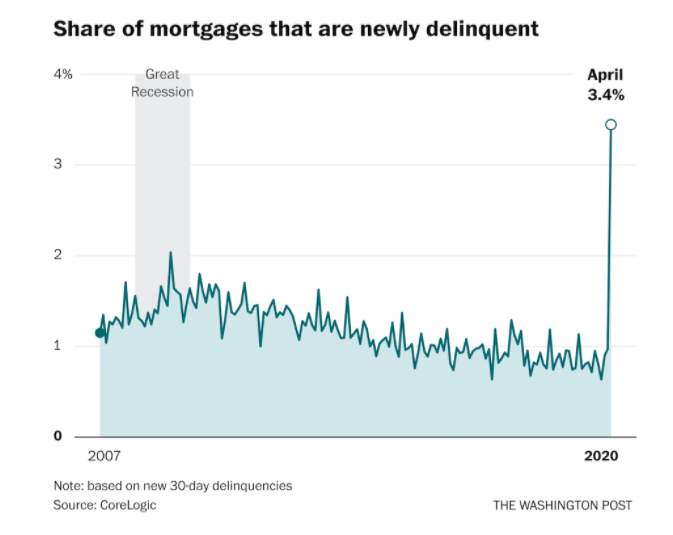
One problem area is the share of mortgages newly delinquent.  The chart beside shows the US trend to the end of April and compared with the 2008 recession.

Even excluding approved mortgage loan deferrals for qualified borrowers, a US Census Bureau survey shows that as of June 30, about 8.4 million households had missed a mortgage payment in the past month and that was up from the end of April. The Mortgage Bankers Association reports 4.1 million households were in forbearance as of July 5.   Millions more who didn’t have a loan backed by the federal government weren’t eligible for the forbearance program and so some loans are going right into delinquency with more likely to follow when permitted deferral periods end.   See  An indicator that presaged the housing crisis is flashing red again.

Similar trends are evident in Canadian household loans, with deferral programs delaying and increasing the likelihood of insolvency filings for many households. Canadian insolvency trustee Doug Hoyes explains in Insolvency Predictions post-COVID-19:

Mortgage and payment deferrals will add to consumer credit balances post COVID-19.  The deferrals are beneficial to help individuals manage cash flow and help lenders manage delinquency rates but the end result is larger balances for longer.

With less ability to pay, many individuals will make partial payments on credit card debt and other obligations, resulting in growing rather than declining credit balances. Delinquencies will increase. While some credit card companies are offering to lower interest rates, interest will still accumulate on ever higher balances.

Worse, some consumers will manage the crisis by taking on more debt. What is worrying is that much of the borrowing will be in the form of high-interest subprime debt, including payday loans and high-interest financing loans. Heavily indebted consumers were already relying on these types of loans to make ends meet before the crisis, and they are increasingly likely to do so now. Alternative lenders will see higher delinquencies and losses in the short run but may offset this financially with massive loan growth.

…Payments through the government economic response programs like CERB will offset some of the demand for more credit and default rates. It is too soon to predict exactly how high insolvencies will rise, how quickly and for how long. However, we do know that Canadians will experience fallout from the heavy burden of debt they carried into this crisis and that the tail will be long.

Companies have also piled on debt during the pandemic, with global firms selling a record $2.1 trillion of bonds to investors this year and nearly half coming from U.S. issuers (Bloomberg data). With many highly indebted coming into the crisis, adding more debt now is imprudent for borrowers, lenders and investors and compounds insolvency prospects.  See:  Father of the z-score predicts a surge in ‘mega’ bankruptcies.

Posted in Main Page | Comments Off on Banks and borrowers not in quick recovery

The real economy has a message for stocks–and it’s not bullish

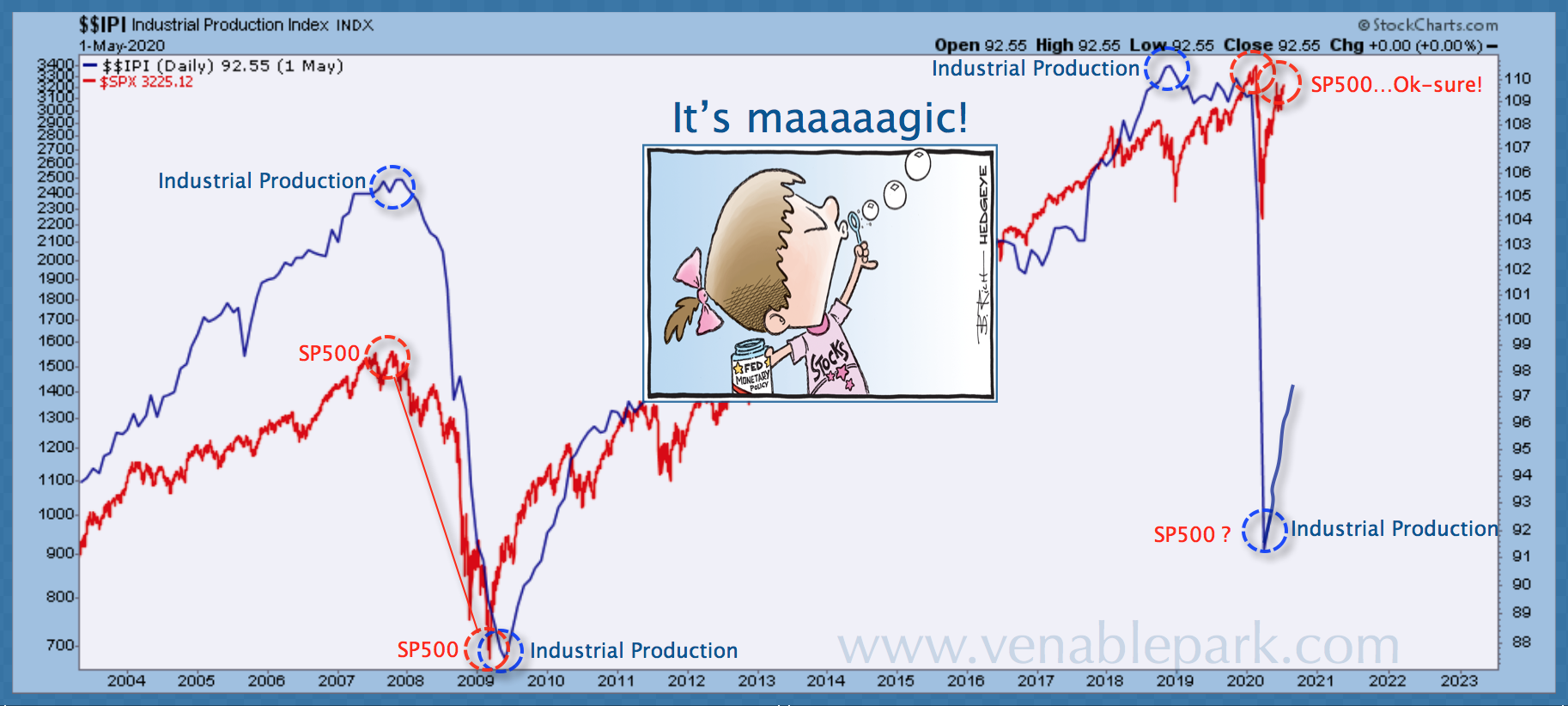
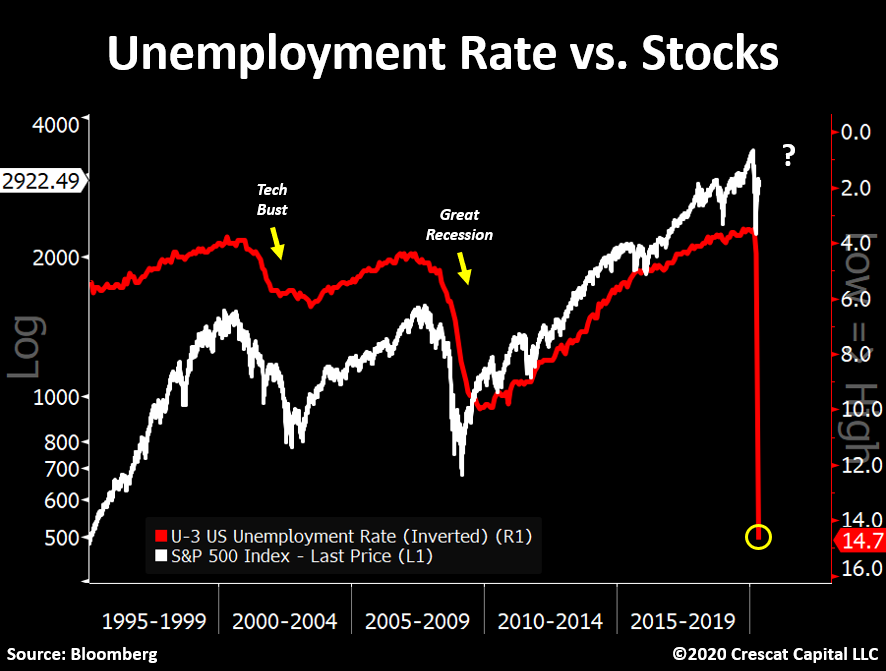
After plummeting between February 20 and March 23, the S&P 500 (below in white) rebounded sharply and is closing in on levels that prevailed at the start of this year. Unemployment meanwhile (inverted in red below), is over three times higher than it was before the Covid-19 outbreak and the highest in decades, as shown in this chart from Crescat Capital. The chart below from my partner Cory Venable shows a similar picture with US industrial production in blue since 2003 versus the wildly unhinged S&P 500 price in July (red line).

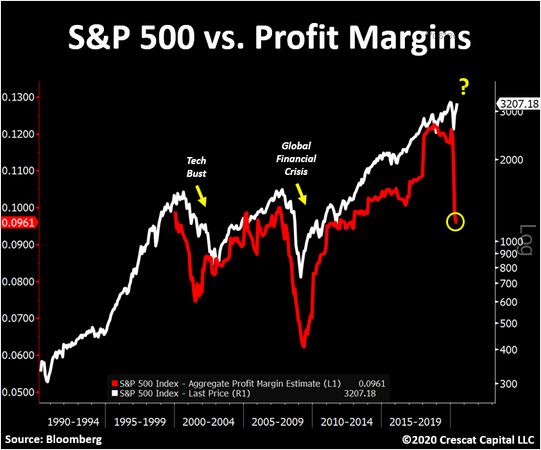
Bulls scream at times like these, “The economy is not the stock market stupid”. True, but textbooks confirm it’s supposed to be a leading indicator of the economy.  In recent cycles though, increasingly extreme plunge protection efforts by policymakers have succeeded in intermittently stalling the market’s mean reversion lower from nose-bleed levels.  Stalled, but not stopped, it must be said.  Stock prices have ended up catching down with real-world economic indicators each cycle eventually.  Oh, and profit margins too.  As shown in this other bothersome picture from Crescat Capital since 1989, estimated S&P 500 profit margins (in red) also have a signal to share about stock prices (white line) in the months ahead.  And it’s not bullish.

Posted in Main Page | Comments Off on The real economy has a message for stocks–and it’s not bullish