Retail participants going for broke (again)

Lockdowns and layoffs have given the masses both free time and a plunge in income over the past three months. This has led to a surge in gambling appetite, hoping to win money through online trading.  Last October’s switch by brokers to commission-free trades has helped to grease the mania even as custodians make hidden fees on credit balances and selling advance notice of their customer order flow to frontrunners.

It has always been the case that the public buys most at market tops and least near market bottoms.  According to data from the Financial Times, 780,000 people opened accounts with three of the four largest brokerages in the US: Charles Schwab, E-Trade, and Interactive Brokers year to date.

Besieged by click-bait and ‘how to play’ tips from the financial sales side, most participants will lose money as usual.  The trouble is, very few can afford to lose what savings they have left, and this makes our collective economic situation even more precarious. Worse, many are drawing on margin and other credit to fund their bets in financial suicide.

The overconfidence and ignorance of so many participants are writ large in chat rooms and comments on financial sites everywhere today.  This is familiar and foreboding. See  It’s a perfect storm of stupid in the stock market right now:

This herd of newbies has charged into the market at a time of incredible uncertainty. Hundreds of companies in the S&P 1500 have withdrawn their revenue guidance for 2020, leaving these new investors with little to go on in the way of forward-looking statements.

…In sum, what we have in the market is an unholy mess. We have bored, unseasoned, emotionally conflicted investors playing around in a murky pool where one of the most opaque sectors [vacinne development] has the ability to make the biggest waves. It’s very stupid — people are going to drown.
Posted in Main Page | Comments Off on Retail participants going for broke (again)

Bear markets bounce before they pounce some more

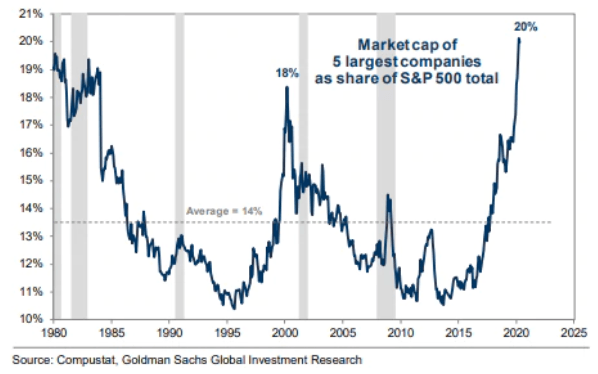
Historically, it is typical for the most widely held, over-valued stocks in a market cycle to have negative or zero returns for many years thereafter.  Today, the top five stocks in the S&P 500–Microsoft, Apple, Amazon, Alphabet (GOOGL), and Facebook–make up over 20% of the large-cap US index and 40% of the NASDAQ 100.

As shown below, this level of extreme valuation for the five largest companies surpasses even the fleeting tech-wreck top of March of 2000, whereafter a 78% decline in the tech sector helped the S&P 500 lose 50% of its value.

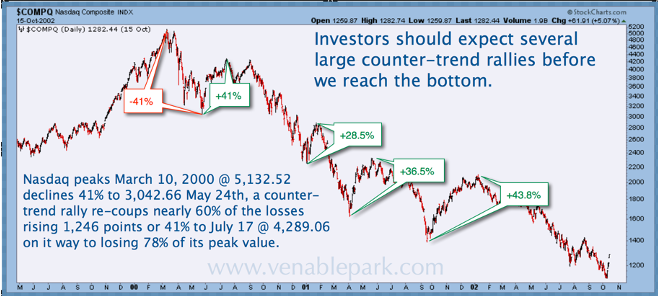
Since March 23, free-flowing funds from governments and central banks have driven a resurgence of animal spirits in market participants and the US stock market has led the world in a price bounce.  As shown in my partner Cory Venable’s chart below of the NASDAQ index from March 1999 to October 2000, very similar price action came after the first 41% drop from March to May 2000 as stocks staged the first of four 28 to 43% rebounds, during their 2.5 year mean-reversion journey back to reality.

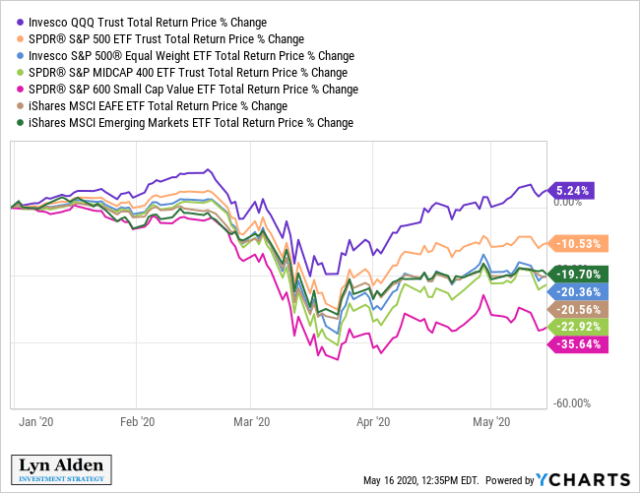
As shown below, today it is once more the NASDAQ 100 (QQQ) index leading the bounce to reclaim a 5.24% gain year to date.  At the same time, other economically sensitive small and medium cap companies as well as emerging markets and Europe, Australasia, and the Middle East (EAFE) shown below remain moribund and deeply negative.  See First Liquidity, Then Solvency.

The biggest tech darlings are overloved and concentrated in most funds and portfolios today.  This is likely to hurt returns from here.  It was not until June 2015–more than 15 years later–that the NASDAQ 100 reclaimed its March 2000 peak.  By then, most of the original holders had long since liquidated in losses.  This time is unlikely to be different.

There is no sign that the 2020 bear market has ended yet.  Buy and holders beware.

Posted in Main Page | Comments Off on Bear markets bounce before they pounce some more

New normal: consolidation in location and education

In the last decade, the dominant corporate model has been about rewarding short-term extractive shareholders and lenders, at all costs, with the masses dependent on debt to make ends meet.  The price has been lost savings and productive investment along with deficits and shortfalls compounding for years into the future.

We don’t empower a nation by taking advantage of the young and vulnerable when they are looking for help to get started.  As I explained in Young and old debilitated by debt-dependent business model:

The answer is not more loans, and lower rates and more government subsidies to for-profit-corporations; the answer is more affordable, efficient programs and systems that cost less and enrich the masses with better health, education and self-sufficiency.

Ironically, it took a pandemic to provide the inevitable tipping point.  With an abrupt drop in income, keeping up debt-fueled appearances is no longer a possibility for many. Suddenly, there is a perfectly respectable reason to seek the services of an insolvency trustee, downsize, reduce spending and look for ways to share costs.

Two areas that have driven the bulk of household debt in Canada over the last decade have been soaring real estate and post-secondary education costs.  Both have now entered into a major reset period.

Evaporation in short-term vacation renters has left many property owners without the necessary cash flow to cover carrying costs at the same time that many long-term renters are falling behind too.  This will drive more to consolidate living arrangements while pushing excess supply onto the rental market, increasing properties for sale, and exerting downward pressure for both rents and prices. At the same time, as more people work from home, many no longer need to be living in the most expensive urban centres and migration to more affordable places makes sense.  See Condo vacancies rise, rents fall as pandemic crushes GTA’s short-term rental market. Commercial properties are over-concentrated in many previous hot spots too, see: BMO says 80% of employees may switch to blended home-office work.

At the same time, post-secondary schools are being forced to offer their programs online, with the prestigious Cambridge University, England being the latest to announce today that all of its lectures will be online until the summer of 2021.

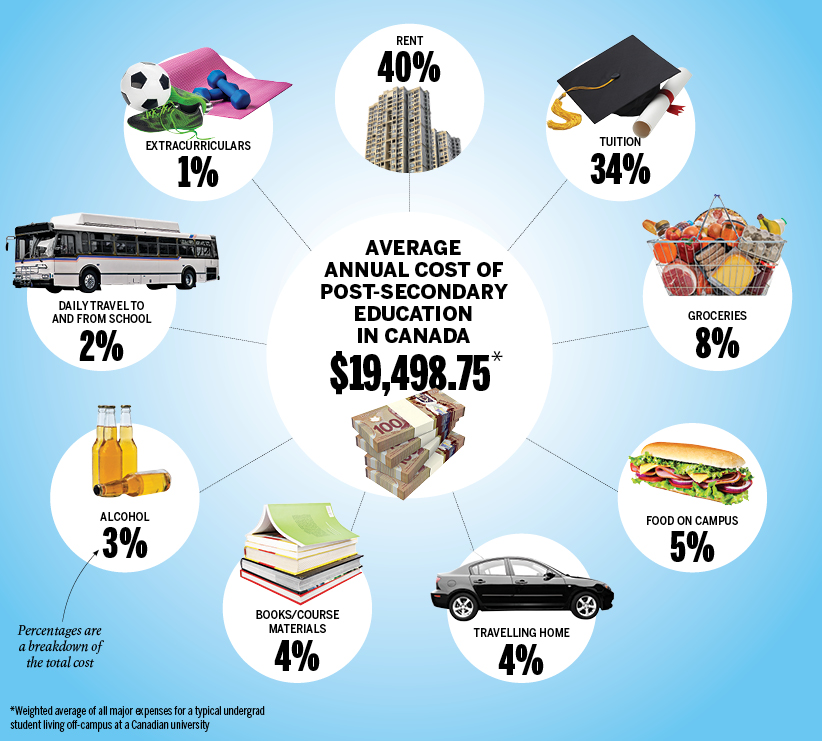
As shown in the chart below, nearly half of the average annual post-secondary costs in Canada are student rent and travel to and from school.  With just a third of students having an education fund (RESP) to draw on, funding depends on help from parents, student jobs and increasing debt for both the parents and the students.

With fewer people working and most already indebted, an obvious solution is for students to live at home wherever possible.  Online studies make this more feasible than ever. Immigrant families have long benefited by the multi-generational efficiencies of shared living arrangements, other families will do so too.

At the same time, there is an expectation that online education should be less expensive than the on-campus experience, and schools will be pressured to reduce the price of their services.

Shelter and education costs, two of the largest drivers of household debt, are coming down.  This is part of a much-needed increase in productivity, reduction in debt, higher free cash flow, and savings for the future.  But, in the process, we should expect ongoing consolidation pain in debt-inflated real estate, education and related sectors.


Posted in Main Page | Comments Off on New normal: consolidation in location and education