Managing risk effectively is the measure that matters most

Yesterday, we sent a note to our clients acknowledging the stress of our present times and wishing them good health. We also noted that their accounts with us have been rising in value throughout, and although not there yet, we are optimistic about the progress underway toward our price targets on corporate assets we’ve been waiting to buy. We received many happy messages in response.

Easy conditions don’t build the best sailors and, for the masses, financial genius is always before the storm. A rising speculative wave makes false prophets appear strong and the wisest look weak.  As euphoria spreads, the prudent grow increasingly unpopular–dismissed as conservative, missing out and dumb.  The longer this persists, the more math and reason are discounted, and the more self-destructive behaviours become widespread.

The hardest part of a commitment to financial prudence and discipline is that you are non-status quo.  You don’t spend as much as you could, you save more than most, you avoid debt and, as an investor, you won’t buy assets that measure uneconomical by your ruleset.

You’ll pile up cash rather than buy risky junk just to look busy.  You’ll counsel those that you care about to do the same, and you’d rather lose a client or a friend than expose them to untenable risk on your watch.

We do this because it has the highest probability of adding lasting value; of building financial resilience in support of lives that are full of great risk–every day in every way.  We prepare for shocks because they always happen.  Building and maintaining strong health and financial foundations are the self-preserving thing to do.

Like President Trump, undisciplined money managers that were taking undeserved credit for rising markets, are now blaming factors beyond their control for capital losses. Everyone is at risk of contracting the coronavirus, but don’t buy the popular line: not everyone is suffering financial trauma.

Risk management choices within our control have a huge influence on how we fare–indeed, the extent to which we manage them well is the most defining feature of our financial performance over time.  Missing out on losses is far more definitive of end results than missing out on fleeting gains.

This global shock is offering yet another opportunity to adopt wiser policies and behaviours for the rest of your life.  Yes, you can.
Posted in Main Page | Comments Off on Managing risk effectively is the measure that matters most

Beware false prophets who never see bear markets coming

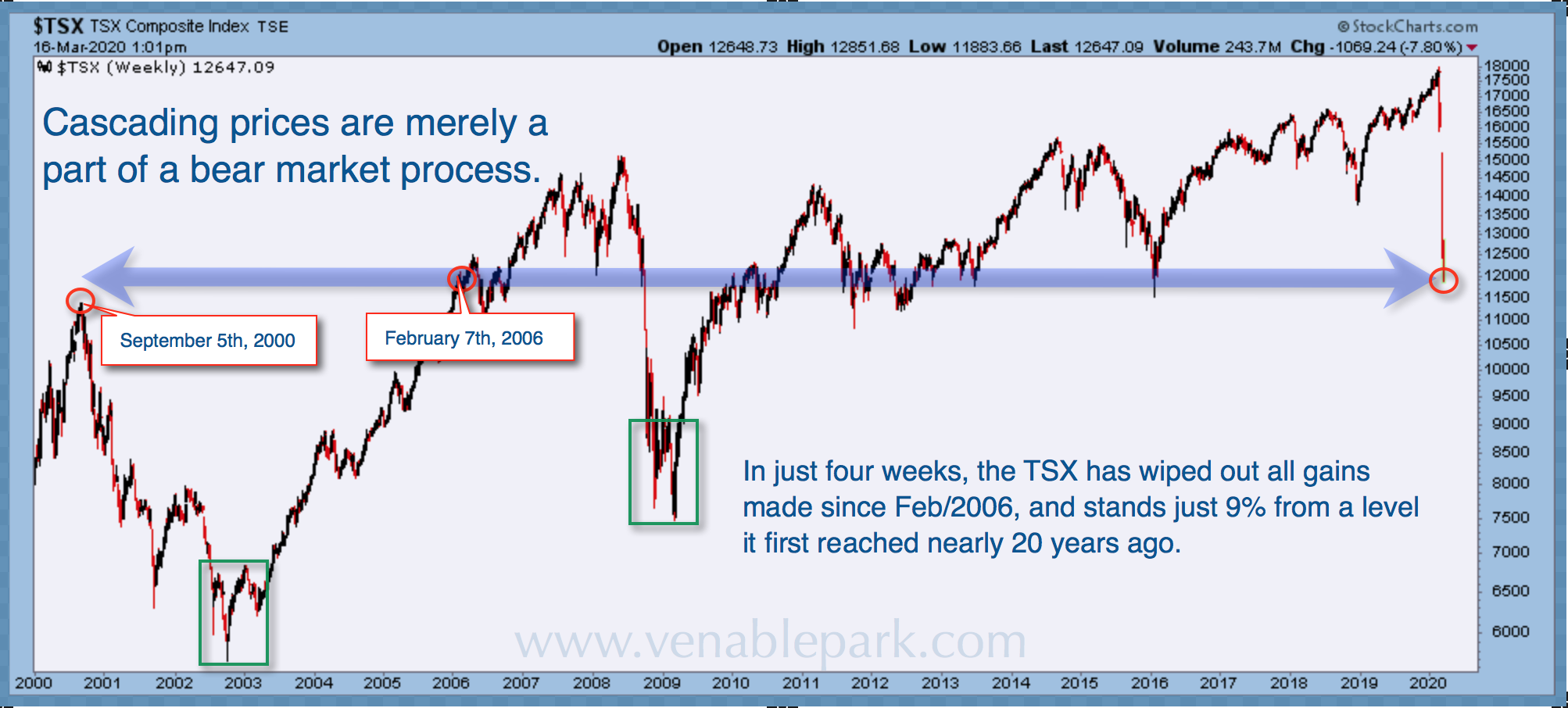
As risk-markets tank worldwide, the Canadian TSX has followed suit with a loss of 30% in less than a month and is already back fathoming the 12,400 level it first reached in December 2006–more than 13 years ago.  This is a good start.

The TSX is now just 9% higher than where it topped in September 2000–nearly 20 years ago–when my partner Cory and I had fewer wrinkles and were anticipating the prospects of an 18 to 20-year secular bear market starting from the irrational exuberance and record stock valuations in early 2000.  Cory’s updated chart of the TSX is shown below.  From here, a retest in the 9,000 area–a further 27% below present levels–would not be surprising in the weeks/months ahead.


We remain cautiously optimistic that the present downdraft could be the much needed third, and potentially final, cyclical bear of this secular bear period; but we note that bear market bottoms are a process that typically takes several months–sometimes a couple of years–to complete (see the rectangles above around bottoming action in the last two cycles).

One of the great vulnerabilities still inherent in the TSX today–following the largest consumer credit, realty and reaching-for-yield-bubble of our lifetime–is its 32% concentration in still grossly inflated and widely held Canadian financial shares.

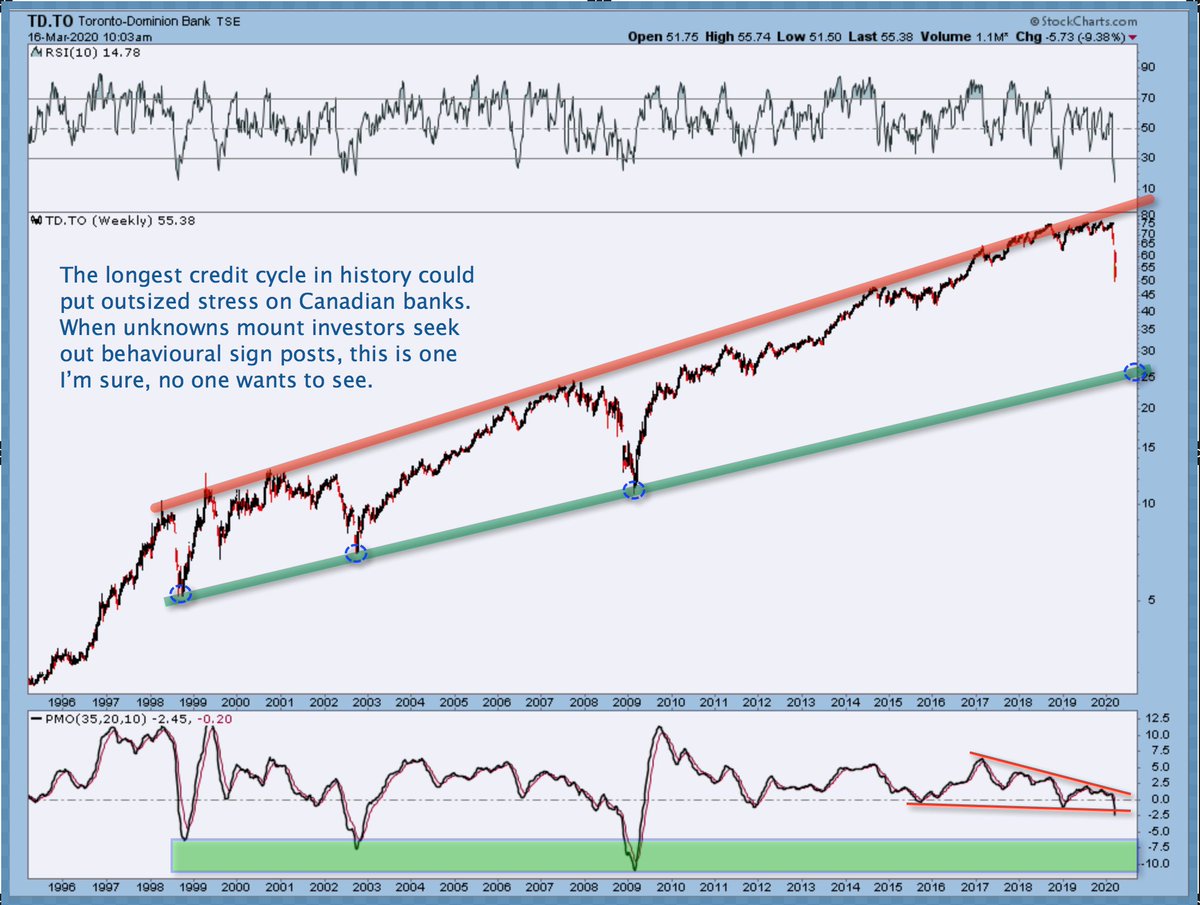
As shown in Cory’s chart below of TD Bank since 1994, the 31% drop in TD’s share price over the past month is good progress, but long-term support remains in the $25 area–a further 50% below present levels–believe it, or not.

The Canadian financial sector basket (XFN)–off 27% in the last month–could easily see a decline of that much again as the present cycle completes.  The basket lost 50% in both the 2000-03 and 2007-09 bear markets, and that was with Canada avoiding a recession in 2o01, being much less indebted heading into both downturns, and with oil-demand prospects then, unlike today, entering a boom.

Today, as usual, the underwriting, product sales and investment ‘advisory’ reps are out in full force calling bottoms and buying opportunities at every price.

But before you listen to these usual suspects, note that they’re the same false prophets who never see downturns coming, and did not recommend that their followers sell or set aside significant cash weights even as equities and corporate debt hit some of the most over-valued and over-bought in the last century of expansion cycles.

We cannot have the mental and financial strength to capitalize on bear markets unless we first protect our savings from their losses and set aside significant cash reserves to buy when everyone else is liquidating in desperation and hopelessness.

No doubt there will be exceptional investment opportunities in the months ahead for those who are properly prepared for them in advance.  But remember this:  when it’s actually time to buy, no one will feel like it’s a good idea.

Based on all the confident bottom-callers today, we’re not there yet.  More lasting pain will be necessary to terrify the reckless–best to wait for it.

Posted in Main Page | Comments Off on Beware false prophets who never see bear markets coming

It’s never too late to learn from mistakes and make better choices

It is entirely rational for the masses to be concerned about their financial holdings and plan.  Most have been set up to suffer greatly in this downcycle.

In case you missed it last week, see my articles Friday the 13th:  Another opportunity to review risk exposure and Time for sober review and wise choices.

People who are not proactive, end up being reactive.  It’s never too late to learn from past mistakes and make better choices and plans for the future.

Posted in Main Page | Comments Off on It’s never too late to learn from mistakes and make better choices