Years of ‘ease’ have made us all the more vulnerable

Global growth was weak and slowing into 2020 and Coronavirus is magnifying the trend.

An estimated two-thirds of the Chinese economy–representing 17% of global GDP–is closed down indefinitely, some 80% of its manufacturing. Global supply chains are feeling the hit. South Korea, the world’s fifth-largest automaker, has closed all of its factories on a lack of parts.  Airlines from 30 countries have cancelled their flights to and from China.  The Chinese people who can afford international travel are big spenders–they’ll be missed all over.  Ambrose-Evans Pritchard gets straight to the point this morning in China’s Coronavirus is not remotely under control and the world economy is in mounting peril.

Australia’s Prime Minister admits that the impact on the Aussie economy will be ‘very significant’.  With China the largest importer of oil and metals, commodities and producers are in for further pain.  British Petroleum estimates that global oil demand in 2020 could be 40% lower on all of the impacts.

All of this was predictable.  Human life is full of risks and sudden shocks are typical.  Our health before one hits often plays a defining role in the damage done and recovery thereafter.

Experts assure us that the medical system is much better equipped to handle the Coronavirus today than it was for the SARS outbreak in 2003—we hope this is right, however, the opposite is certainly true of the financial system.

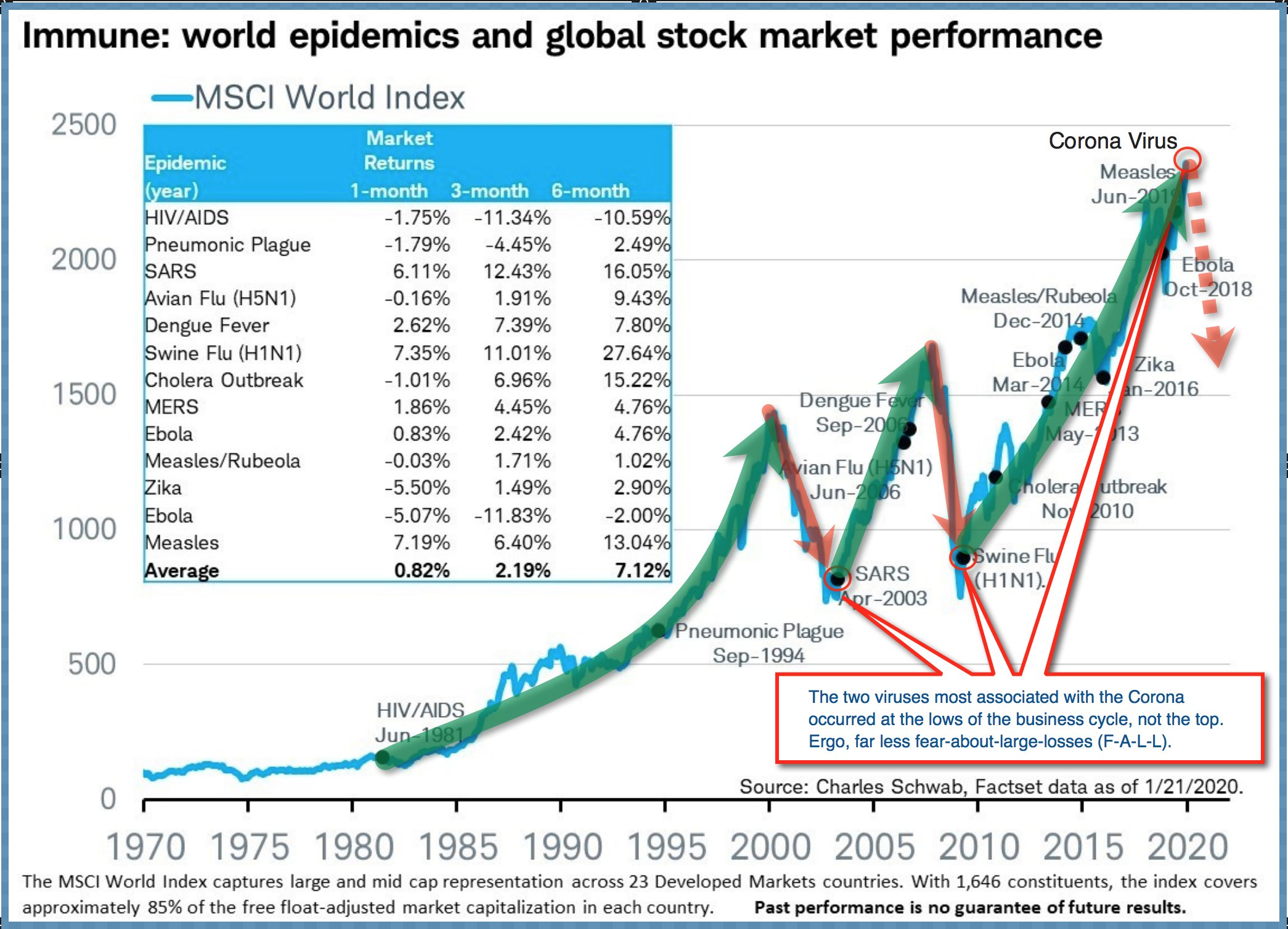
In 2002, as SARS hit, the world was emerging from recession and a two-year bear market that had already wiped out weak companies and knocked 50 to 80% off the price of survivors. Investment valuations and dividend yields were the best in a decade, even as sentiment was dark and pessimism rampant.  Fraudsters were on the run, and financial hubris had transformed into contrition.

In short, in a world pricing worst-case scenario there was much room for an upside surprise in 2002.  As we can see in the below chart of the world stock market price (MSCI Word Index) since 1970, and the price impact of past pandemic threats, today, the polar opposite is true. 
Credit abuse has extended the life of companies and households with unsustainable financial models all around the world.  Today, the level of household, corporate and government debt relative to income has never been higher.

Expansion, mergers and the accumulation of uneconomical assets has continued so long as more cheap debt could be added, and central banks have done everything possible to enable it.

Now, interest rates have moved up, defaults are spreading and loans are harder to find.  Defaults spread pain from borrowers to lenders, to the economy and taxpayers.  It’s no surprise that global business surveys are finding recession risk as a top concern in 2020–preparedness and resilience are at rock-bottom levels.

Speaking in the European Parliament this morning, new ECB chief Christine Lagarde joined a chorus of central bankers in recent months who’ve tried to lower expectations for more monetary tricks to the rescue, saying:

“This low interest rate and low inflation environment has significantly reduced the scope for the ECB and other central banks worldwide to ease monetary policy in the face of an economic downturn.”

Undoubtedly, this is true.  Indeed, years of ‘ease’ have made us all the more vulnerable.



Posted in Main Page | Comments Off on Years of ‘ease’ have made us all the more vulnerable

Canada’s largest property and casualty insurer urges policy focus on behavioral change

From 2010 to 2020, the average number of catastrophic events per year almost doubled in Canada, while the average annual reported insured losses quadrupled (from $0.5 billion per year in 2000-2009 to $2.02 billion per year in 2010 to 2018).

At the same time, investment yields on the most capital-secure securities like government bonds–where insurance companies traditionally hold funds to match with projected payout needs–have fallen from 6% in 2000 to less 2% today.

Not surprisingly, insurance companies are responding to higher claims and lower yields with higher deductibles and premiums and, increasingly, an absence of coverage.

Through significant consolidation over the past 20 years Intact is today Canada’s largest provider of property and casualty insurance.  As such, the company is keenly focused on sober assessments of environmental and climate-related risks in Canada.  CEO Charles Brindamour’s recent interview in the Globe and Mail articulates the case for action:

“The business community needs to think more proactively about the impact climate change has on their businesses and the opportunities that come with it. It’s not just all downside.

…We need to act. We need to mitigate the impact of human influence, but more importantly, we need to protect ourselves against the consequences of change. And those consequences are here. We are on the front line.

…Pricing is a powerful behaviour changer, yes. But I think it’s not just about raising premiums, because there’s a point at which affordability becomes a problem. The sophistication of pricing drives behavioural changes.

…I’m optimistic when I see governments putting more emphasis on adaptation. I’m optimistic when I see that a portion of the solution is green infrastructure. I think that as a nation, in the next decades, we’ll be in a very good position to face these changes. But it’s all hands on deck. And it shouldn’t be seen as a constraint for businesses. It should be a core part of one’s strategy.”

Posted in Main Page | Comments Off on Canada’s largest property and casualty insurer urges policy focus on behavioral change

Carbon-neutral, zero-waste circular systems are the new model

The world’s biggest offshore wind developer of large scale projects, Danish Orsted, is taking the necessary next step of moving to carbon-neutrality over the next 5 years in both its own operations and that of its suppliers.

To achieve this, the company is replacing coal-fired electricity with a new 20 gigawatts on and offshore wind installation and asking that its suppliers use 100% renewable electricity to build their components such as wind turbines, cables, foundations and components. In addition, they will be asked to optimize their current shipping fleet by powering vessels with renewable energy.

In the process, Danish turbine manufacturer Vestas announced that it is adopting a “circular economy approach” in the design, production, service and end-of-life parts that aims to create zero waste from its operations.

This is a massive paradigm shift now underway globally–full of challenge and opportunity.


Posted in Main Page | Comments Off on Carbon-neutral, zero-waste circular systems are the new model