Oil and gas cleanup costs are massive and ours to share

Full-cost accounting, producer responsibility and segregated cleanup funds were not adequately enforced when oil and gas prices were soaring and profits booming, now with the sector in crisis, taxpayers, landowners and public health are being left to absorb the costs. Tailing ponds in the oil sands are just one of the problem areas.

Andrew Leach, associate professor at the Alberta School of Business, discusses the problem of cleaning up oil sands tailings in the province. Here is a direct video link.

Abandoned oil and gas wells are another.  When wells are done producing, owners are supposed to be responsible for plugging, decommissioning them and returning the land to its original state. But some larger owners have transferred their responsibility to smaller companies with insufficient resources who then go bankrupt or shut down leaving cleanup uncompleted.

A study released last week from the California Council on Science and Technology (CCST), commissioned by the state’s oil and gas regulator, estimated some 5,540 wells in California appear to be orphans.

In Alberta, the problem looks even bigger with 3,406 abandoned wells on the property of rural landowners, 2,772 decommissioned sites in need of environmental reclamation, and another 94,000 at risk of abandonment.

While oil and gas companies are supposed to post a security deposit or ‘bond’ set aside for cleanup, the amounts collected have been chronically insufficient in most places.

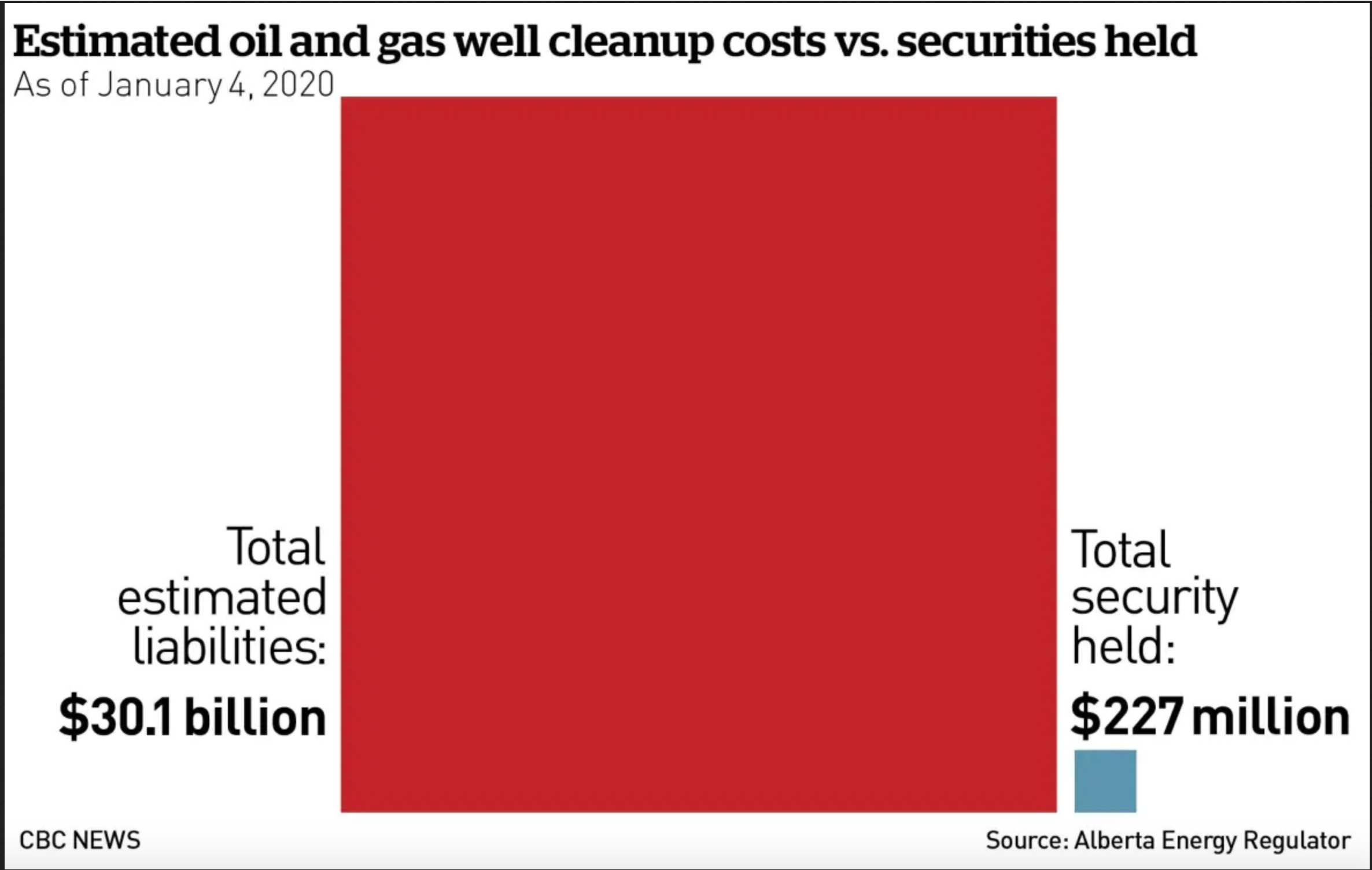
As shown below, the eventual cleanup bill for every oil and gas well in Alberta was recently estimated at $30 billion (red on left) while the Alberta Energy Regulator (AER), the agency that oversees the energy industry and its activities, holds just $227 million (blue bar) in financial security for this purpose.  See:  Alberta’s looming multi-billion orphan wells problem prompts auditor general probe.
Apparently, like many of the companies themselves, AER continued to presume inflated 2008-2010 oil prices in their calculations over the last decade, which grossly overstated producer assets and meant appropriate security deposits were not collected.  Now asset values are being written down and IOU’s are mounting.

The industry says using accurate pricing will force more companies into bankruptcy, and increase end-of-life obligations left on the public purse and landowners.  Others point out that authorities are well aware of which companies drilled the wells and passed off their environmental responsibility and governments must intensify efforts to pursue them.

Credit rating agency Moody’s warned in 2018 that the energy transition now underway represents “significant business and credit risk for fossil fuel companies and their lenders.”  Taxpayers must be added to this list.

On top of cleanup costs, last week, rural towns and municipalities in Alberta announced they are presently owed $173 million by oil and gas companies in unpaid taxes which is forcing them to cut services and raise taxes on other businesses and homeowners.

Alberta’s current energy minister is trying to blame the previous NDP government for this mismanaged mess.  In truth, responsibility for years of willful blindness is on all of us.

As Shell CEO Ben van Beurden said in an interview with Time Magazine last month, when asked how the company continued expanding production knowing the environmental impact of fossil fuels:

Yeah, we knew. Everybody knew,” he said. “And somehow we all ignored it.”

Van Beurden explained that in the 1990s Shell publicly acknowledged climate science and said the world needed to act to combat the problem. But at that time, neither governments nor consumers seemed too concerned about emissions, and the demand for oil was growing like gangbusters, so the company doubled down.  By 2018, Shell was the third-largest company in the world in terms of revenues.

Now, he says conditions have changed and “We have to figure out what are the right bets to take in a world that is completely changing because of society’s concerns around climate change.”

But ‘concerns around climate change’ is understating the catalyst here.  The evolution away from fossil fuels and toward less polluting, more efficient energy sources and systems is about financial viability.  The status quo of extracting profits for a few and leaving crippling costs for the many is simply no longer fundable.

Posted in Main Page | Comments Off on Oil and gas cleanup costs are massive and ours to share

Central banks have no vaccine against financial contagion

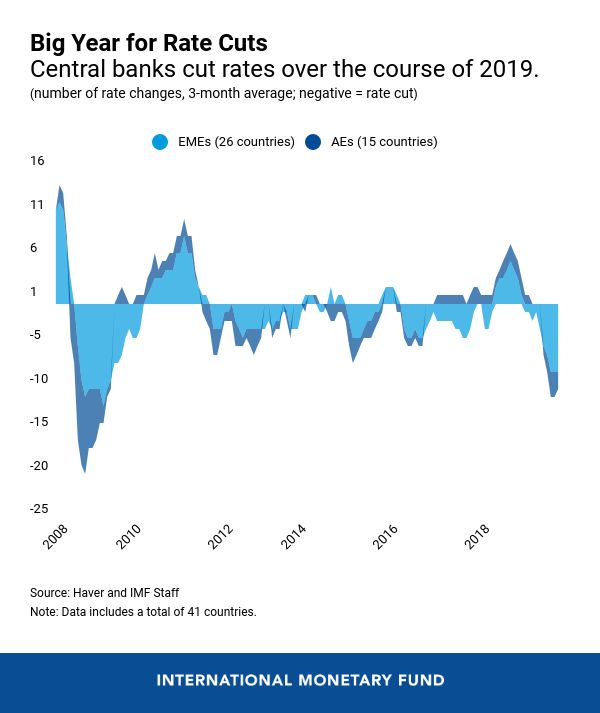
Globally, central banks undertook monetary easing efforts in 2019 by the most since the 2008 financial crisis as shown in the chart below courtesy of the IMF.

This enabled unsustainable deficits, debts, businesses and financial Ponzis to continue a while longer and made the global economy and markets more correlated and vulnerable to inevitable shocks.

In reality, central bank balance sheets are tiny relative to the few hundred trillion in asset markets globally.  And monetary placebos are only effective so long as they are believed.  When the herd turns from manic to panic, central bank offsets are insufficient.

Today, pandemic fears join the foreseeable secular headwinds of climate change, political upheaval, falling birth rates, aging developed world populations, mean-reverting corporate profits (lower), tax rates (higher), financialization, central bank powers and globalization (all receding), and creative destruction of status quo systems and beliefs.  The world in 2030 promises to look dramatically different than the world in 2020, and most are woefully underprepared for the changes afoot.

Like other financial markets, a decade of asset inflating policies has also made global home prices–the most widely held asset in the world–increasingly synchronized.  While this was cited as progress on the way up, the IMF warns that it also magnifies fragility on the way down, as reported by the Wall Street Journal in New Cloud over Global Growth:  Synchronized Housing Slowdown:

Mr. Martínez-García said there is a point at which lowering long-term interest rates can no longer effectively prop up residential investment. “We might be reaching that point,” he said.

And lower interest rates may be less effective given long-run restraints on housing such as the slower global growth expected over the next few years, property regulations and declining fertility rates. Supply is constrained in many cities where workers want to live. These factors are common to many countries, another reason the housing market is now globally synchronized.

Global growth was weak and slowing into 2020, and Coronavirus will doubtless magnify that trend as trade, travel and consumption are hurt by this unexpected shock.  But it’s highly correlated, highly-leveraged, hyper-inflated asset markets, and rock bottom interest rates, that present the greatest contagion risks for the global economy today.

As the People’s Bank of China injected another round of monetary elixirs into the financial system last night, defaults are spreading and Chinese stocks went limit down nonetheless.  See China’s rate cuts in response to coronavirus ‘too marginal’ to help economy.

Monetary placebos can have some effect so long as they’re believed.  But, in truth, central banks have no vaccine to prevent global financial contagion, and that realization is certain to spread.

Posted in Main Page | Comments Off on Central banks have no vaccine against financial contagion

Unraveling the roots of addictive behaviour

I recently stumbled upon this episode of Rich Roll’s podcast and it’s ruminated with me since. Like many people, my family tree is full of anxiety and addiction and I have spent my life pondering how and why this manifests to such varying degrees and behaviours in different people.

Dr. Gabor Maté has spent a lifetime on this topic and offers thought-provoking observations.

In a nutshell, Dr. Maté notes that being alive is to exist in a state of constant uncertainty, risk and vulnerability to pain.  This causes anxiety and suffering in all of us, to varying degrees, whether we admit it or not.  The extent to which we can admit this and discuss our suffering and feelings with a compassionate witness can make a difference between constructive or destructive behaviours in our life.

You can advance the play bar to 8:09 to skip the opening commercials.

At 34:26 the discussion around Rich’s own life offers some context for those who had a relatively fortunate childhood, and yet, suffer all the same.

Here is a direct audio link, advance the playbar to 8:09 to skip the intro commercials.

As an author, Dr. Maté has written extensively on the subjects of addiction, early childhood development & trauma, attention deficit disorder, and the relationship between stress and disease. His most recent award-winning book, In the Realm of Hungry Ghosts: Close Encounters with Addiction* (a #1 bestseller in Canada) mixes personal stories with science to present a radical re-envisioning of addiction not as a discrete phenomenon confined to an unfortunate or weak-willed few, but as a continuum that runs throughout (and perhaps underpins) our society at large; not a medical “condition” distinct from the lives it affects, but rather the result of a complex interplay among personal history, emotional, and neurological development, brain chemistry, and the drugs (and behaviors) of addiction.

Posted in Main Page | Comments Off on Unraveling the roots of addictive behaviour