HBR: Why stock buybacks are dangerous for the economy

Two of the leading democratic candidate contenders have proposals to greatly curtail share buybacks as a form of illegal market manipulation.  Last October the International Monetary Fund’s Global Financial Stability Report, noted “debt-funded payouts” as a form of financial risk-taking by U.S. companies that “can considerably weaken a firm’s credit quality.”

This week a Harvard Business Review article draws the connection between buybacks and extreme dividends funded by debt and low corporate tax rates with weak productivity, shrinking R&D investment, financial fragility, soaring government deficits, and extreme income disparity.  See  Why Stock Buybacks are Dangerous for the Economy:

Why have U.S. companies done these massive buybacks? With the majority of their compensation coming from stock options and stock awards, senior corporate executives have used open-market repurchases to manipulate their companies’ stock prices to their own benefit and that of others who are in the business of timing the buying and selling of publicly listed shares. Buybacks enrich these opportunistic share sellers — investment bankers and hedge-fund managers as well as senior corporate executives — at the expense of employees, as well as continuing shareholders…

Whether it is corporate debt or government debt that funds additional buybacks, it is the underlying problem of the corporate obsession with stock-price performance that makes U.S. households more vulnerable to the boom-and-bust economy. Debt-financed buybacks reinforce financial fragility. But it is stock buybacks, however funded, that undermine the quest for equitable and stable economic growth. Buybacks done as open-market repurchases should be banned.

In short, buybacks are indefensible and policy change in this area is essential.

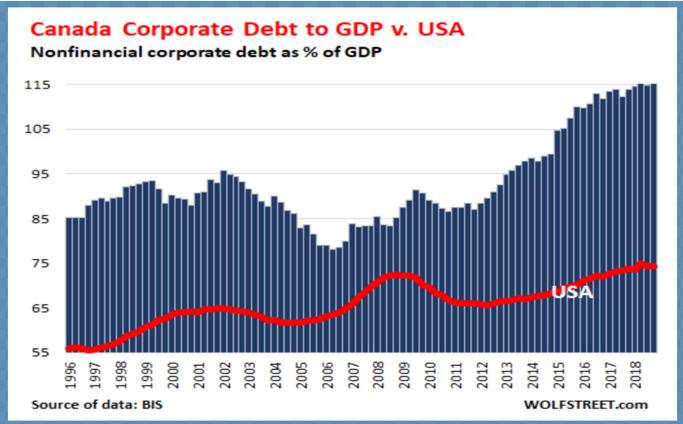
The buyback damage done to corporate balance sheets with record debt to GDP in both Canada and the US is evident in Wolf Richter’s chart below. Canada’s corporate debt to GDP hit a freakish 115% in 2018 versus 70% in the US, and compared with cycle peaks of 95% in Canada in 2002 and 85% in 2008.

Posted in Main Page | Comments Off on HBR: Why stock buybacks are dangerous for the economy

Overbuilt condo market weighing on Manhattan

A new report from Halstead Development Marketing says Manhattan has 7,050 unsold, newly built condo units and 85% of them — almost 6,000 — haven’t been formally listed for sale.  See Manhattan’s flood of new condos could take six years to sell:

The secret supply is a heavy weight on a market in which sales, especially of higher-end properties, have slowed to a crawl. It would take take 74 months — more than 6 years — to clear all of Manhattan’s unsold units at the pace of contracts in 2019, the report shows.

The glut is a product of a post-recession construction boom aimed at globe-trotting investors, who now show little interest in collecting lavish Manhattan homes. And most newly built apartments are out of reach for the majority of New Yorkers.

Et tu, Toronto and Vancouver?


Posted in Main Page | Comments Off on Overbuilt condo market weighing on Manhattan

Cash-strapped boomers selling their homes to rent

Cash-strapped retirees are increasingly looking to liquidate real estate in exchange for cash and rental accommodations.  This trend is likely to continue for the next decade-plus and exert downward price pressure on elevated property markets all over the world.

This will be particularly felt in places like North America, where an aging population of present homeowners, low investment yields and insufficient savings (aggravated by some of the most expensive housing in the world), are quickly changing the dream of homeownership into the dream of less overhead.  Meanwhile, highly indebted younger people have a similar plan.  This leaves the question of who will buy the present inventory of super-expensive housing?

At some point, the cost of renting will no doubt rise to the point where homeownership is relatively cost-effective once more, but not before the price of homes have corrected considerably.

See More Americans are ditching their mortgage to rent in retirement, and it shows how their lifestyles–and finances– are changing:

Before Joe retired in 2016, they lived in a 4,000 square-foot home in southern Washington. It just wasn’t for them anymore.

These days, their home is a six-foot by seven-foot overlanding vehicle they use to travel the world, and they plan to rent something more permanent when their adventure is over.

The couple wanted to start living their retirement dreams sooner rather than later, and found that selling their home was the best way to do that. “Selling the house wasn’t so much a strategy as it was a necessity. It was the only way we could retire early,” Joe says.

For this couple and a growing number of retirees, a combination of lower expenses, freedom, and flexibility are making renting more alluring than owning.

Posted in Main Page | Comments Off on Cash-strapped boomers selling their homes to rent