Funding crunch in short-term lending raises alarm

A repurchase agreement (repo) is a crucial form of short-term borrowing for dealers in government securities where they sell or swap government tbills on an overnight basis in exchange for cash and buy or swap them back the following day.

The New York Federal Reserve has funnelled hundreds of billions of dollars into repo markets since mid-September when a shortage of liquidity caused overnight borrowing rates to spike from about 2% to a stress-inducing 10% on September 17 to 18.  A similar liquidity crunch sideswiped financial markets last December when overnight rates spiked to 6%.  This time, funding strains have been more persistent.

The short-term repo rate is what bond dealers, hedge funds, and other market participants are charged for borrowing funds on a short-term basis, in return for highly liquid collateral such as Treasurys.  The Fed was initially said to be supplying liquidity for third-quarter-end corporate tax payments in September and treasury auctions.

Trouble is, they have had to continue intervening on a near-daily basis over the last 2 months, and this is raising concerns about why banks would rather hoard cash at the Fed to pick up 1.55% than lend to each other for more.

At the current pace of injections, the Fed would own 20% of the T-bill market within six months compared with 1% today. This is on top of $60 billion in QE assets they are buying monthly, which has ballooned the Fed’s balance sheet back toward $4 trillion and enabled rampant financial speculation in corporate security markets with compounding risks and negative effect. See The repo market is ‘broken’ and Fed injections are not a lasting solution, market pros warn.

“This is now far bigger than anyone thought this was going to be,” Bianco said. “I think they’re hoping the market will magically fix itself. I don’t see why it would.”

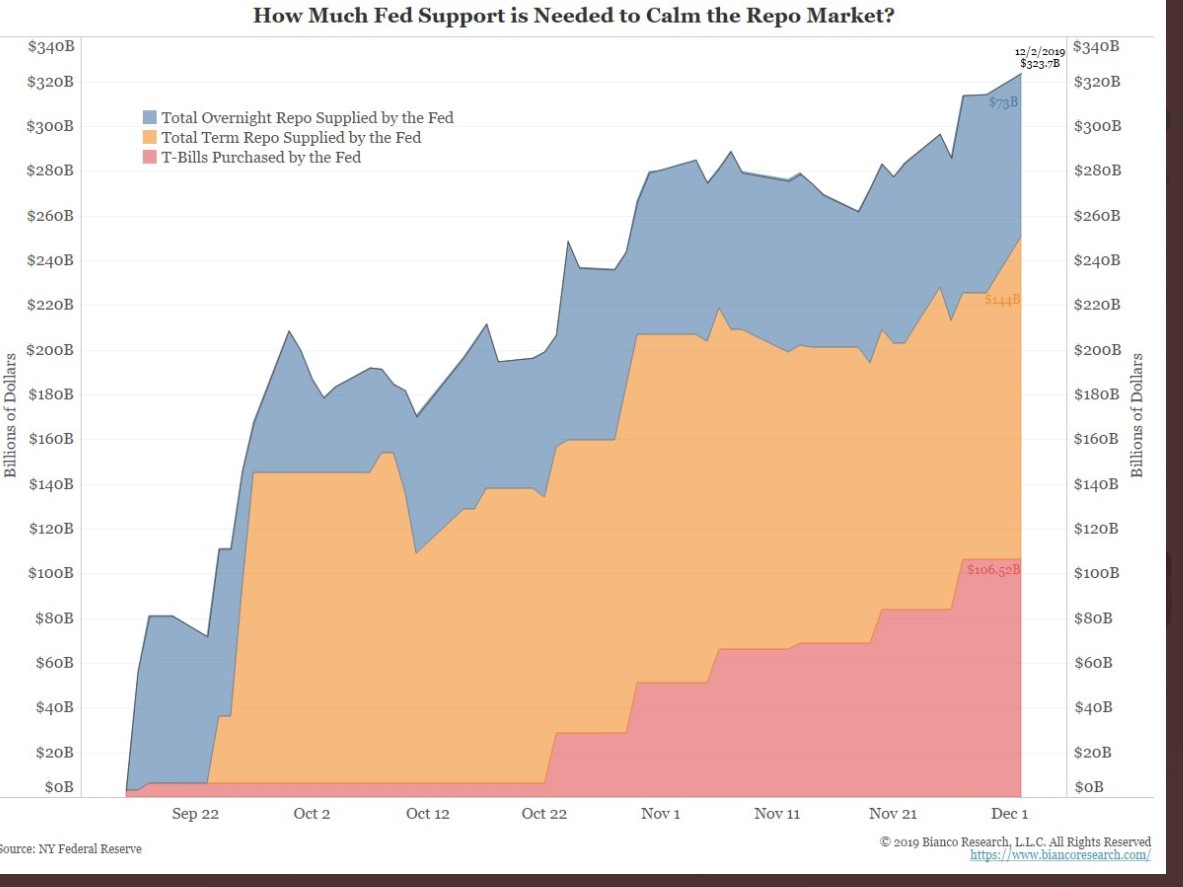
Jim Bianco’s chart below shows the $320 billion in repo market support from the Fed up to December 2.
Posted in Main Page | Comments Off on Funding crunch in short-term lending raises alarm

Bank of Canada stuck in low-rate catch 22

Yesterday, as expected, the Bank of Canada left its policy rate unchanged at 1.75% for the ninth consecutive meeting, even though other central banks have implemented dozens of rate cuts and liquidity injections over the last year in many countries. See Bank of Canada holds rate.

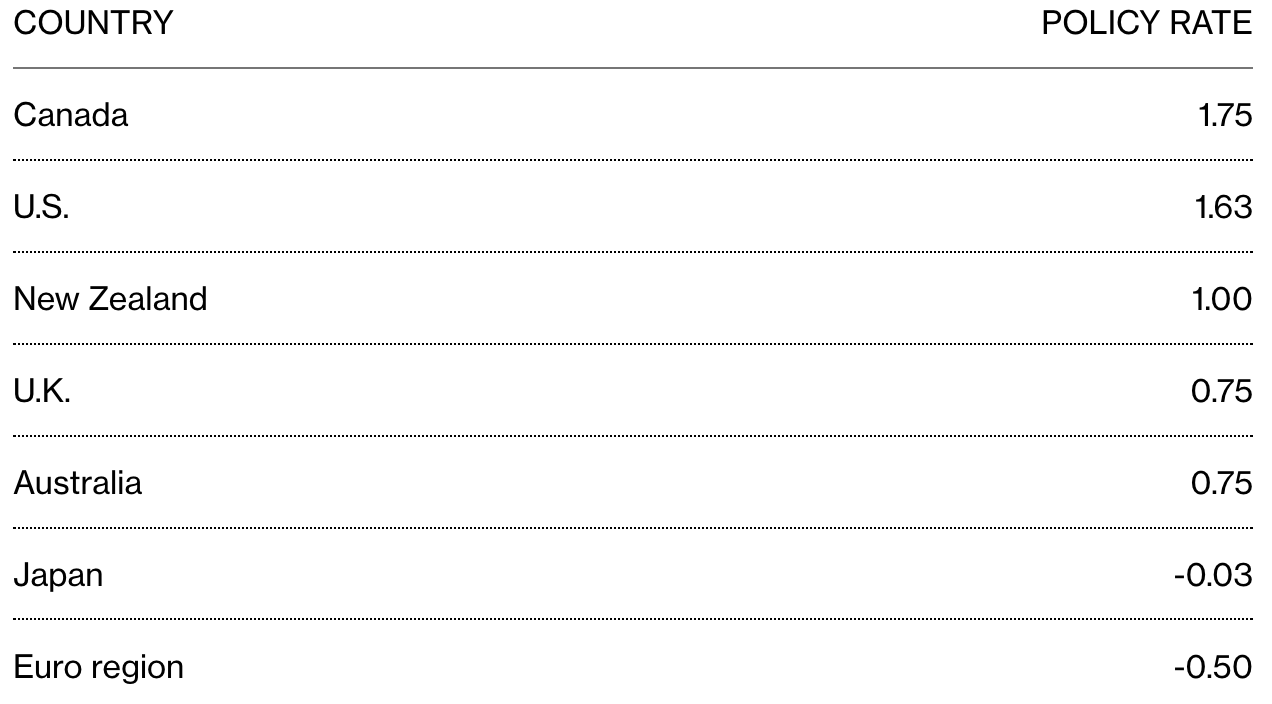
As a result, Canada’s overnight rate is now the highest among major trading partners (as shown below), even while the Canadian economy is forecast to grow at just 1.3% in the second half of 2019, and 1.7% in 2020.


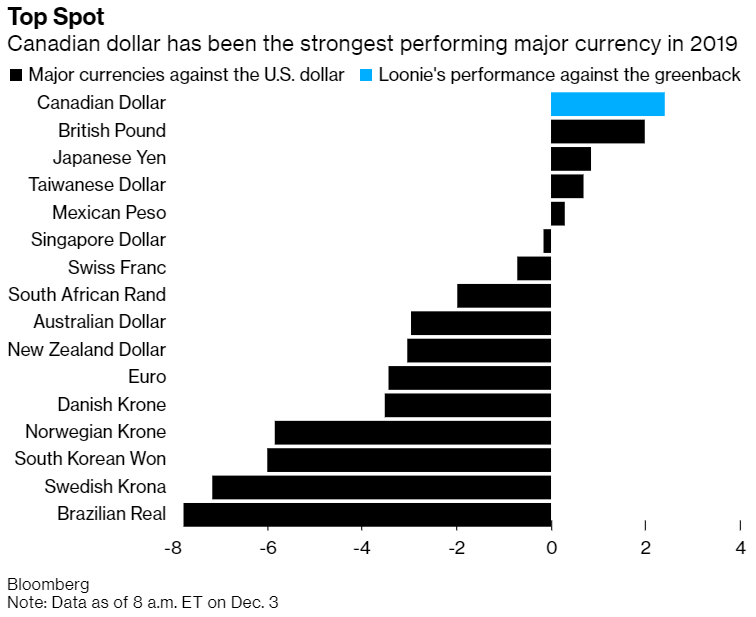
Canada is export-needy and our relative yield bonus is not helping that cause.  Yield-hungry in-flows have helped buoy the loonie over the past year– 3% against the greenback– the best relative strength of all major currencies year to date (as shown below).  With the domestic economy weak, Canada can’t afford currency strength for long.
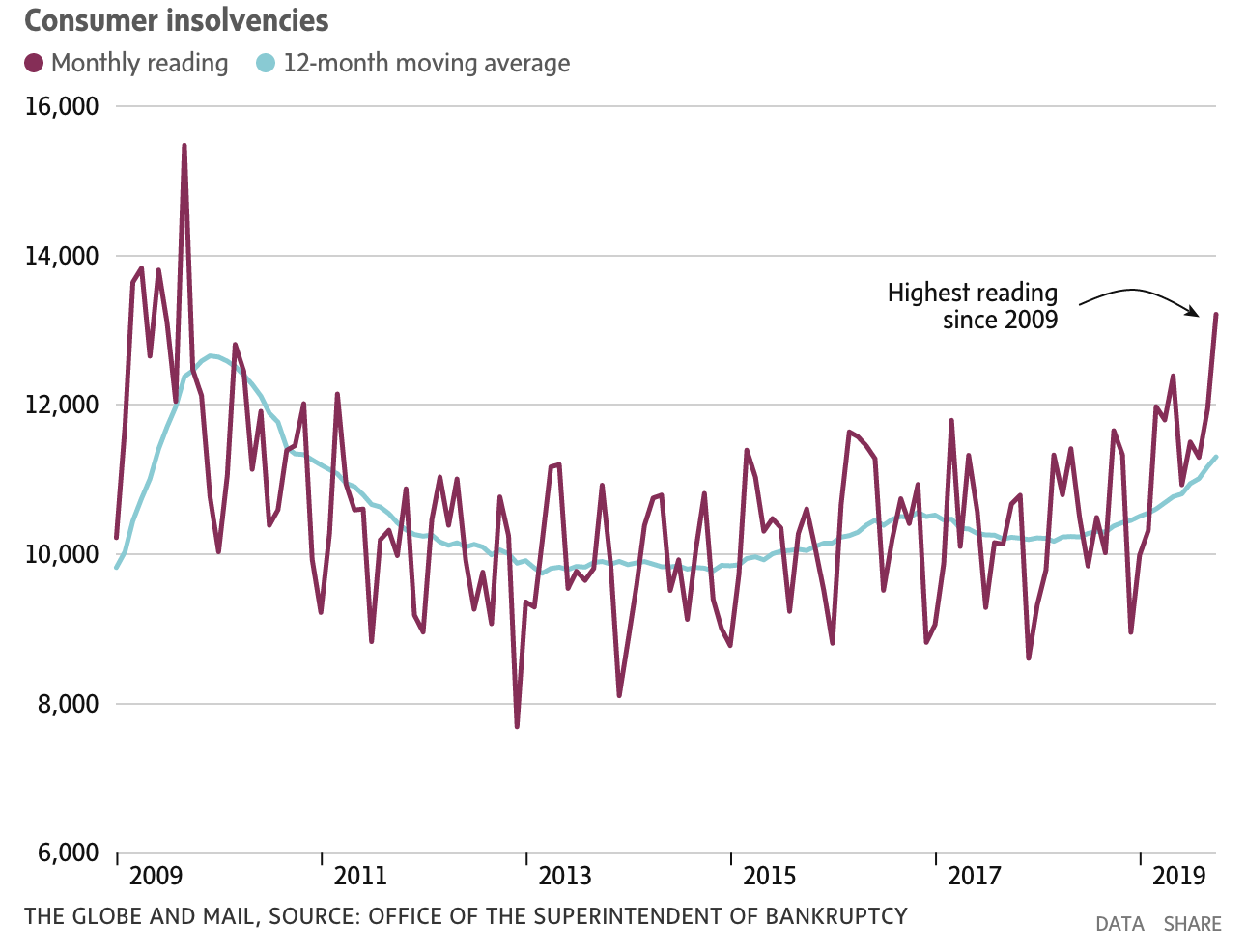
Policymakers would like a weaker buck to help boost Canadian exports, of course, but the Catch 22 is now at hand.  A decade of low rates and credit abuse have already enabled record household debt (177% of disposable income).  And Canadian insolvencies are leaping (as shown below since 2008), last month touching the highest level since the 2008-09 recession, even while lending rates remain historically low and employment rates, so far, near cycle highs.  It’s alarming to model how defaults and losses will compound once layoffs accelerate and job openings shrink.


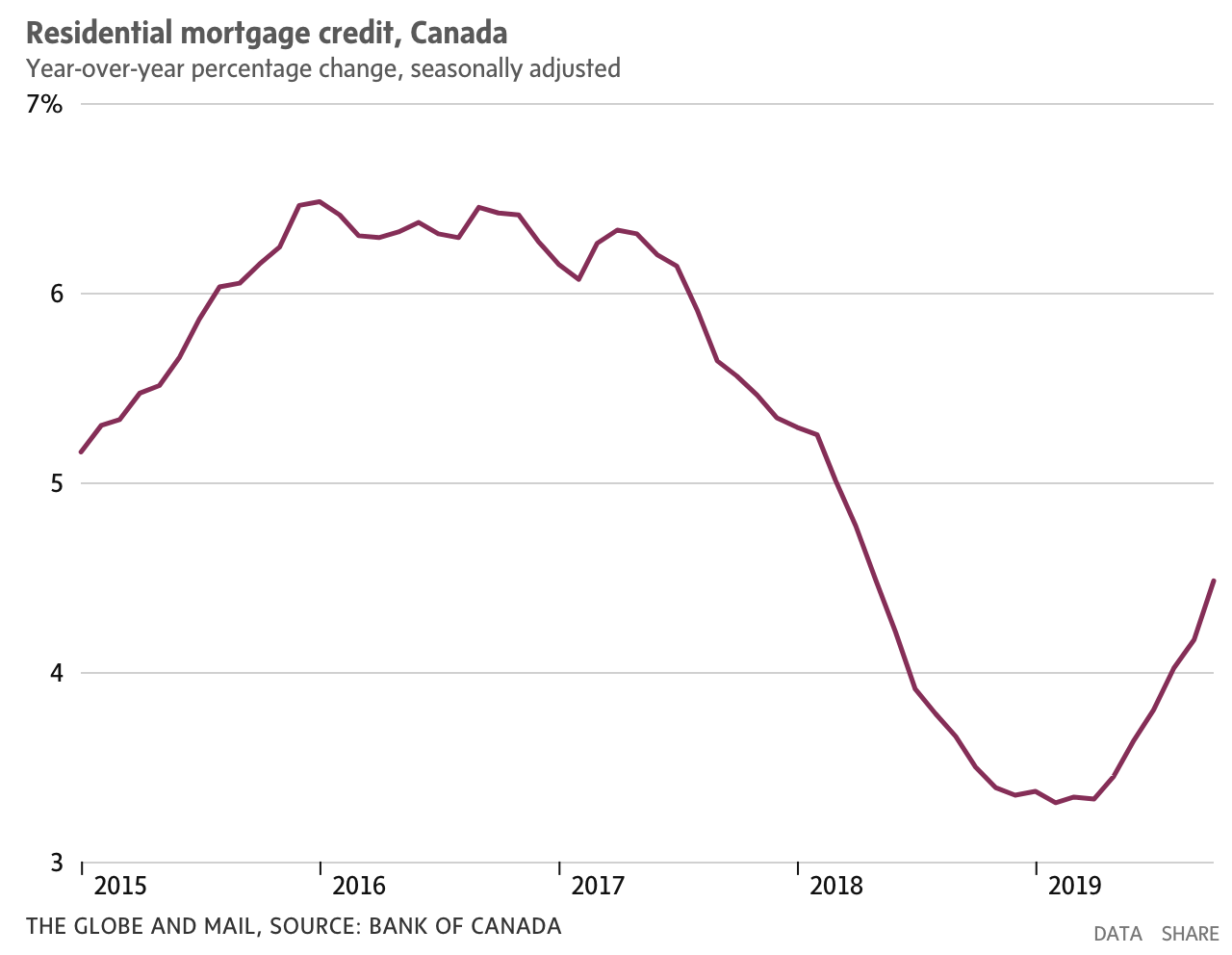
As I discussed last February, higher interest rates, tighter lending standards and speculation taxes in 2017 helped to begin a much-needed deflation in Canada’s housing bubble into early 2019, and the growth rate in residential mortgage credit mercifully halved (as shown below).  But as weakness has permeated the global economy, and yield-seeking capital flows into Canadian government treasuries, their yields fall pushing Canadian mortgage rates down once more. Right on cue, borrowing has increased in 2019 at the fastest pace in a couple of years, escalating unaffordable housing and credit strains further.

Less than two percent above zero, the BOC doesn’t want to blow all its rate easing room early and have nothing to help counter the coming recession.  For now, they say they will “monitor the evolution of financial vulnerabilities related to the household sector.”

At this point in such a garishly extended credit cycle, monitoring is nearly all they can do.

Posted in Main Page | Comments Off on Bank of Canada stuck in low-rate catch 22

Danielle on The Financial Survival Network

Danielle was a guest on The Financial Survival Network with Kerry Lutz, talking about recent developments in the world economy and markets.  Here is a direct audio link.
Listen to “The Madness of Crowds and Canadians – Danielle Park #4589” on Spreaker.

Posted in Main Page | Comments Off on Danielle on The Financial Survival Network