Gilded Age redux: bank vault exclusively for billionaires

A new bank vault in a grade-II listed gothic mansion built in 1899 for soap magnate Robert William Hudson, will have more of the feel of an “exclusive private members club than a bank” next to the Dorchester Hotel on London’s Park Lane will open for business next week.

“We won’t deal with millionaires,” says Sean Hoey, managing director of the facility, run by International Bank Vaults (IBV).

“We will be dealing only with billionaires.

…all applicants will be vetted to ensure we maintain a certain calibre of clients.

…Many prospective customers, Hoey says, are rich people from overseas (mostly Russia, China and the Middle East) who maintain a home in London in the summer.

IBV says it is opening the London vault due to spiking demand from the world’s wealthiest people for safety deposit boxes, in fear of a possible reaction against rising inequality and the impact of the climate crisis, as well as storing their wealth in gold bars as banks begin to charge them to store cash deposits.  See: Billionaires only, please! London vault for the ultra-rich opens.
Posted in Main Page | Comments Off on Gilded Age redux: bank vault exclusively for billionaires

Insurer Allianz estimates $2.5 trillion in climate costs flowing to corps over next decade

Insurers are experts at pricing costs because they have skin in the game:  they are in the business of compensating property, life, and disability damage.  Believe whatever you like about causes, the fact is that climate change is rapidly escalating costs on earth, and the burden of this will not continue to be absorbed by just insurance companies, governments, and poor people.

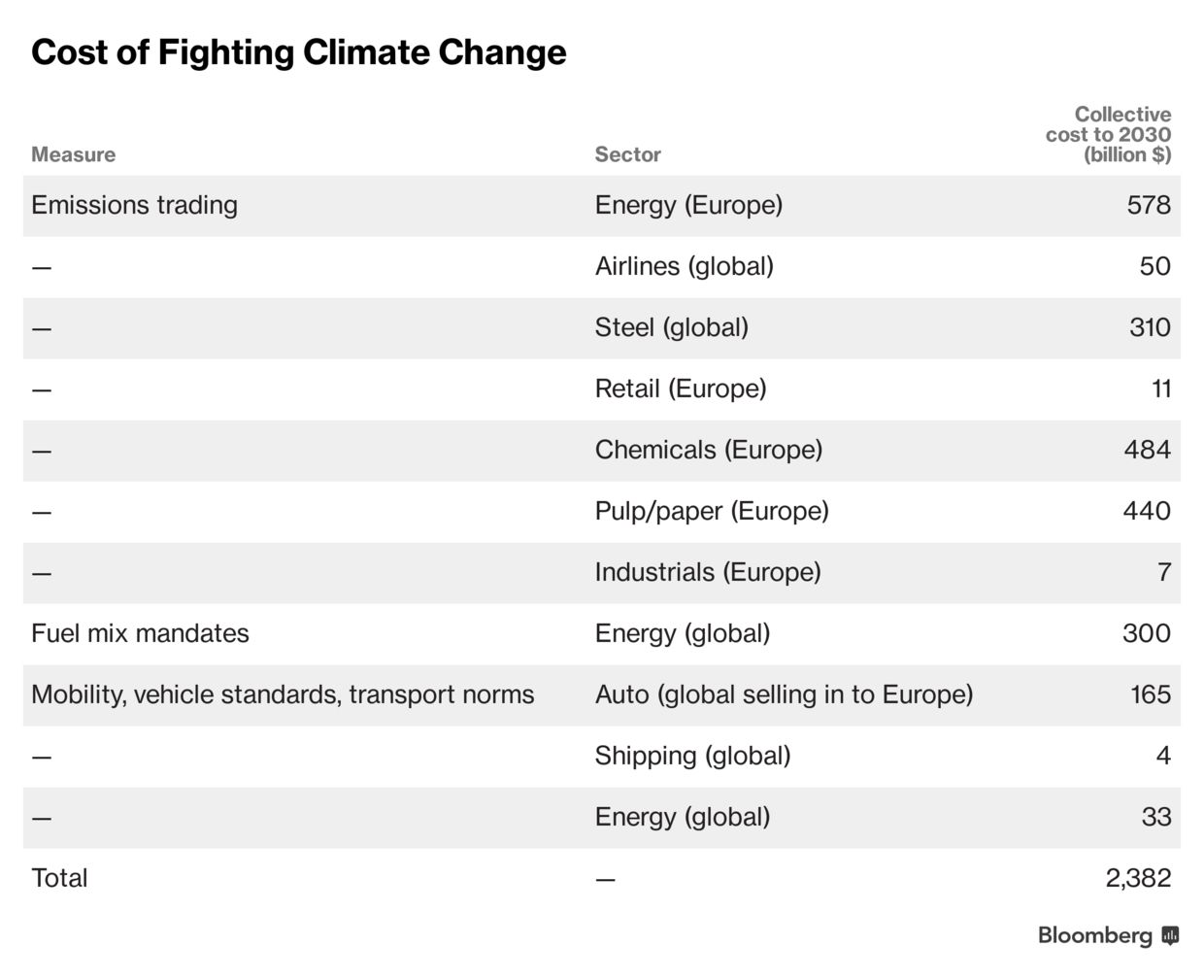
German insurance company Allianz SE estimates that addressing the costs of climate change will flow to companies worldwide in the amount of about $2.5 trillion over the next ten years, with oil and gas companies bearing about a trillion of that ($900 billion) directly.  Other sectors facing escalating cost burdens are steel, chemicals, pulp and paper, and the auto sector, as shown below.  But most sectors will bear significant weight in the transition to sustainable systems and products.  See more here. Every way we slice it, the private sector is on the hook for much greater responsibility and full cost accounting for its activities going forward.   This will increasingly demand capital investment, absorb cash flow, and squeeze profit margins.  It will also necessarily incent more cost-effective business models and management choices and bring huge opportunities for those able and willing to accept reality and adapt quickly.

At the end of the day, this challenge is about math and effective resource management.  The last decade of blowing cash on old-world systems, expensive mergers, and stock buybacks, is coming into a period of harsh review.  And would-be investors holding expensive corporate shares and debt on the presumption of business as usual, are due for a reality check.

Posted in Main Page | Comments Off on Insurer Allianz estimates $2.5 trillion in climate costs flowing to corps over next decade

Hoisington Third Quarter Review worth reading

Hoisington Investment Management’s always insightful Q3 2019 review, can be read here.

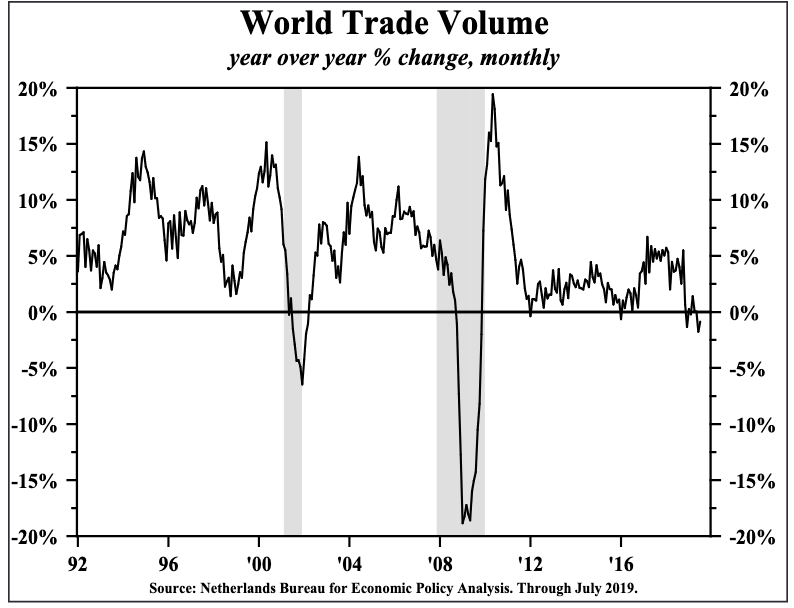
As shown below, year-over-year world trade volume fell in the third quarter by the most since the recessions of 2000 and 2008.

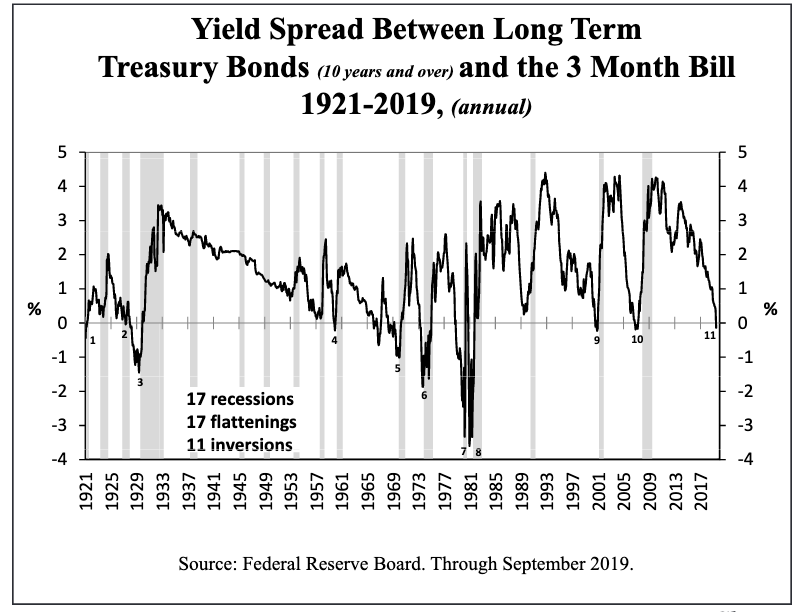
Confirming slowing growth, thirty-year Treasury bonds rose and their US yield fell to a record low at 1.90% (the previous record low was 2.09% in August 2016). The spread between the 3-month and treasury bonds 10 years and longer has been inverted now for more than 6 months.  There were ten such inversions lasting four months and longer between 1921 and 2008.  All of them signalled the onset of a recession as shown below.
This time is unlikely to be different.  If anything, record global indebtedness and unprecedented monetary slack have sewn the seeds for deflation and weak growth this cycle, more than average.  As Dr. Lacy Hunt concludes:

“The global over indebtedness has clearly restrained growth, and therefore has had a profound disinflationary impact on every major economic sector of the world. This fact, coupled with an overzealous U.S. Central Bank have created the conditions for an economic contraction in the U.S. and abroad. This has also created a worldwide decline in inflation and inflationary expectations. It is therefore unsurprising that record lows in long term interest rates have been established in all major economic regions. A quick and dramatic shift toward greater accommodation by the Fed could begin to shift momentum from contraction toward expansion. However, policy lags are long and slow to develop…”

Posted in Main Page | Comments Off on Hoisington Third Quarter Review worth reading